
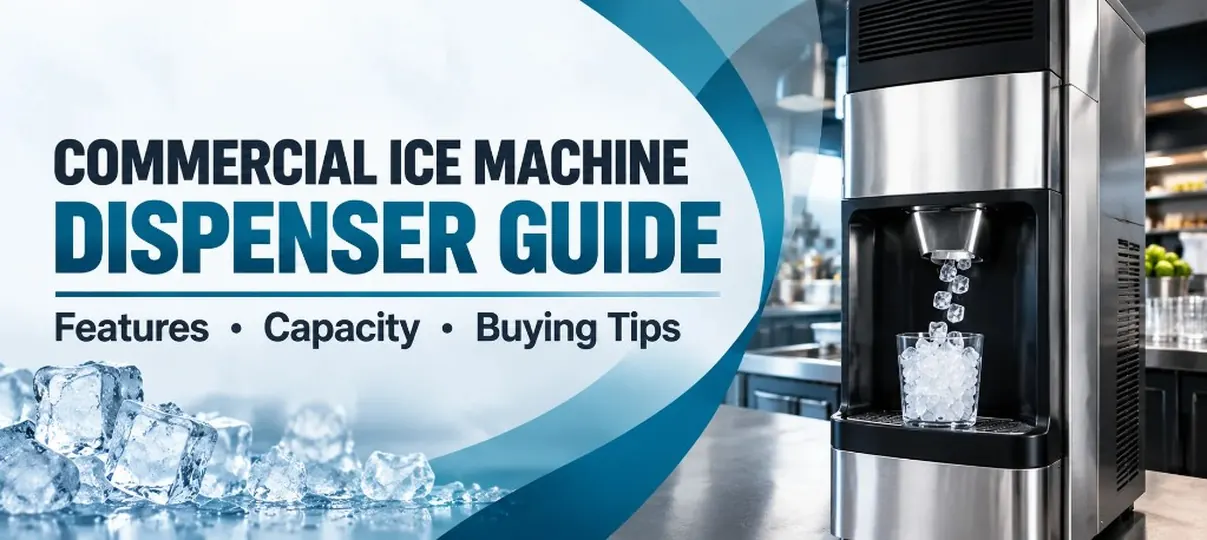
A commercial ice machine with dispenser should match your busiest service period, available space, and maintenance resources-not just your daily ice total. This commercial ice machine dispenser buying guide explains how to compare equipment configurations, production, installation needs, and ownership costs. Use it to build a shortlist before requesting quotes.
Which commercial ice machine dispenser fits your operation?
Undercounter ice makers are the compact layout when the dispenser has to live in a tight service station.
The right configuration depends on whether you need equipment that makes ice, dispenses ice, or does both. Manufacturers offer integrated ice-and-water machines alongside dispenser units with separate ice-making equipment. Confirm exactly what the quoted package includes; a dispenser's storage capacity is not proof that it produces ice.
Start with the service point rather than the catalog. Who will fill containers, what size containers will they use, and how many people arrive together? Take those answers into your equipment demonstration.
- Staff beverage station: Test filling speed with your actual cups and pitchers, and check whether controls interrupt drink preparation.
- Self-service area: Look for clear controls, a usable filling area, and straightforward access for routine cleaning.
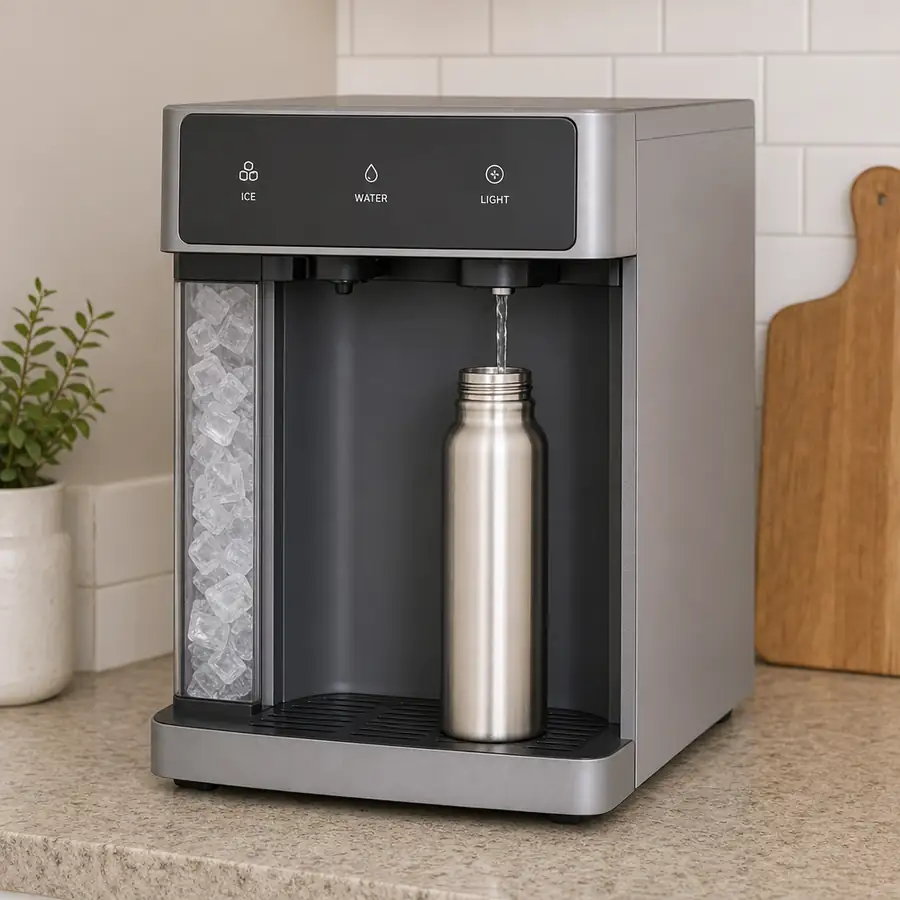
- Combined hydration station: Compare a commercial ice machine and water dispenser when users need both functions at one location.
- Separate dispenser setup: Request written confirmation that the proposed commercial ice maker, dispenser, and connecting components are compatible.
An ice maker dispenser that suits a breakroom may not suit a rush of customers carrying large tumblers. Ask to see the complete filling process before committing.
Size production and storage separately
Walk-in coolers can hold backup ice when the dispenser storage is the limit.
Daily production tells you how much ice a machine can make under stated test conditions. Storage tells you how much ice is available in reserve. Scotsman lists these separately, and its specifications show that output can differ with air and incoming water temperatures. Compare ratings that reflect your installation conditions rather than relying on the largest advertised number.
Build your estimate from your own service pattern. Record drink counts, typical ice portions, pitcher filling, and any other demands placed on the same machine. For a replacement, note whether staff currently buy supplementary ice; Scotsman specifically recommends accounting for that shortfall when sizing new equipment.
Then examine your busiest window. Ask the supplier to explain how stored ice and ongoing production will cover that period, including the time available to recover afterward. Request the calculation in writing so competing proposals can be assessed against the same demand assumptions.
Match dispensing features to everyday use
Air-cooled ice makers need open clearance so the condenser can reject heat.
Commercial dispensers come with different controls and ice configurations, including touch-free ice-and-water models and cubelet ice machines. Availability depends on the model, so verify the exact ice type and activation method on the specification sheet. Do not assume every commercial ice dispenser machine offers the same functions.
During a demonstration, use the containers your team or customers actually bring. Check whether a tall bottle fits without tilting, whether the ice lands cleanly inside the opening, and whether users can stop dispensing easily. Ask staff who will clean the unit to inspect the drip tray and dispensing area, too.
For shared spaces, compare visibility and ease of use rather than choosing controls on appearance alone. A useful trial should reveal awkward movements, unclear labels, or filling bottlenecks before installation.
Check installation before placing an order
Water-cooled ice machines move condenser heat into the water line, so the utility plan changes.
An ice dispenser machine needs a site assessment, not simply an empty countertop. Manufacturer specifications identify operating requirements, dimensions, electrical information, and utility needs. Have your installer review the exact model documentation before approving the location.
Use this checklist to make the installation quote specific:
- Space: Record equipment dimensions, required clearances, overhead access, and the delivery route.
- Electrical supply: Have the installer verify the specified voltage, circuit requirements, and connection location.
- Water supply: Request confirmation of pressure requirements and suitable water treatment.
- Drainage: Ask the installer to document the drainage arrangement and any additional components.
- Service access: Confirm how technicians will reach components without dismantling the surrounding workspace.
Ask for any required site work to be priced separately. This makes it easier to distinguish the equipment cost from the cost of preparing your location.
Should you buy or choose an ice dispenser rental?
Remote condenser ice machines are a purchase option to price when the room cannot exhaust heat.
Compare buying and renting over the same expected operating period, using written quotes rather than the monthly payment alone. An ice machine rental may include maintenance and repairs, but inclusions must be checked against the actual agreement. For example, Easy Ice describes a subscription covering equipment and service while also identifying an installation fee.
For a purchase, request separate figures for equipment, installation, scheduled service, filters, and warranty exclusions. For an ice dispenser rental, ask about contract length, payment increases, cancellation, cleaning coverage, and breakdown response. Also establish who pays for site alterations and what happens when the agreement ends.
Choose only after those responsibilities are clear. A lower headline payment is not enough information to judge the better arrangement for your business.
Make maintenance part of the decision
Ice supplies such as scoops belong on the same cleaning list as the dispenser.
Cleaning and sanitizing are separate tasks, and the correct procedure is model-specific. Hoshizaki explains that descaling does not replace sanitizing and directs owners to follow equipment instructions. Water conditions may also affect maintenance needs.
Before buying, request the maintenance manual and identify who will handle each task. Ask about cleaning access, approved chemicals, filter replacement, and service scheduling. Build that work into your operating plan rather than leaving it until the machine needs attention.
Choose with a complete specification
Refrigeration around the dispenser still needs room so staff can restock without blocking the pour.
When comparing options from The Horeca Store or another supplier, bring your demand estimate, site measurements, container sizes, and service expectations. Request an itemized proposal that addresses each point. The strongest choice is the one whose capacity, installation requirements, and ongoing responsibilities you can verify before signing.