
Commercial ice dispensers give hotel guests, restaurant teams, and self-service customers a convenient way to collect ice without scooping from an open bin. Choosing the right setup means matching the dispenser to your busiest periods, available space, and cleaning routine - not simply buying the largest machine. Before discussing options with The Horeca Store, use this guide to organize your requirements and identify the details worth checking.
What type of commercial ice dispenser does your operation need?
The right commercial ice dispenser depends on whether you need equipment that makes ice, equipment that dispenses ice from a separate machine, or a combined ice-and-water station. Self-contained ice maker-dispensers combine production and dispensing, while dispenser-only models require a compatible ice source. Hotel dispenser ranges include both configurations, so confirm exactly what the quoted equipment includes.
This distinction matters when comparing commercial ice machines with dispensers. A machine's ability to produce ice does not automatically tell you how guests will collect it. Likewise, a dispenser's storage capacity does not establish how quickly the complete system can replenish that ice. Treat production, storage, and dispensing as separate purchasing questions, then check how the proposed components work together. Manufacturer specifications identify compatible machine-and-dispenser combinations.
Start with the service experience you want:
- Guest-operated ice collection: Prioritize straightforward controls and enough clearance for the containers guests actually use.
- Combined beverage access: Consider commercial ice and water dispensers when customers need both functions at one station.
- Staff-operated service: Evaluate how the dispenser fits drink preparation, replenishment, and movement behind the counter.
- Distributed self-service: Assess each location separately rather than assuming every floor or dining area needs an identical unit.
Write down who will use the equipment before comparing models. That simple step keeps an attractive feature list from distracting you from the job the dispenser must perform.
Match the station to hotels, restaurants, and shared spaces
Commercial ice dispensers for hotels, restaurants, and self-service areas should be evaluated in their intended setting. A useful planning exercise is to follow one user from arrival through filling and departure. Note where they will place their container, read instructions, and move afterward.
Hotels: plan around guest containers and location
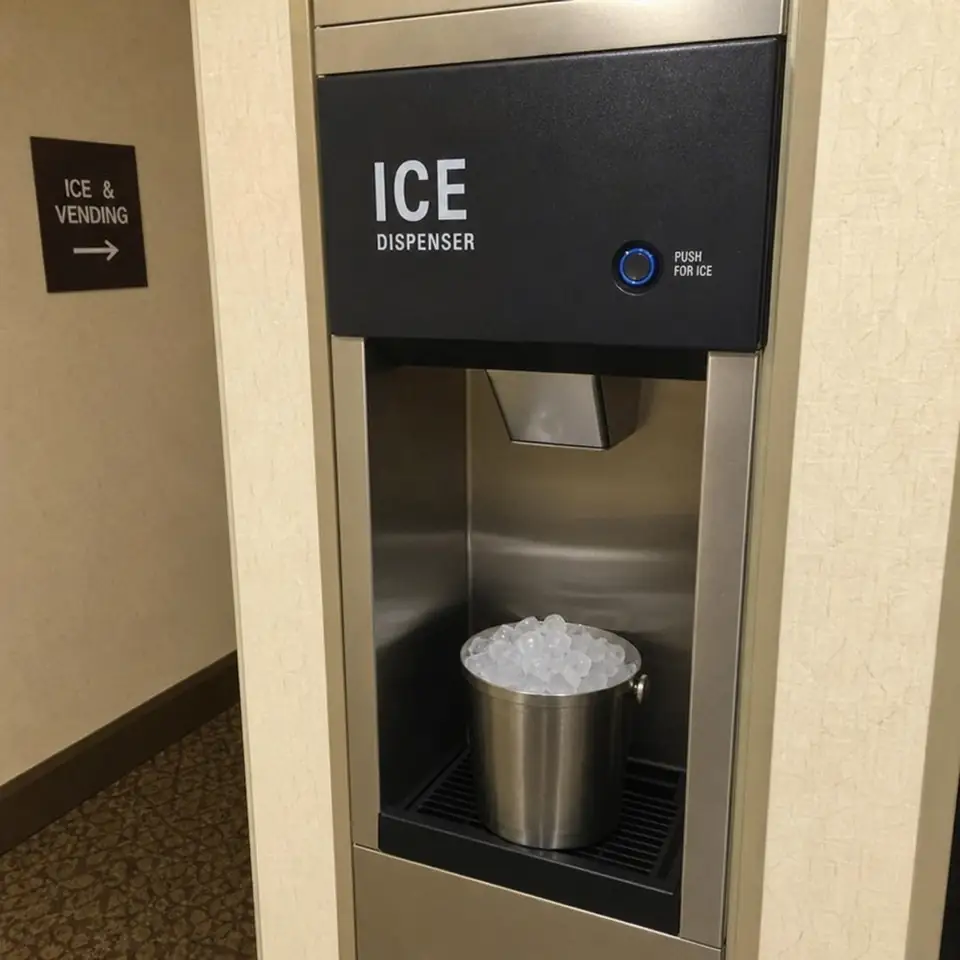
For a hotel, test the proposed dispensing area with your intended ice bucket rather than relying on a product photograph. Check whether the bucket can sit comfortably beneath the outlet and whether the controls remain visible during filling. Hotel dispensers can offer push-button ice delivery and a separate water lever, but the arrangement and container clearance are model-specific.
Include placement in your review. Walk the route from guest rooms to the proposed station, and consider how maintenance staff will reach it with supplies. If noise near bedrooms is a concern, request model-specific information instead of assuming all dispensers sound alike.
Restaurants: protect the drink-service workflow
In a restaurant, start by mapping the steps involved in preparing a drink. Decide whether customers or employees will collect ice, then position the proposed station on that route. Avoid planning a layout that requires staff to cross a customer queue whenever they replenish cups or inspect the machine.
Bring your actual glassware to an equipment demonstration where possible. Ask a team member to simulate normal service, including filling, setting down a drink, and moving to the next task. Use that exercise to identify awkward reaches before committing to the layout.
Self-service areas: make operation obvious
For cafeterias, breakfast rooms, and shared refreshment stations, aim for a setup that needs little explanation. Compare button, lever, and touch-free options against the users and containers you expect. Manufacturers offer countertop and stand-mounted ice-and-water dispensers, including sensor-operated models intended for shared spaces.
How much ice production and storage should you plan for?
Plan production around total demand and storage around the amount needed during your busiest collection periods. Do not treat a published daily production rating as a promise that the same quantity is available immediately. Check the manufacturer's production data under conditions relevant to your site, because ambient air and incoming-water temperatures affect output.
Build your estimate from your operation rather than an unsupported universal allowance. Record busy periods, count the containers filled, and note other uses drawing from the same ice supply. If you are replacing equipment, ask staff when shortages happen and whether the problem is an empty bin, slow dispensing, or downtime.
Use this planning sequence:
- List every demand source. Include guest buckets, beverage service, and any other approved use supplied by the proposed system.
- Identify the busiest window. Record when demand concentrates rather than relying only on a daily average.
- Review storage separately. Ask how much usable ice the proposed dispenser holds and how that relates to the rush.
- Check production conditions. Compare the rating conditions with expected room and supply-water temperatures.
- Discuss a realistic reserve. Explain seasonal demand, events, or planned growth instead of adding capacity without a reason.
For example, ask a hotel team to assess simultaneous bucket filling, while a restaurant team models its busiest meal service. These are planning scenarios, not sizing formulas. Request a documented equipment recommendation based on your assumptions so you can revisit the decision if occupancy or service patterns change.
Commercial ice water dispensers: assess both functions
Commercial ice water dispensers deserve a closer look when you want one collection point for drinking water and ice. Combined units are available in different formats and capacities, so compare the actual dispensing arrangement rather than assuming every model offers the same experience. Some hotel units use separate ice and water controls, while other ranges include touch-free operation.
During your assessment, test each function with the cups, bottles, or buckets you intend to provide. Ask whether the water is chilled or supplied at incoming temperature; do not infer this from the words "ice and water." Check how users switch between functions and whether the instructions remain clear once a container is in position.
Consider the whole station, too. Decide where cups belong, where users can set down personal items, and who will inspect the collection area. If the proposed unit replaces separate stations, sketch the likely queue before finalizing its location.
Confirm installation details before ordering
A dispenser that fits the available floor space is not necessarily ready to install there. Manufacturer documentation specifies utility connections, operating limits, and service clearances, which vary by model. For example, installation manuals address potable-water supply, drainage, and power, while specification sheets may require additional space for airflow and component removal.
Have the installer review the exact model documentation before purchase. Use this checklist to keep the discussion concrete:
- Overall dimensions: Include the complete assembly, stand, legs, and any required top-mounted machine.
- Service access: Confirm that panels and components can be removed without dismantling surrounding cabinetry.
- Water connection: Verify supply requirements and access to an appropriate shutoff.
- Drainage: Establish the drain route and have the installer check the required arrangement.
- Electrical supply: Match the specified connection and circuit requirements to the site.
- Airflow: Preserve the clearances stated for the selected equipment.
These checks should be resolved using the installation instructions, not assumptions based on a similar-looking model. Scotsman, for example, directs installation of its HID207 dispenser to an experienced ice-machine installer and specifies its water and drain connections.
Also review the delivery route. Measure doorways, turns, and access to the final position, then identify who is responsible for receiving, positioning, connecting, and commissioning the equipment. Put those responsibilities in the purchase discussion so nothing depends on an unspoken assumption.
What does commercial ice dispenser maintenance involve?
Commercial ice dispenser maintenance involves routine surface care, scheduled cleaning and sanitizing of the ice-contact system, and model-specific checks of components and water treatment. Follow the selected manufacturer's instructions for chemicals, procedures, and intervals. Published cleaning schedules differ between equipment families, and manufacturers may call for more frequent attention under demanding water or operating conditions.
Create a maintenance plan before the first busy service, not after a problem appears. Separate the tasks employees are trained and authorized to perform from work assigned to a service technician. Keep the correct manual accessible and make one person responsible for checking that scheduled work is completed.
A practical maintenance record should include:
- Equipment identification: Model, serial number, installation date, and the applicable manual.
- Routine observations: Leaks, unusual dispensing behavior, visible buildup, or changes reported by users.
- Completed work: Cleaning, sanitizing, filter service, inspections, and repairs, with dates and responsible personnel.
- Follow-up actions: Unresolved issues, service appointments, and the next scheduled task.
Avoid treating a wiped exterior as evidence that the internal system has been serviced. Manufacturer cleaning procedures can require removing ice, accessing internal parts, and completing distinct cleaning and sanitizing steps. Use the prescribed process rather than substituting an improvised chemical mixture or borrowing instructions from another model.
When reviewing water treatment, ask which filtration approach suits both the equipment and your supply. Do not assume a filter eliminates cleaning requirements: Scotsman notes that carbon filtration can remove chlorine and may increase the need for sanitization.
Keep beverage ice and dessert toppings separate
Commercial ice cream topping dispensers belong to a different equipment category from beverage-ice dispensers. Dry-food dispensers handle ingredients such as candy and dry toppings, while topping pumps and warmers serve compatible sauces. Neither category should be confused with equipment designed to produce or dispense drinking ice.
If your self-service area includes both beverages and desserts, prepare separate equipment requirements for each. Identify the actual topping ingredients before choosing a dispensing mechanism, and ask the supplier to confirm compatibility. Plan distinct replenishment and cleaning instructions so employees do not treat every dispenser as interchangeable.
On a layout drawing, show where guests collect drinks and where they add toppings. Then check whether either activity blocks access to the other. Keeping those decisions separate makes the equipment conversation clearer without preventing you from designing a coordinated service area.
Compare the complete setup, not just the purchase price
When reviewing commercial ice dispensers, request an itemized proposal that makes the scope easy to understand. Separate the dispenser, any required ice-making equipment, stands, connections, installation, and initial servicing. Ask which items are included and which remain your responsibility.
Evaluate the proposal against your operating plan. Can the team explain how the configuration addresses peak demand? Have the installer and maintenance provider reviewed it? Are you comparing equivalent systems, or does one quote omit a component that another includes?
Before approving an order, collect the specification sheet, installation manual, cleaning instructions, and written warranty terms. Confirm the process for obtaining service and replacement parts without assuming a particular response time. A lower initial quote is only useful if you understand exactly what it buys and what still needs arranging.
Choose around the way people actually use ice
A sensible selection starts with users, containers, peak demand, and a workable location. Turn those needs into a written checklist, then verify the proposed configuration against its documentation. Include installation and ongoing care in the decision rather than leaving them for later.
Bring that checklist to The Horeca Store when discussing your requirements. Ask for confirmation of the complete equipment combination, required connections, and maintenance expectations before choosing a model. The goal is straightforward: an ice station your guests can understand and your team can manage.