

Commercial ice dispensers release stored ice into cups, pitchers, or buckets; some also make ice and dispense drinking water. Available configurations include countertop ice-and-water units and hotel dispensers paired with separate ice makers. Choosing between them means matching production, storage, and dispensing access to your operation-not simply choosing the largest machine. This article explains the features, capacity figures, and practical checks that matter.
What is a commercial ice dispenser, and does it make ice?
A commercial ice dispenser delivers ice from a storage compartment through a dispensing outlet. It does not necessarily manufacture that ice: an integrated machine makes, stores, and dispenses it, while a separate dispenser needs a compatible ice-making unit or another manufacturer-approved supply arrangement. Confirm which configuration a quotation includes before comparing prices.
This distinction matters when reviewing commercial ice machines. A hotel dispenser may be one component of a larger assembly, whereas a countertop ice-and-water machine can combine those functions in one cabinet. For example, Scotsman describes pairing its iceValet hotel dispenser with a separate Prodigy Plus ice machine.
Start your shortlist with three questions:
- What must it deliver? Ice only, or ice and drinking water?
- Who will operate it? Employees, customers, hotel guests, or care staff?
- What containers must fit? Check your actual cups, bottles, pitchers, and buckets rather than relying on photographs.
Treat those answers as purchase requirements. A machine that meets daily demand still deserves rejection if users cannot comfortably fill their usual containers.
How much ice production and storage capacity do you need?
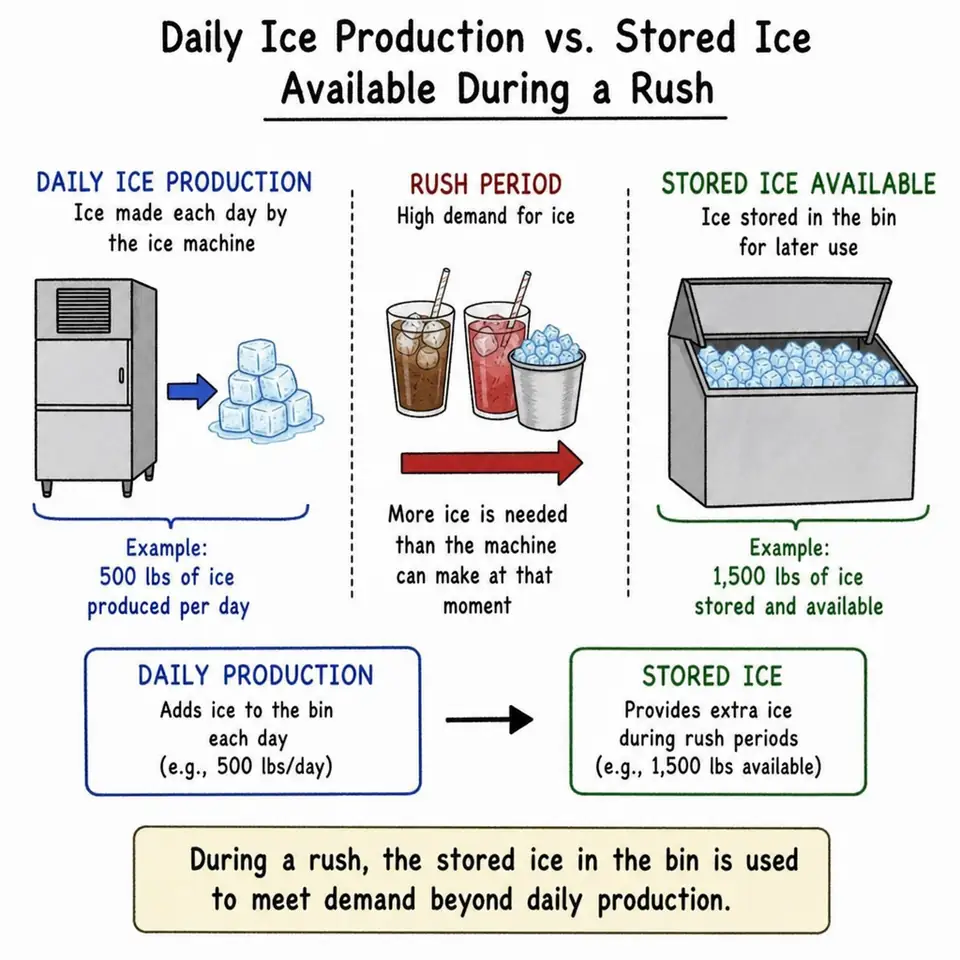
You need enough production to replace the ice used throughout the day and enough storage to cover concentrated demand between replenishment periods. Production describes how much ice a machine can make under stated conditions; storage describes how much its bin holds. Those numbers are not interchangeable.
Separate daily output from the reserve
The Scotsman HID525 illustrates the difference: its published specifications list production of 500 pounds per 24 hours at 70°F air and 50°F water, but storage of 25 pounds. At 90°F air and 70°F water, listed production falls to 380 pounds per 24 hours. These are model-specific ratings, not promises for every installation.
That example shows why headline output needs context. Compare competing models at equivalent temperature conditions, then ask the supplier which rating best represents your location. Do not assume a high daily production figure means that amount is waiting inside the cabinet.
Build an estimate from measured servings
For a useful starting estimate, weigh the ice used in representative servings. Include different container sizes and distinguish an ordinary day from your busiest realistic day. Use measured ice weight, not the container's fluid-ounce capacity.
Consider this hypothetical calculation:
| Planning input | Assumed amount |
|---|---|
| Drinks served daily | 400 |
| Measured ice per drink | 4 ounces by weight |
| Total drink ice | 1,600 ounces |
| Converted daily requirement | 100 pounds |
This example covers only the stated drinks. Add separately measured requirements for pitchers, other service points, and additional uses. Document assumptions so the supplier can challenge them rather than treating an estimate as established demand.
Check the busiest service window
Next, calculate demand during the busiest interval. In the same hypothetical operation, 100 drinks using four ounces of ice each require 25 pounds. Ask whether usable stored ice plus production during that interval can meet the requirement, especially if the bin is not full when the rush starts.
Request a peak-demand assessment rather than dividing daily output by opening hours. Follett's sizing guidance likewise emphasizes that usage patterns and other ice uses affect equipment selection.
Features that deserve attention during a demonstration
Evaluate features through actual tasks: filling a bottle, positioning a pitcher, stopping ice flow, and cleaning the serving area. Manufacturer offerings include touch-free and push-button dispensing, but controls and container requirements vary by model. Hoshizaki, for example, specifies opaque containers for the hands-free sensor on its DCM-500B_K-OS models.
Use your own containers during a demonstration. Ask the supplier to show the following, rather than accepting a general assurance that the machine is easy to use:
- Dispensing clearance: Can the tallest approved container sit beneath the outlet without awkward tilting?
- Activation and stopping: Can a first-time user start and stop dispensing predictably?
- Ice selection: Is the machine's ice type suitable for your intended drinks and serving method?
- Water delivery: Does the quoted configuration dispense water, and is that water chilled?
- Cleaning access: Which components come off, what tools are needed, and who should perform the work?
Check the specification sheet for ice type rather than assuming all dispensers deliver the same product. Hoshizaki's dispenser range, for instance, includes mini cubelet and small cubelet machines. Its ice-and-water units also come in different cabinet sizes and production capacities.
Keep the demonstration focused on the least convenient task, not just a successful cup fill. Ask a staff member who will use or clean the unit to participate. Record any compromises before approving the purchase.
Match the configuration to the service location
Countertop, freestanding, and wall-mounted options deserve separate consideration. Hoshizaki offers countertop dispensers that can pair with optional stands, while Follett's documentation covers countertop, wall-mounted, freestanding, and undercounter configurations. Availability depends on the product family.
| Configuration | Useful starting point | Question to resolve |
|---|---|---|
| Countertop | A staffed or self-service beverage counter | Does the complete installation leave enough working space? |
| Freestanding or stand-mounted | A dedicated refreshment station | Can users approach without blocking circulation? |
| Wall-mounted | A location where counter space is limited | What mounting support and service access are required? |
| Separate maker and dispenser | A modular hotel-style installation | Which maker, adapter, and dispenser combination is approved? |
Use this table to organize a site discussion, not as a substitute for installation instructions. Ask for a drawing of the complete assembly, including any stand, adapter, filter, or separate ice maker. Review the dimensions of that assembly rather than one component.
Practical uses across commercial settings
Manufacturers position commercial ice dispensers for offices, hotels, restaurants, healthcare facilities, and other shared environments. Those settings may use similar equipment, but they should not automatically use the same purchasing priorities. Scotsman's range includes both hotel dispensers and integrated ice-and-water models.
For a hotel, assess the containers guests will fill, access around the station, and how staff will reach the equipment for service. Include the separate maker in the review where applicable. Ask whether the complete assembly suits the planned location, not simply whether the dispenser fits.
For a restaurant or cafeteria, map the drink-making sequence before comparing ice maker options. Decide whether the station serves employees, customers, or both. Then evaluate the busiest meal period, rather than basing the purchase solely on average daily sales.
For an office, start by counting users and observing when they fill drinks. Bring reusable bottles to the demonstration and ask about operating sound in the proposed location. Include cleaning responsibility in the decision, even if demand seems modest.
For healthcare, involve the facility's operations and infection-prevention teams before selecting equipment. Follett provides application-specific sizing guidance for patient-care dispensers and notes that different usage patterns can change requirements. Treat generic sizing examples as a starting point for review, not a facility-specific recommendation.
Verify installation requirements before ordering
Cabinet dimensions alone do not establish installation fit. Manufacturer documents also specify ventilation space, utility connections, and operating limits. For example, the Scotsman HID525 specification sheet calls for space at the left, back, and right for ventilation and utility connections; use the requirements for the exact model being purchased.
Have the installer confirm these items in writing:
- Water supply: Required pressure, connection location, and the proposed filtration arrangement.
- Drainage: Connection requirements, the planned drain route, and any additional equipment needed.
- Electrical supply: Voltage, circuit requirements, and outlet position for every powered component.
- Ventilation: Required clearances and whether nearby equipment affects the proposed location.
- Support and access: Counter, stand, or wall suitability, plus room for maintenance and component removal.
Also compare cooling configurations carefully. Hoshizaki publishes separate potable-water, condenser-water, energy, and heat-rejection figures for air-cooled and water-cooled versions of its DCM-500 dispenser. Ask the supplier to explain the implications using your installation and utility costs.
Do this review before approving cabinetry or placing the equipment order. If an installation assumption remains unresolved, keep it visible on the quotation rather than leaving it for delivery day.
Make cleaning and maintenance part of ownership
Cleaning involves more than wiping the exterior. Scotsman's dispenser manual identifies maintenance areas including the drip tray and drain, condenser and filter, dispensing bin and rotor, ice-level control, and ice-making water system. A clean-looking front panel does not establish that these internal areas have been maintained.
Build the maintenance plan from the exact manufacturer manual. Follett specifies different intervals for different components and assigns ice-machine-system cleaning to trained maintenance personnel or an authorized service agent. Its guidance also allows for more frequent cleaning when environmental conditions warrant it.
Before purchase, assign responsibility for routine checks, scheduled cleaning, filter servicing, and repair calls. Ask how long planned maintenance takes and what alternative ice supply you will use during downtime. Keep the manual accessible and record completed work so responsibility remains clear when staff change.
Compare ownership costs and avoid category confusion
A practical ice machine buying guide should compare complete proposals, not equipment prices alone. Request separate lines for the machine, dispenser, adapters, stand, filtration, delivery, installation, and planned service where applicable. Ask suppliers to identify exclusions explicitly.
For commercial ice and water dispensers, also confirm whether water chilling is included. Follett notes that its chilled-water option can increase ice requirements, so the feature belongs in the capacity discussion as well as the equipment quotation.
Keep commercial ice cream topping dispensers out of the same comparison. These dispense ingredients such as candies, dry toppings, or sauces rather than beverage ice. Server Products, for example, offers dry topping dispensers and separate topping warmers; their capacity and selection criteria address a different job.
Choose for the rush, not the headline number
The best shortlist starts with measured demand, actual containers, and a verified installation location. Compare production and storage separately, test the dispensing experience, and include cleaning and service in the ownership plan. Before ordering, ask the supplier to document how the complete system meets your busiest service window-not just your average day.