
Commercial griddles provide a broad cooking surface for breakfast dishes, burgers, sandwiches, and other foods that benefit from direct contact with a heated plate. Choosing the right flat-top for your menu means matching its fuel source, cooking area, controls, and plate construction to the work your team actually does. This guide helps you turn those needs into a practical equipment shortlist before comparing options at The Horeca Store.
Start with your busiest service, not the most impressive product photo. Write down what cooks together, where orders stall, and which installation constraints you cannot change. Those details give every specification a purpose.
Which commercial griddle fits your menu?
The right commercial griddle fits your peak cooking workload, provides suitable temperature control for your dishes, and works with your kitchen's utilities and layout. Breakfast-heavy operations should investigate control consistency, while kitchens repeatedly loading burgers should examine recovery performance. Manufacturers offer different plates and control systems because those cooking demands are not identical.
Build your initial requirements around the food rather than an assumed equipment size:
- Breakfast service: List pancakes, eggs, bacon, and other items that must share the plate. Note which dishes need different cooking settings.
- Burger-focused menus: Record patties per order, simultaneous tickets, and whether buns or onions also occupy the surface.
- Sandwiches and quesadillas: Measure the footprint of assembled portions and leave room to turn them without disturbing neighboring orders.
- Mixed menus: Map competing tasks, including vegetables, proteins, and bread. Identify where separate equipment or utensils may be necessary.
For example, a café adding grilled sandwiches should first measure sandwich batches, not copy the equipment choice of a burger restaurant. Treat your own production pattern as the starting point.
Gas, electric, and propane: compare the installation first
Commercial electric griddles and commercial gas griddles both serve professional kitchens, but the available utility supply can narrow your options immediately. Do not assume every gas model needs no electricity: some controls and ignition arrangements require electrical service. Equally, an electric countertop model is not automatically compatible with an ordinary outlet.
Commercial electric griddles
Commercial electric griddles deserve consideration where gas service is unavailable or an electric cooking platform is preferred. Check the exact voltage, phase, and electrical load rather than relying on the word "electric." Manufacturer specifications can offer several electrical configurations within one product family, so the complete model designation matters.
Before shortlisting one, ask an electrician to compare the specification sheet with your building's supply. Include any required circuit work in the purchase budget. This avoids choosing kitchen appliances around a connection your site cannot support.
Commercial gas griddles
For commercial gas griddles, verify the specified gas type, connection requirements, and installation instructions before ordering. Manufacturer manuals require attention to the appliance's rating information and proper gas installation. Have a qualified installer assess the proposed location rather than treating an existing gas connection as proof of compatibility.
When comparing commercial gas griddles for sale, request the exact specification sheet for each configuration. Also ask whether accessories, regulators, or electrical connections are required. Keep those answers beside the quotation so apparently similar offers can be compared fairly.
Commercial propane griddles
If your operation uses propane, shortlist commercial propane griddles explicitly configured for that fuel. Confirm the model's gas designation and obtain manufacturer guidance before considering any conversion. Gas type is an installation requirement, not an interchangeable shopping preference.
For mobile or temporary operations, ask your installer to review the complete proposed setup, including fuel supply and equipment placement. Do not infer outdoor suitability from the presence of a propane connection. Request written confirmation that the appliance suits its intended operating environment.
Size the surface around your busiest service
Treat usable cooking area and overall equipment dimensions as separate measurements. Manufacturer specifications distinguish the appliance footprint from plate dimensions, and some product lines offer different cooking depths. Compare both before deciding that a nominal width will fit your production needs.
Use this planning exercise before browsing commercial griddles for sale:
- Choose a peak service window. Use actual tickets where available, rather than daily averages that hide short bursts of demand.
- List simultaneous batches. Include everything occupying the plate at once, not just the main protein.
- Lay out representative portions. Use a measured paper template to explore spacing, turning, and access.
- Assign the proposed cooking zones. Identify foods that need different settings and check whether the shortlisted unit supports that arrangement.
- Test the surrounding workflow. Account for utensils, ingredient access, plating space, and movement to neighboring stations.
Ask for a demonstration using a representative batch if possible. Observe the complete cycle: loading, cooking, turning, unloading, and preparing for the next order. Record where the process pauses instead of judging only the first finished item.
Avoid treating unused width as automatic future-proofing. First establish whether the rest of your line could support the extra production. A purchase should solve a defined capacity problem, not simply occupy the available counter.
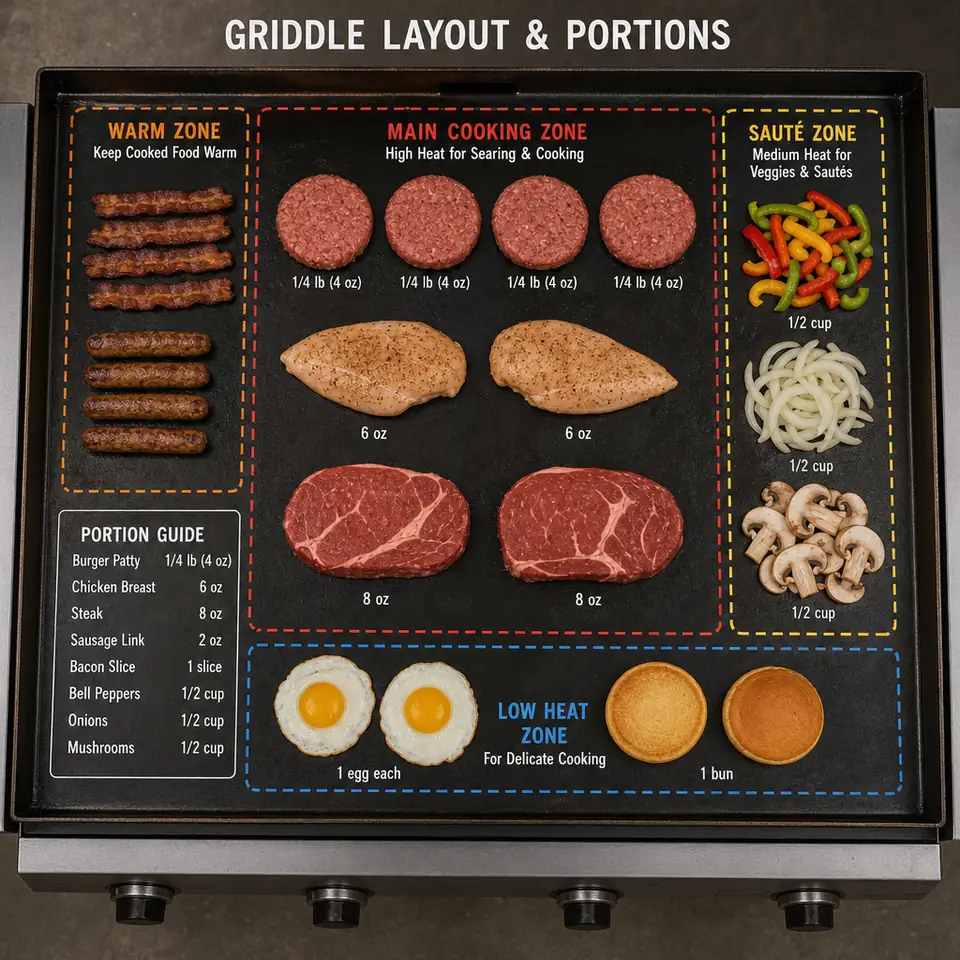
Plate construction and recovery deserve a closer look
Manufacturers offer steel, chrome, and composite plates with different operating and maintenance characteristics. Vulcan's plate comparison, for example, distinguishes traditional steel from chrome and an aluminum-core composite design. Those differences make plate construction worth investigating beyond its appearance.
For steel, review the model's seasoning and cleaning procedures before committing. For chrome or composite surfaces, identify approved tools and any restrictions on abrasives. Do not assume that the cleaning method used on your current flat-top will suit a replacement.
Recovery is another useful comparison point: it concerns how the cooking surface responds after food draws heat from it. Manufacturer guidance identifies plate design and control systems as contributors to recovery performance. That makes a representative cooking demonstration more informative than comparing fuel type alone.
Ask the demonstrator to load the quantity and starting condition of food you expect during service. Then watch successive batches, not just the first one. Use consistent portions and loading patterns across demonstrations so your comparison has a meaningful basis.
Do thermostatic controls matter for your cooking style?
Thermostatic controls matter when you want the griddle to work toward a selected temperature rather than requiring cooks to manage burner output manually. Manual controls adjust heat input without automatically maintaining a chosen plate temperature. Thermostatic systems respond to temperature changes, although their accuracy and response vary by design.
For your shortlist, ask how the controls operate, where temperature is sensed, and how many independently controlled sections are available. Request an explanation of any performance claim under realistic cooking conditions. A stated temperature tolerance should not be interpreted without understanding its test conditions.
Consider staff experience as part of the decision. Would your team prefer a repeatable temperature setting, or does your established cooking process rely on active manual adjustment? Ask cooks from different shifts to evaluate the controls during a demonstration.
Finally, check the zone layout against your proposed menu map. Some electric models, for example, specify multiple cooking zones within one plate. Verify the actual configuration rather than assuming that every knob creates the same working arrangement.
Fit the equipment into the whole commercial kitchen
A commercial kitchen installation involves more than making space on a countertop. Manufacturer instructions address clearances, supporting surfaces, ventilation, utility connections, and access. Use the installation manual for the exact model as your planning document, and have qualified professionals review site suitability.
Do not assume electric means ventilation-free. The electric griddle installation manual includes ventilation considerations, so fuel choice alone does not settle that question. Confirm the proposed appliance, cooking application, and local requirements with your installer and relevant authorities before purchasing.
Prepare a site checklist covering:
- Physical fit: Overall dimensions, manufacturer-required clearances, and access to controls.
- Support: A compatible stand, countertop, or equipment base with the required capacity.
- Working access: Space to remove the grease drawer and reach approved cleaning points.
- Utilities: Verified electrical configuration or gas supply for the exact model.
- Delivery: Doorways, turns, unloading arrangements, and movement into the final position.
These checks also help you compare commercial gas griddles and flat top grills without overlooking installation expenses. Ask suppliers to identify exactly what their quotations include. Keep delivery, placement, connection, and commissioning as separate line items until their scope is clear.
Cleaning and ownership costs belong in the buying decision
Review the cleaning routine before choosing restaurant equipment, not after the first service. Surface-specific instructions can be important: Vulcan's chrome-plate guidance prohibits abrasive scouring pads and griddle bricks because they can damage the finish. Other plate types have different care requirements, so follow the applicable manual rather than a universal cleaning shortcut.
Ask the team responsible for closing to review the proposed procedure. Check whether approved tools are easy to obtain and whether the grease drawer is practical to handle. Include those supplies in your purchasing plan instead of assuming existing tools will be suitable.
For operating-cost comparisons, investigate independently documented efficiency information where available. ENERGY STAR provides a commercial griddle product finder and equipment-calculation resources to support purchasing decisions. Use your expected operating schedule and utility rates rather than adopting a generic savings claim.
Build a total-cost worksheet that includes purchase, delivery, installation, cleaning supplies, planned maintenance, and potential utility work. Ask about warranty exclusions and local service availability. The aim is a complete ownership picture, not a prediction based solely on the lowest advertised price.
Read griddle reviews with your own workload in mind
Use griddle reviews to develop questions, then verify answers against manufacturer documentation and a representative demonstration. A review is most useful when it explains the exact model, menu, batch size, operating schedule, and maintenance experience. Without that context, a broad verdict may tell you little about your commercial cooking needs.
Look for details you can investigate:
- Repeated-batch performance: What was cooked, in what quantity, and under what starting conditions?
- Control experience: Did operators discuss settings, adjustments, and differences between sections?
- Cleaning practicality: Which tools and procedures were used, and were they manufacturer-approved?
- Service experience: Was the issue identified clearly, and was the relevant warranty coverage explained?
Separate missing information from demonstrated problems. If a reviewer reports uneven results without describing loading or settings, ask for a controlled demonstration before drawing a conclusion. Likewise, do not treat a positive experience in a lightly used station as proof of suitability for continuous production.
Choose for the menu you actually serve
The strongest shortlist begins with your food, peak batches, available utilities, and working space. Use those requirements to compare flat top griddles, then verify controls, cleaning procedures, installation needs, and ownership costs. Leave room for realistic growth, but make today's workflow the foundation.
When you are ready to compare options at The Horeca Store, bring your menu, site measurements, utility details, and peak-service notes. Request model-specific specifications and a complete quotation. That turns a broad equipment search into a focused purchasing decision.