

Commercial gas ranges combine burners or specialty cooking surfaces with an oven or storage base, bringing several cooking tasks into one station. Choosing the right model means matching its width, cooking configuration, and utility requirements to your menu - not simply buying the most burners. This guide explains the features to compare, the measurements to check, and the questions to settle before ordering.
Whether you are preparing a shortlist for The Horeca Store or comparing supplier quotes, start with a written description of your busiest service. Use that description to judge which features deserve space and budget.
What size commercial gas range does your kitchen need?
The right size depends on simultaneous cooking tasks, cookware dimensions, available floor space, and the approved ventilation layout. Common restaurant range widths include 24, 36, 48, and 60 inches, with 72-inch configurations also available. Treat these as product categories rather than guaranteed installation dimensions; check the exact specification sheet before planning your opening.
Use this planning table to organize your shortlist, not as a substitute for a production assessment:
| Nominal width | Consider it when | Main question to resolve |
|---|---|---|
| 24 inches | You want a compact, focused cooking station | Can your busiest pan combination fit? |
| 36 inches | You need burners, an oven, or a compact mixed top | Would a griddle displace essential burners? |
| 48 inches | You are considering more cooking-surface variety | Does the added width solve an actual bottleneck? |
| 60 inches | You want to evaluate a larger mixed-top station | Can utilities and ventilation accommodate the configuration? |
| 72 inches | You need to assess a broad cooking station | Would separate appliances suit the workflow better? |
Available tops and bases vary by series; width alone does not establish burner count or oven capacity.
Measure the whole installation, not just the appliance
Record overall width, depth, working height, backguard height, and oven-door clearance. Include the delivery route: doorways, corners, loading access, and any elevator. Ask your installer to mark the appliance footprint and required clearances on the kitchen plan before you approve the purchase.
Nominal dimensions can be misleading. For example, one Southbend range marketed in the 48-inch category measures 48⅝ inches wide. That difference matters when replacing equipment between fixed neighboring appliances.
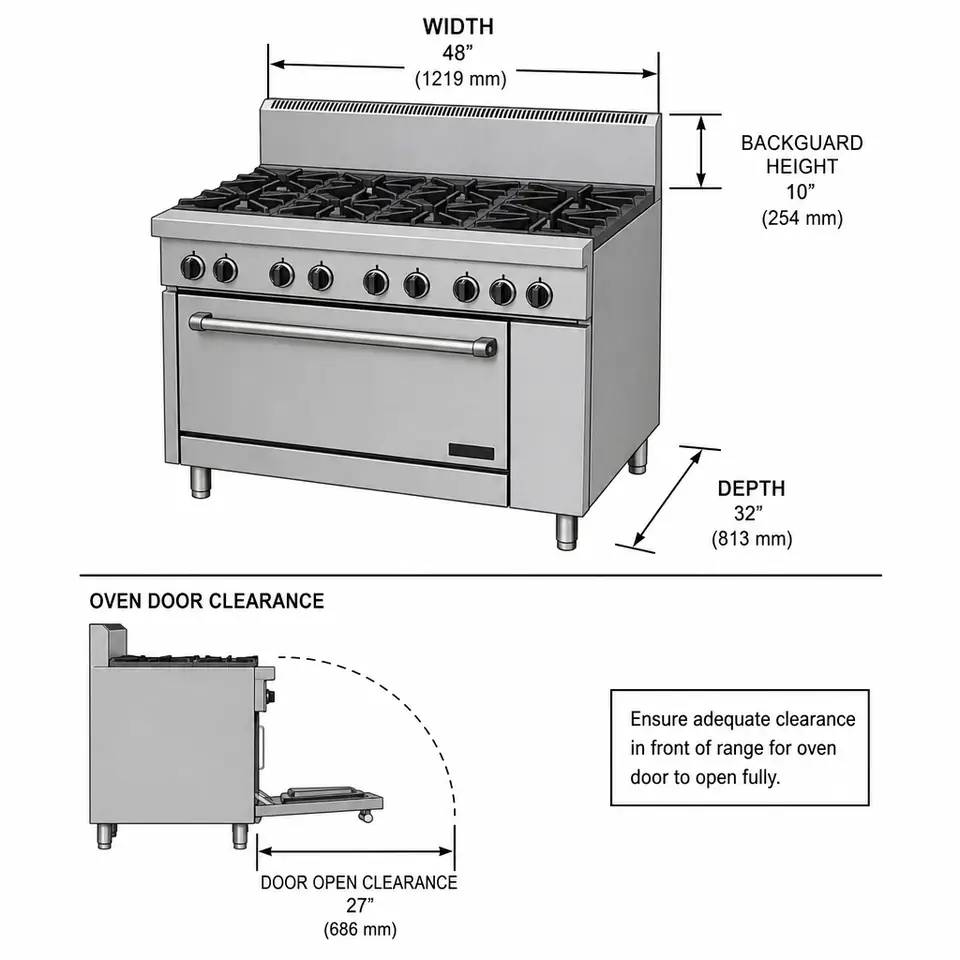
Which features matter most in a commercial gas range?
Prioritize the cooking surface, usable heat control, cookware support, oven configuration, and cleaning access. These determine how well the range fits your actual production routine. Compare professional gas ranges against the same menu tasks rather than treating one impressive specification as proof of a better appliance.
Burner layout and usable heat control
Check both the individual burner input and the appliance's total gas input. Then ask how the burners behave during your actual tasks: holding sauce, sautéing to order, or heating a large stockpot. Request a demonstration where possible, using cookware similar to yours.
Do not assume every gas version has identical ratings. Southbend's S36 specification sheet, for example, lists different open-burner inputs for natural gas and propane. Compare the exact fuel configuration you intend to purchase, not a headline rating from another version.
Grate geometry deserves equal attention. Large pots need suitable support, while small sauté pans should sit securely without tipping. Check whether handles interfere with neighboring pans and whether a full rear pot leaves the front burner practical to use.
Open burners, griddles, and specialty tops
Open burners provide direct flame beneath cookware; griddles provide a flat surface for cooking food directly. Other configurations include hot tops and charbroilers. Mixed tops combine cooking methods, but each section occupies space that could otherwise hold another cooking surface.
Build your preferred configuration around a service exercise:
- Sauté-heavy menu: List the pans needed simultaneously, including sauces and garnishes - not just main dishes.
- Breakfast menu: Sketch the griddle area needed for one representative rush, then reserve burners for skillet items.
- Mixed menu: Identify which specialty surface earns its space throughout the day.
- Changing menu: Ask whether the proposed layout still works if a signature item changes.
Confirm the control type as well. Manufacturers offer manual and thermostatic griddle configurations, so two visually similar ranges may have different controls. Request the operating instructions for the exact option rather than relying on the product photograph.
Oven capacity and base configuration
Available bases include standard ovens, convection ovens, and storage cabinets. A standard oven supports general baking and roasting, while convection uses fan-assisted airflow. Choose according to the food, pans, and production schedule; convection should not be treated as a universal promise of faster cooking.
Check internal dimensions, rack spacing, supplied racks, and pan orientation. Ask the supplier to confirm that your actual pans fit with the clearances required by the manufacturer. A wide cooktop does not tell you how usable the oven will be for your batches.
Also verify electrical requirements. A gas range with a convection base can still need electricity for its fan motor; Southbend lists a 115-volt motor on the cited convection configuration. Put that requirement on the installation plan rather than discovering it at delivery.
Installation requirements belong in the buying decision
Before selecting gas cooking equipment, have qualified professionals assess the proposed installation. Confirm fuel type, available supply, required pressure, connection arrangement, electrical service, and manufacturer-specified clearances. Do not assume the existing installation is suitable simply because the replacement range occupies a similar footprint.
Ask the hood designer or installer to review the exact cooking configuration, including any griddle, charbroiler, or elevated accessory. Ventilation and fire-protection requirements depend on the equipment, application, and local authority having jurisdiction. Obtain project-specific confirmation instead of applying a generic hood-overhang rule.
If you want casters for cleaning access, confirm the approved connector and restraint arrangement. Vulcan's cited manual requires an appropriate flexible connector, quick-disconnect device, and a separate means of limiting movement on caster-mounted ranges. These are installation components to specify, not details to improvise after delivery.
Ask for installation responsibilities in writing. Identify who supplies accessories, makes utility connections, performs startup, and coordinates any required inspections. Keep the approved specification sheet with the purchase order so substitutions receive the same review.
How should you use gas range reviews when comparing models?
Use gas range reviews to generate questions, then verify the answers against documentation and your operating needs. Give greater weight to comments that identify the model, fuel, cooking workload, ownership period, and service experience. A review without that context should not decide a major equipment purchase.
Separate subjective preferences from issues you can investigate. A complaint about awkward controls calls for a hands-on check; a report about service delays calls for questions about local support. Avoid treating one owner's experience as a guaranteed outcome for your kitchen.
For each shortlisted model, investigate:
- Workload match: Does the reviewer describe a service pattern similar to yours?
- Configuration match: Are the burners, griddle, fuel, and oven the same as the quoted unit?
- Service detail: What failed, who diagnosed it, and how was it resolved?
- Evidence quality: Does the account distinguish delivery damage, installation problems, and equipment faults?
Compare all models using the same questions. This makes reviews a useful supplement to your evaluation rather than a substitute for it.
Cleaning access and service support deserve a close look
Inspect removable grates, crumb trays, grease collection, oven surfaces, and access around controls. Manufacturers offer features such as removable grate tops and one-piece crumb drawers; ask to see how those components come out and go back into place. Judge the process from the perspective of the employee closing the station.
Follow the exact model's cleaning instructions. Vulcan's general guidance calls for controls to be off and equipment cool before cleaning, and directs owners to the installation and operation manual for model-specific procedures. Do not assume a cleaning chemical or burner-cleaning method approved for one appliance suits another.
Before buying restaurant kitchen equipment, request the warranty document and identify who handles service in your area. Ask about coverage conditions, startup requirements, replacement parts, and the process for reporting a fault. Keep written answers with the quote rather than relying on verbal assurances.
Compare total installed cost, not just purchase price
Build a budget that includes the appliance and everything needed to put it into approved service. Request separate amounts for delivery, placement, installation accessories, utility work, ventilation changes, startup, and removal of old equipment. Mark each item as included, excluded, or awaiting confirmation.
Use identical configurations when comparing commercial cooking appliances. Quotes can differ in oven type, griddle controls, racks, casters, connectors, shelves, and other accessories. Middleby's purchasing guidance specifically recommends aligning those details alongside freight, installation, warranty, and service support.
Create a comparison sheet with a column for each model and a row for every requirement. Mark unknowns clearly instead of assuming they are included. A lower initial quote should remain provisional until you understand what completing the installation will require.
Your commercial gas range buying checklist
Use this checklist before authorizing payment. Attach the supporting specification sheets, installation assessment, and written quote so every approval refers to the same configuration.
- [ ] Document peak production. Identify simultaneous pans, griddle batches, and oven loads during the busiest service.
- [ ] Choose the top layout. Confirm that each burner or specialty section supports a regular menu task.
- [ ] Test cookware fit. Check large pots, small pans, handle clearance, and oven-pan orientation.
- [ ] Verify exact dimensions. Include the appliance, delivery route, operating space, and required clearances.
- [ ] Match the fuel. Confirm that the model code and order specify the intended natural gas or propane version.
- [ ] Approve utilities and ventilation. Obtain professional confirmation for the exact appliance configuration.
- [ ] List installation accessories. Identify approved casters, connectors, restraints, shelves, and mounting components where applicable.
- [ ] Review cleaning procedures. Make sure the team can access routine cleaning points and follow the manual.
- [ ] Confirm support. Review warranty terms, service contacts, parts arrangements, and startup responsibilities.
- [ ] Reconcile the quote. Resolve exclusions, delivery arrangements, damage-reporting procedures, and installation costs.
When preparing an inquiry for The Horeca Store, send your preferred width, fuel type, top configuration, base choice, and installation constraints together. Ask for confirmation against the exact model number. A detailed inquiry gives you a clearer basis for evaluating the response.
Buy for the service you need to deliver
Start with your menu and busiest cooking period, then work outward to size, features, installation, and cost. Keep unresolved requirements visible until someone qualified confirms them. The goal is not the largest range or the longest feature list - it is a documented, workable choice for your kitchen.