
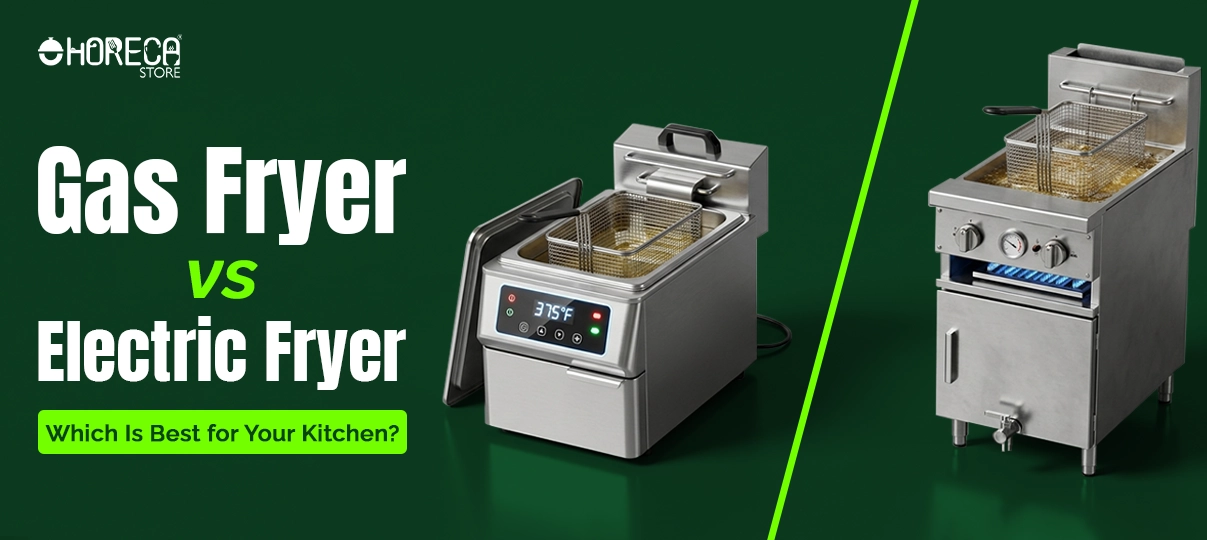
You’ve got a line of customers out the door, ticket times are creeping up, and your fryer is struggling to get back to temperature. Every minute that oil sits below 350°F is a minute you aren’t making money, and serving soggy food during a rush is the fastest way to damage your reputation. The choice between gas and electric models determines whether your business thrives or bottlenecks during peak hours.
Deciding between the two requires balancing the sticker price against your long-term operational reality. Fryer reviews and deep fryer comparison data consistently show that while electric units often lower monthly utility bills, they can come with higher upfront costs or require expensive electrical upgrades. Moving past the guesswork requires investing in the engine your kitchen actually needs based on your specific menu and building setup.
The 'Recharge Battery' Effect: Why Temperature Recovery Speed Determines Your Throughput
Think of your fryer as a battery storing heat. When you drop a basket of cold wings or frozen fries, you instantly drain that energy, dropping the oil temperature well below the target 350°F. If the unit takes too long to "recharge" back to cooking temperature, the food sits in lukewarm oil, soaking up grease rather than searing the outside. This lag is called recovery time, and it is the single biggest factor determining whether your rush-hour fries come out crispy or limp.
The speed of this recharge depends entirely on how the heat gets into the oil. Gas fryers generally operate like a campfire under a heavy pot; the flame heats the metal tank from the outside, and the tank eventually transfers that heat to the oil. Much of the energy escapes up the exhaust flue before it ever touches your food. In contrast, electric fryers use heating elements submerged directly inside the oil. Because there is no barrier between the heat source and the liquid, the transfer of energy is nearly 100% efficient.
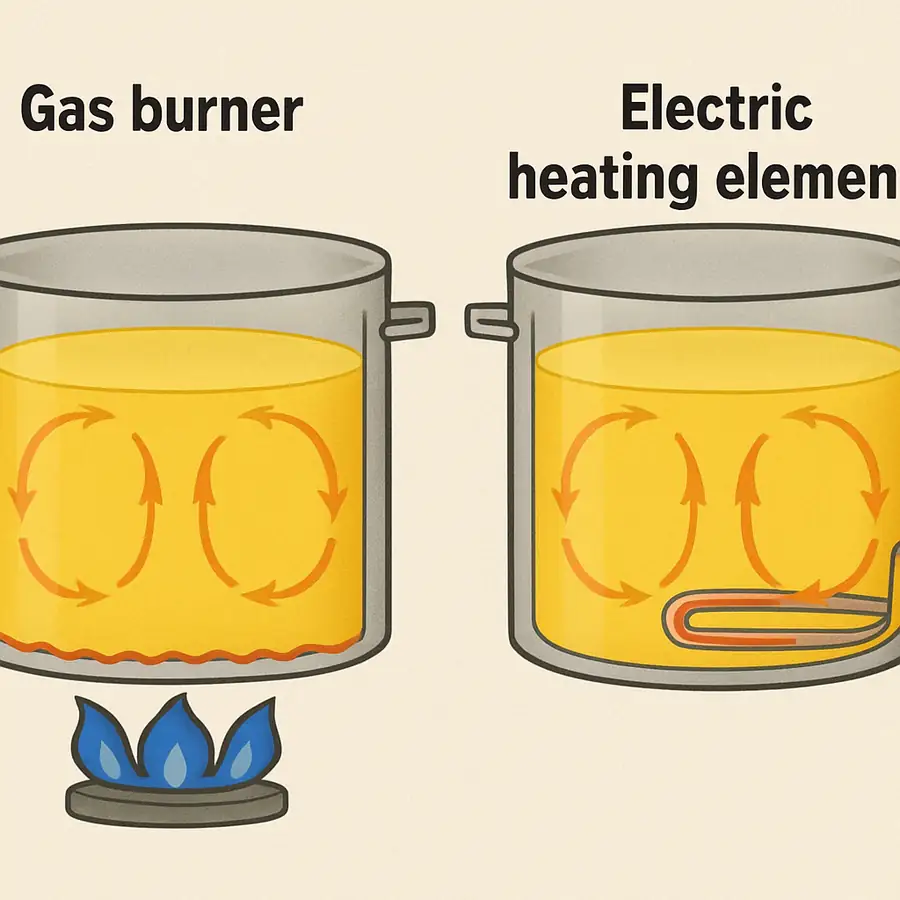
Comparing raw numbers on a spec sheet can be misleading because the units of measurement differ. Gas uses British Thermal Units (BTUs) while electricity uses Kilowatts (kW). To level the playing field, remember that 1 kW equals roughly 3,400 BTUs. However, due to the difference in thermal transfer, a lower-rated electric fryer often outperforms a powerful gas fryer in real-world speed tests:
- Standard Gas Fryer (Tube Design): ~12–15 minutes to reach 350°F from cold.
- High-Efficiency Electric Fryer: ~7–10 minutes to reach 350°F from cold.
Raw power doesn't matter if it doesn't reach the food. While electric units often win the race for speed and consistency, that performance comes at a premium on your monthly overhead. This trade-off dictates whether the efficiency gains are worth the potentially higher utility rates in your area.
Why Electric Fryers Win the Efficiency Race—But Might Lose Your Utility Bill
Efficiency is a direct measurement of how much money you are setting on fire. Are electric fryers more energy efficient than gas? The answer lies in where the heat actually goes. Because gas fryers rely on burners located outside the fry pot, a significant portion of that heat bypasses the oil entirely and escapes through the ventilation system. This wasted energy is known as flue loss—essentially, you are paying to heat up your exhaust hood rather than your cooking oil.
The difference in technology creates a massive gap in transfer efficiency:
- Standard Gas Fryers: Only 35–50% of the energy you pay for heats the oil.
- High-Efficiency Gas Fryers: Advanced designs improve this to 60–70%.
- Electric Fryers: Because the element is submerged, they achieve 85–95% efficiency.
However, superior engineering does not automatically guarantee a lower monthly bill. The operating cost differences between gas and electric fryers depend heavily on local utility rates. Natural gas is historically much cheaper per unit of energy than electricity in many regions. Even though an electric fryer wastes almost nothing, the electricity itself might cost three times as much as gas. Check your local utility rates—specifically the cost per "therm" for gas versus "kWh" for electricity—to calculate if the efficiency gains will offset the higher price of power.
Another factor is the impact on your kitchen’s ambient temperature. Since gas units radiate heat into the surrounding air, they force your air conditioning and ventilation systems to work overtime, adding a "hidden tax" to your electric bill. An electric fryer puts the heat into the food, keeping the kitchen cooler and your staff more comfortable. Yet, even if the math favors electric on paper, you can’t simply plug one in anywhere; the physical constraints of your building often make the final decision for you.
The Hidden Infrastructure Tax: Gas Lines vs. High-Voltage Wiring
Buying the fryer is often the cheapest part of the acquisition process; the real sticker shock usually arrives when you try to turn it on. Many first-time restaurateurs assume that installation involves nothing more than plugging in a cord or tightening a hose, but commercial fryers are industrial beasts that require industrial infrastructure. Before committing to a fuel source, audit your building’s "bones," because upgrading your utility connections can easily cost three times as much as the fryer itself.
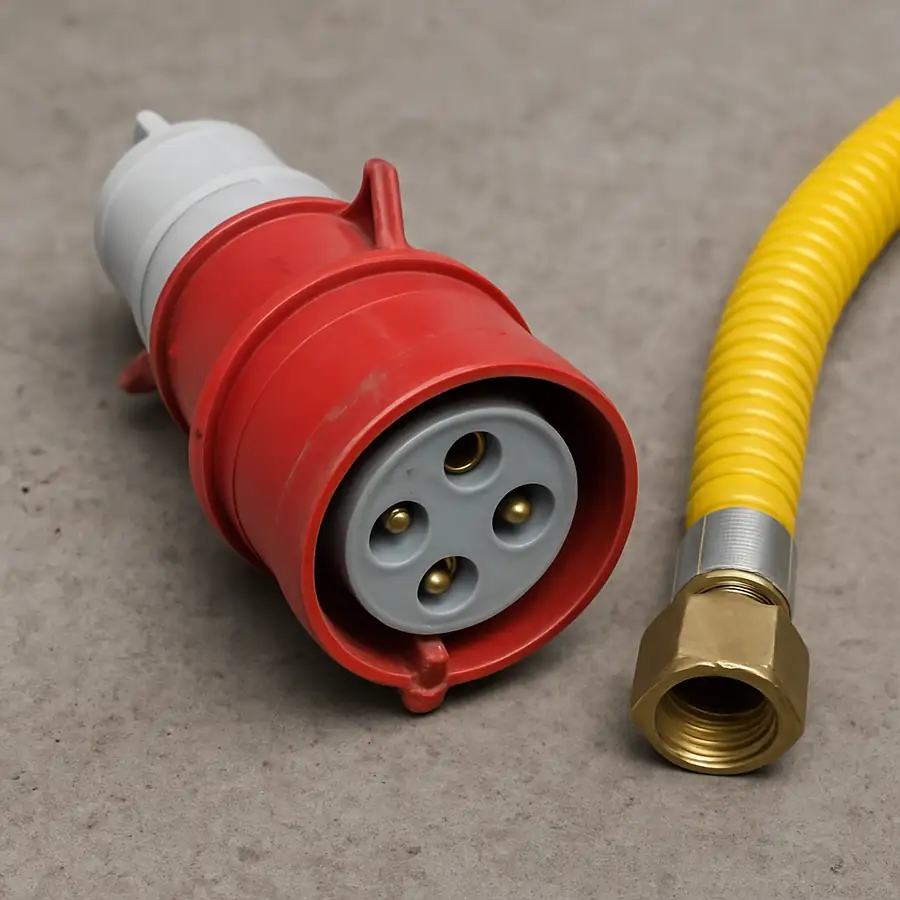
Commercial electric fryers demand a massive amount of current to recover temperature quickly, far exceeding the capacity of standard 110V outlets. Most high-performance units require electrical infrastructure for high-voltage kitchen equipment, specifically 208V or 240V circuits, and often utilize "3-Phase" power. Unlike standard single-phase power, 3-Phase power delivers a continuous, steady stream of energy that is more efficient for heavy loads but requires specific wiring configurations. If your building is an older conversion, bringing a 3-Phase circuit to your cookline could require a complete, expensive overhaul of your electrical panel.
While gas units might save you from electrical panel upgrades, they impose a strict penalty on your ventilation budget. Fire codes almost universally dictate that gas equipment must sit under a Type I Hood, specifically designed to handle grease-laden vapors and smoke. These are significantly more expensive than Type II hoods because they require integrated fire suppression systems (Ansul systems) that automatically cut the gas supply in an emergency. If your current space lacks kitchen hood ventilation requirements for gas equipment, the cost of punching new ductwork through the roof can be astronomical.
Ultimately, your choice may come down to which expensive upgrade you want to avoid: rewiring the building or reconstructing the ventilation system. Once you have determined whether your building favors a gas line or a high-voltage circuit, look inside the tank itself to see how the heating elements interact with your specific food items.
Open Pot vs. Tube-Fired: Matching Your Fryer Design to Your Menu
The decision shifts to the physical geometry of the fryer tank. The biggest enemy of your oil’s lifespan isn't just the temperature setting; it is sediment—the crumbs, batter, and breading that fall off your food. If these particles sit near the heat source, they burn, turning your expensive oil dark and bitter. The shape of your fryer determines whether those crumbs burn or settle safely, impacting your operating costs every single day.
Gas units frequently utilize a tube-fired design, where metal tubes housing the flames run directly through the center of the oil vat. The primary advantage of this setup is the creation of a deep "cold zone" at the bottom of the tank, sitting well below the heating tubes. Because the oil at the very bottom stays cooler than the cooking area, heavy sediment can settle there without scorching. This cold zone design for oil longevity is non-negotiable for kitchens producing fresh-breaded chicken or fish, as it prevents carbonized debris from ruining the flavor profile of the shortening.
Conversely, open pot fryers—which include most electric models and some high-efficiency gas units—heat the vat from the outside or use heating elements that swing up out of the oil. Without fixed tubes obstructing the tank, these units are significantly easier for your staff to scrub and sanitize. However, they typically feature a smaller, shallower sediment zone.
Choosing between open pot vs tube fired burner systems is essentially a matching game for your menu:
- Fresh-Breaded Chicken or Fish: Choose Tube-Fired. The deep cold zone handles heavy crumb fall-off effectively.
- Frozen French Fries or Wings: Choose Open Pot. These items shed very little debris, allowing you to prioritize easy cleaning and energy efficiency.
- Donuts or Funnel Cakes: Choose Flat Bottom. These specialized tanks have no cold zone, allowing dough to float freely and cook evenly without snagging on tubes or elements.
Selecting the right design saves you money on oil replacement and labor hours during cleanup. However, if your business model involves taking your kitchen on the road, the stability of your fuel source and the portability of the equipment become the new priorities.
Why Mobility and Catering Favor the Electric Spark
Taking a kitchen on the road changes the math entirely because you lose access to the infinite supply of a municipal gas line or the electrical grid. For food trucks, liquid propane is the industry standard simply because it offers high-BTU heating in a portable tank, but this portability comes with a technical hurdle. Most commercial fryers ship from the factory calibrated for natural gas, requiring a specific natural gas vs liquid propane fryer conversion kit to function safely with portable tanks. Without swapping the regulator and orifices to match the higher pressure of propane, your equipment will burn inefficiently or fail to light.
While plugging in sounds simpler than hauling heavy tanks, reliance on generators makes electric heating elements impractical for most mobile vendors. A standard 50-pound electric fryer acts like a massive energy sponge, drawing a continuous load that can easily stall a standard food truck generator. To power a commercial electric fryer reliably, you would need a generator so large and expensive that it eats into your cargo space and fuel budget. Consequently, unless you have guaranteed access to high-amperage "shore power" at every stop, the electrical draw usually rules out electric units for curbside vending.
Indoor events are the specific scenario where mobile electric fryers for catering businesses suddenly become the superior choice. Many convention centers and office buildings strictly prohibit open flames and pressurized propane tanks due to fire codes, leaving electric units as the only legal option for pop-up service. If your business model bounces between outdoor festivals and indoor corporate banquets, owning one of each type may be necessary to capture every revenue stream. regardless of the fuel source, the biggest ongoing cost remains your shortening, which makes your filtration strategy the final piece of the profitability puzzle.
Industrial Oil Filtration and Preventative Maintenance Secrets
Since replacing shortening is often more expensive than the energy bill itself, preserving oil quality is the fastest way to improve your profit margin. Modern industrial fryer oil filtration systems have evolved from luxury add-ons to essential cost-saving features, often paying for themselves in under six months. Built-in filtration allows an employee to cycle the oil through a paper or mesh filter with the flip of a lever, removing the carbon particles that ruin flavor and degrade shortening, effectively doubling the lifespan of your oil.
Hardware longevity relies entirely on how your staff treats the heating source. For electric models, the biggest risk is "dry firing." This occurs when the fryer is turned on before the vat is filled with oil. Without liquid to absorb the intense energy, the submerged heating elements turn red hot and snap within seconds. Preventing this requires strict training protocols: never touch the dial until the oil level is verified.
Gas models require vigilance centered on combustion efficiency. Over time, the burner orifices can become clogged with grease and carbon. A clogged burner produces a lazy yellow flame instead of a sharp blue one, meaning you are paying for gas that isn't generating maximum heat. While daily wiping is standard, preventative maintenance for commercial frying units powered by gas usually requires a professional technician to rod out these ports annually.
To keep either system running through the Friday rush, implement this simple check:
- Electric Units: Inspect heating coils weekly for carbon crusting, which acts as an insulator and slows down cooking.
- Gas Units: Visually check the pilot and burner flame monthly; if it’s flickering yellow, call a technician.
- All Units: Boil out the frypot every 3 to 6 months to remove old gum and varnish that alters food taste.
Once you understand the maintenance demands, you can accurately forecast the long-term financial impact by calculating the 5-Year Total Cost of Ownership.
Calculating the 5-Year Total Cost of Ownership
The sticker price on a showroom floor is only the tip of the iceberg. Smart business owners look at the "Total Cost of Ownership" (TCO), which combines the purchase price with five years of energy bills and maintenance fees. While a high-efficiency electric model might cost $1,000 more upfront, its ability to transfer heat directly to the oil often creates significant savings over time compared to a standard gas model that wastes heat through the exhaust flue.
Local utility rates play a massive role in this equation. Natural gas has historically been cheaper than electricity in many regions, but electric fryers use that energy far more efficiently. This efficiency directly improves temperature recovery speed in busy kitchens, ensuring you aren't paying for fuel while aimlessly waiting for the oil to heat back up between batches. Consider this hypothetical 5-year breakdown for a high-volume kitchen:
- Standard Economy Gas Fryer: $1,500 Purchase + $12,000 Utilities + $1,000 Maintenance = $14,500 Total
- High-Efficiency Electric Fryer: $3,000 Purchase + $9,500 Utilities + $400 Maintenance = $12,900 Total
Beyond the monthly bills, consider asset depreciation. A high-quality unit typically retains better resale value than a budget economy model, providing a stronger financial safety net if you ever need to upgrade or liquidate. By accurately calculating the total cost of ownership for commercial fryers, you stop viewing the equipment as a mere expense and start seeing it as a variable that controls your monthly profit margin.
Your Pre-Purchase Checklist: 5 Questions to Ask Before Signing the Invoice
Choosing the right equipment is about surviving the Friday night rush without losing money to downtime. The myth that one fuel source is universally superior is outdated; the reality is a balancing act between your building’s infrastructure and your menu’s demand.
Run your specific situation through this diagnostic checklist to highlight the deal-breakers unique to your operation:
- Menu Volume: Do you need the raw power and rapid recovery for high-volume frozen goods (Gas), or the precise temperature control for delicate, fresh items (Electric)?
- Utility Access: Is a gas line already plumbed in, or do you have existing high-voltage electrical panels? The most affordable option is often the one that doesn't require a renovation.
- Ventilation Capacity: Does your current hood system have the capacity to handle combustion fumes, or do you need the cleaner exhaust profile of an electric model?
- Kitchen Climate: Can your HVAC system handle the intense ambient heat radiated by gas, or is keeping the kitchen cool a priority for staff comfort?
- Budget Timeline: Are you prioritizing a lower sticker price today, or are you willing to pay more upfront to lower your monthly utility bills over the next five years?
This commercial fryer comparison ultimately comes down to throughput versus infrastructure. If your kitchen is limited by power outlets but has great ventilation, gas is your natural ally. If you are in a tight space where ambient heat kills morale, electric is the smarter long-term play.
Before finalizing your order, verify your choice against your local building and fire codes. Regulations regarding ventilation and fire suppression often have the final say. Once you have that clearance, you can buy with confidence, knowing you chose a machine that fits your kitchen's rhythm, not just its layout.
Buy Commercial Gas & Electric Fryers from The Horeca Store
Whether you choose a commercial gas fryer for its fast heat recovery and high-volume performance or an electric fryer for its precise temperature control and easy installation, The Horeca Store has the right solution for your kitchen. We offer a wide range of commercial gas and electric fryers from trusted brands, designed to meet the needs of restaurants, hotels, cafés, fast-food outlets, cloud kitchens, and catering businesses. Our fryers are built for durability, efficiency, and consistent cooking results, helping you prepare crispy, high-quality fried foods with ease.
At The Horeca Store, you'll find commercial fryers in a variety of capacities and configurations to suit businesses of every size. With competitive pricing, expert product guidance, and dependable customer support, we make it easy to choose the ideal fryer for your cooking requirements. Explore our collection of commercial gas and electric fryers to improve kitchen productivity, reduce operating costs, and deliver exceptional food quality to your customers.