
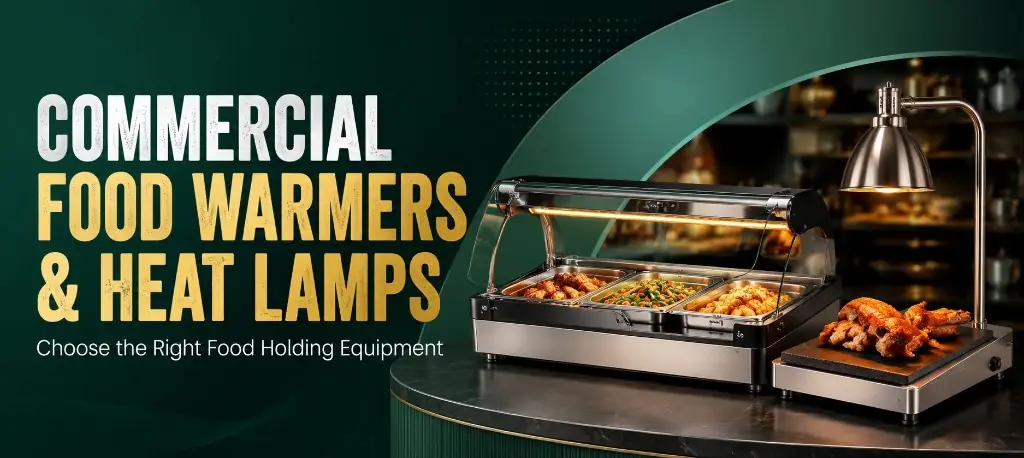
Commercial food warmers and heat lamps keep prepared dishes ready for service, but they suit different foods, holding periods, and kitchen layouts. Choosing the right equipment means matching the heating method to your menu, then checking capacity, installation requirements, and food-safety procedures. This guide explains those decisions so you can compare options at The Horeca Store with a clear purchasing brief rather than relying on appearance or wattage alone.
What is the difference between commercial food warmers and heat lamps?
Commercial food warmers typically hold prepared food in heated wells, drawers, or cabinets, while heat lamps provide overhead radiant heat at serving and pickup stations. A pan warmer supports a different workflow from a lamp over plated orders: one holds batches for portioning, while the other supports the handoff to service. Manufacturers distinguish between these equipment families because their applications are not interchangeable.
Start by identifying the job you need done. Are you keeping soup ready for ladling, staging several pans before a banquet, or holding completed plates while servers collect an order? Describe that task before comparing models.
Use these starting points to organize your shortlist:
- Pan-based service: Investigate heated wells or countertop warmers for food portioned directly from containers.
- Batch staging: Consider holding cabinets when prepared food needs organized storage before service.
- Plated pickup: Compare overhead lamps and strip heaters for an accessible service pass.
- Off-site events: Evaluate transport equipment separately from the equipment used to serve guests.
Treat these as categories to investigate, not automatic approvals for every menu item. Confirm each model's intended use in its documentation.
Match wet and dry heating to your operation
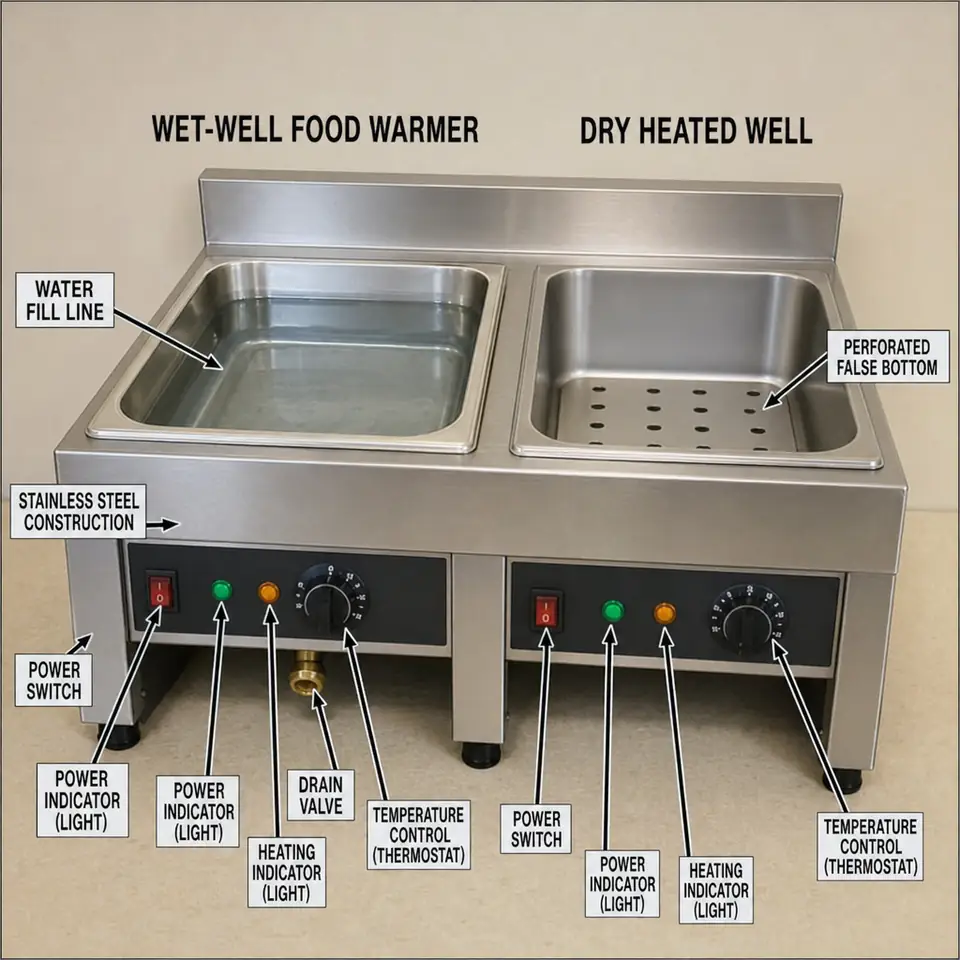
Wet-well warmers use water to transfer heat around food pans. Dry wells operate without a water bath, while some models are specifically designed for either method. These distinctions affect setup and daily maintenance; never assume a wet-only warmer can run dry simply because another unit can.
For restaurant food warmers, begin with the actual pan contents and serving routine. Ask the supplier how the proposed model handles your foods, whether lids are required, and what operating steps staff must follow. A demonstration using your normal pan arrangement is more useful than a photograph of an empty unit.
Wet wells and water management
A wet-well comparison should include filling, monitoring, draining, and cleaning - not just heating performance. Ask where staff will obtain water and how they will remove it after service. Check whether the specified installation includes a drain and whether that drain will remain accessible once the counter is fully arranged. Wet wells require water for correct operation, so these practical details belong in the buying decision.
Dry wells and model-specific instructions
Dry operation removes the water-bath task, but it does not make all dry wells equivalent. Hatco distinguishes between dry-well heating designs and emphasizes selecting equipment that heats gently rather than scorching food. Ask for guidance on compatible pans, loading, and controls before deciding that a dry unit is the simpler choice for your menu.
Choose heat lamps around coverage and mounting
Heat lamps deserve a place on the shortlist when the main task is briefly holding food at pickup or serving stations. Strip heaters are another overhead option, particularly where a line must accommodate multiple plates. Hatco's selection guidance distinguishes smaller pickup applications from higher-volume holding areas rather than treating every overhead heater as equivalent.
Map the usable holding area before choosing a fixture. Mark where plates will sit, where staff will reach, and where the heater can be mounted. Then compare that arrangement with the manufacturer's coverage and clearance requirements.
Pay particular attention to these specifications:
- Mounting height: Match the installation distance to the heater's approved configuration and emitter type.
- Coverage: Compare the full plate or pan arrangement with the recommended heated area, not merely the fixture's length.
- Single or dual configuration: Select around the volume and layout of food being held.
- Controls and lighting: Decide where switches should be accessible and whether separate illumination is needed.
Do not select commercial heating equipment by wattage alone. Ask the supplier to confirm that the complete configuration - heater, mounting arrangement, controls, and holding surface - is appropriate for your intended application. Record the approved arrangement so installation does not become an improvised decision on delivery day.
Size countertop equipment around peak service
When comparing commercial countertop food warmers, prepare a capacity plan using your busiest realistic service period. List each food, its pan format, the amount you intend to hold, and how often staff expect to replenish it. Ask vendors to match that plan to documented equipment capacity rather than choosing by exterior dimensions alone.
Separate the quantity on display from the backup quantity. Your purchasing brief should show where each will be held and who will replenish the serving station. This makes it easier to identify whether you are buying a service warmer, a staging cabinet, or both.
Before ordering, check:
- Pan fit: Confirm compatible pan dimensions, depths, covers, and any required adapters.
- Working footprint: Include access for lids, utensils, controls, and cleaning.
- Refill route: Walk through how staff will exchange pans without obstructing service.
- Menu changes: Ask how the proposed configuration would accommodate different pan combinations.
Run a simple layout exercise with your existing pans before committing. Place them on a measured surface, position serving utensils, and have a team member simulate replenishment. Bring that arrangement to the supplier for verification against the proposed model.
Remember to measure the delivery route as well. Record doorway openings, turns, counter access, and any stairs, then ask how the equipment will arrive and who is responsible for positioning it. Resolving those questions before ordering is preferable to discovering an access problem during installation.
How hot must food stay during commercial holding?
The FDA Food Code generally specifies hot holding at 135°F or above for time/temperature control for safety foods, subject to stated exceptions. The Food Code is a model used by regulatory authorities, so confirm the requirements adopted in your jurisdiction. Measure the food itself with an appropriate thermometer rather than assuming a control setting proves compliance.
Holding and reheating are different tasks. Under the FDA model provisions, food cooked and cooled on-site generally must reach 165°F for 15 seconds within two hours when reheated for hot holding. Different provisions apply to certain commercially processed foods and other specified cases.
A holding-only warmer should not be treated as a rethermalizer. Vollrath explicitly distinguishes equipment designed to keep hot food hot from equipment designed to bring prepared chilled food back to temperature. Check the model's intended function before building reheating into your workflow.
Create a written operating procedure covering preheating, loading, temperature checks, and corrective action. Have the person responsible for food safety verify it against local requirements and the equipment manual before service begins.
Plan catering and buffet service as separate stages
Catering food warmers need to be considered within the whole event journey: kitchen preparation, loading, transport, unloading, setup, and service. An insulated carrier and a serving warmer perform different roles. Cambro offers both insulated and electrically heated transport options, illustrating why transport requirements deserve their own equipment review.
Build an event worksheet before choosing equipment. Include the travel period, setup window, planned serving period, available power, and the person responsible for checking food temperatures. Ask the venue to verify its facilities rather than relying on an assumption that an outlet will be nearby.
For buffet food warmers, plan the guest-facing arrangement and the replenishment route together. Decide where spare pans, clean utensils, lids, and temperature-checking equipment will be kept. Walk through the layout from both the guest's side and the employee's side before finalizing it.
Transport procedures also matter. Cambro recommends preheated carriers for hot food and maintaining components such as seals and latches in good condition. Follow the specific carrier's instructions, and verify your proposed loading arrangement with the manufacturer instead of assuming every food or journey will perform alike.
Check installation and ownership costs before buying
Compare complete, usable configurations rather than base-unit prices. Request an itemized quotation showing the equipment, necessary accessories, installation work, and delivery arrangements. Leave no uncertainty about whether the quoted setup includes the controls, mounting hardware, pans, or covers your operation requires.
Use this purchasing checklist when comparing food warmers for commercial kitchens:
- Electrical requirements: Have a qualified professional verify the model's voltage, connection, and circuit requirements against the installation site.
- Clearances and mounting: Obtain the current installation manual and confirm the proposed location meets it.
- Included components: Identify which pans, adapters, lids, stands, or controls are supplied separately.
- Cleaning access: Ask staff to review how they would reach wells, drains, removable parts, and surrounding surfaces.
- Service arrangements: Request written warranty terms, service contacts, and replacement-part information.
- Operating requirements: Document preheating, water management where applicable, and shutdown procedures.
Model details can affect the purchase substantially. For example, Hatco specifies particular control arrangements for its strip heaters and links some portable configurations to mounting components that establish the correct height. Treat accessories as part of the technical selection, not merely optional extras.
Compare quotations line by line, then ask each supplier to resolve missing items in writing. A lower equipment price is not a complete comparison if another quotation includes components that the proposed installation requires.
Validate food quality before standardizing the setup
Once a model meets the operational and safety requirements, plan a menu trial. Define what acceptable service quality looks like for each food: sauce consistency, surface appearance, portioning ease, and texture. Use your normal recipe, pans, and serving utensils rather than an unusually small demonstration batch.
Ask the supplier or manufacturer to help establish suitable starting settings. Holding cabinets may offer humidity control, and manufacturer guidance makes clear that recommended settings can vary with the food and preparation. Do not apply one setting to every item simply because the equipment has enough space.
During the trial, record:
- The recipe, batch size, pan arrangement, and equipment settings.
- Food-temperature readings taken under your approved procedure.
- Observations at the beginning, middle, and end of the intended service period.
- Staff feedback on access, portioning, replenishment, and cleanup.
Use those notes to create a repeatable setup sheet. If results are disappointing, review the application with the supplier before changing settings or extending holding periods. The goal is a documented method your team can reproduce, not a successful one-off demonstration.
Make the final choice around the job
Choose holding equipment by defining the food, service task, capacity, and installation first. Then verify the model's instructions and test the proposed workflow. When comparing options at The Horeca Store, bring your menu, pan plan, site measurements, and power details - and request confirmation that the complete configuration fits the job.