
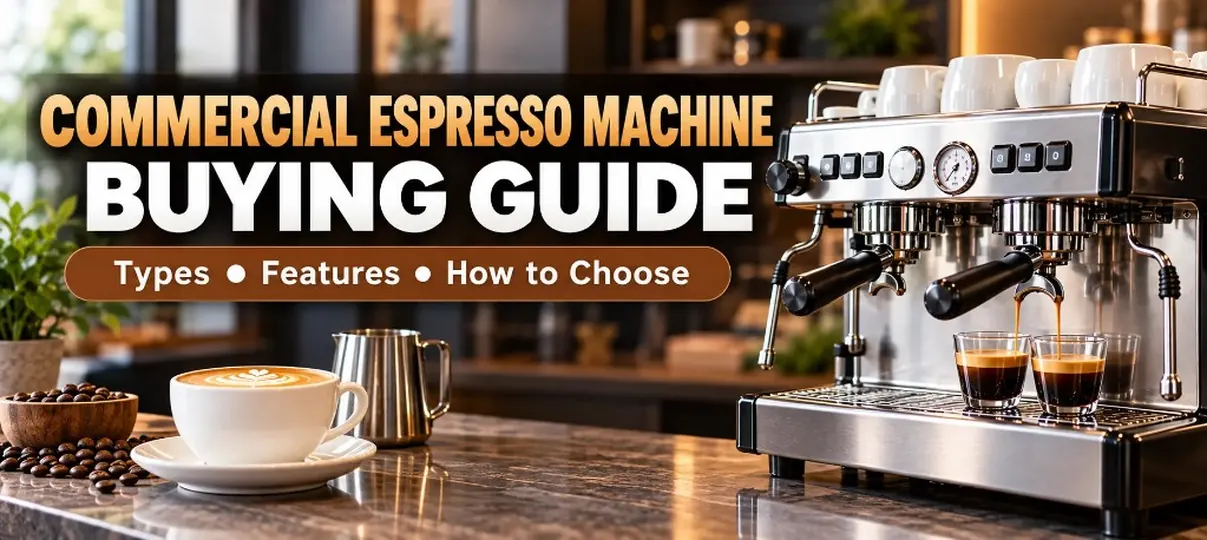
The right cafe espresso machine is the one that matches your drink volume, menu, bar layout, staff skill level, and service expectations. For most cafes, that means a 2-group volumetric or gravimetric machine with strong steam performance, stable brew temperature, reliable service access, and the right water treatment from day one.
A commercial espresso machine is professional foodservice equipment built to brew espresso repeatedly under business conditions. Unlike home machines, commercial coffee and espresso machines are designed for higher output, plumbed water, stronger boilers, multiple group heads, faster recovery, and daily espresso machine maintenance.
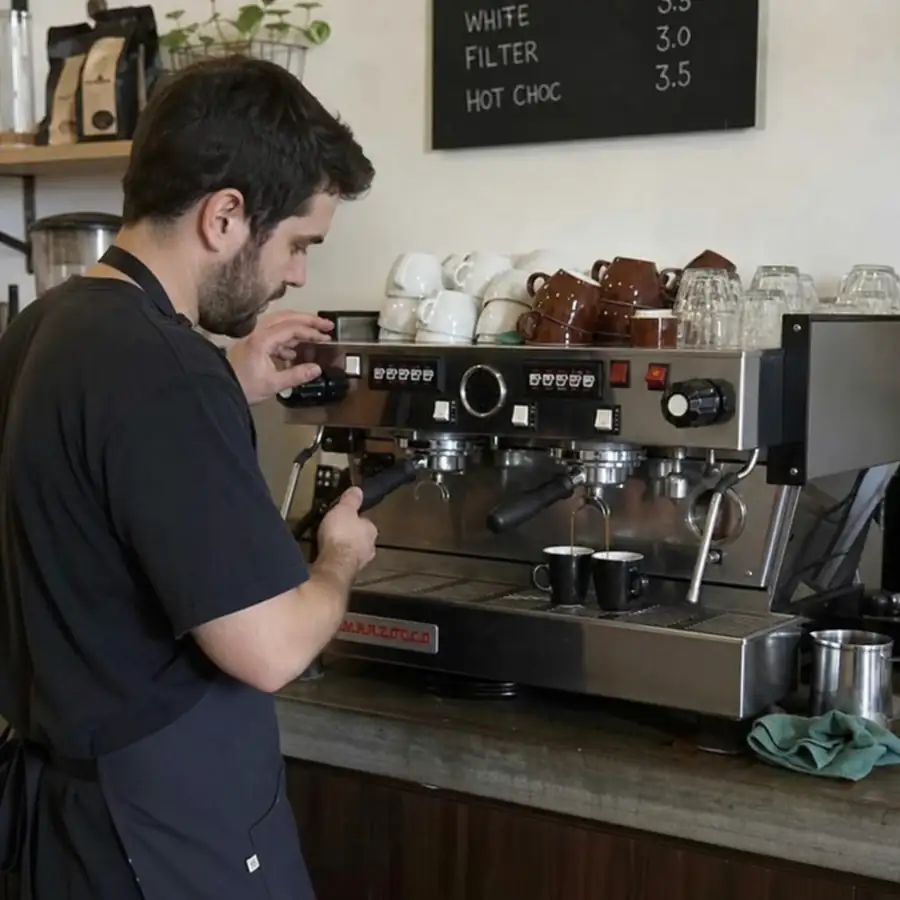
Which commercial espresso machine is right for your cafe?
The best fit depends on how many espresso-based drinks you expect to serve during peak periods, not just across the whole day. A quiet bakery may be well served by a compact 1-group or 2-group compact machine, while a busy coffee bar usually needs a full 2-group or 3-group professional espresso machine with excellent steam capacity.
If your menu is mostly milk drinks, prioritize steam power, ergonomic wand placement, and boiler recovery. If you run a specialty espresso program, temperature control, brew pressure control, group stability, and recipe repeatability matter more. This Commercial Espresso Machines for Cafes: Types, Features, and Buying Guide will help you connect those needs to practical buying decisions.
Main types and configurations
Commercial espresso machines are usually grouped by automation level, number of groups, boiler design, and installation format. Each choice affects workflow, training, consistency, and long-term cost.
Semi-automatic machines
Semi-automatic machines let the barista start and stop extraction manually. They offer hands-on control and are often appreciated by skilled teams, but they demand training and attention during rushes.
They suit specialty cafes, espresso bars, and restaurants where staff can monitor each shot. The business advantage is flexibility; the trade-off is that consistency depends more heavily on the barista.
Volumetric machines
Volumetric machines dispense a programmed amount of water through each group. This improves consistency because staff can use programmed buttons for single, double, or custom recipes.
For many cafes, volumetric control is the practical sweet spot. Nuova Simonelli's Appia Life, for example, is offered in volumetric 2- and 3-group versions, with compact and 1-group configurations available for tighter sites.
Gravimetric machines
Gravimetric machines use built-in scales or weight-based systems to stop shots by beverage weight. This can reduce variance and waste, especially when different staff members are preparing espresso at high speed.
They are useful for specialty cafes that care about repeatable recipes but still need fast service. They generally cost more, so the value is strongest where precision supports menu quality and brand consistency.
Traditional, automatic, and super-automatic options
A satellite coffee brewer is the batch machine when the bar stays on espresso.
Traditional machines require a grinder, tamping workflow, trained operators, and regular cleaning. Super-automatic machines automate grinding, dosing, brewing, and often milk preparation.
Traditional equipment is usually better for cafes that sell craft and theatre. Super-automatic equipment can suit hotels, offices, QSRs, self-service counters, and venues where speed and low training requirements matter more than a barista-led experience.
Key espresso machine features that affect business performance
The espresso grinders guide covers burr size and dose beside the machine choice.
Features are not just technical details. They shape queue speed, labour requirements, drink consistency, utility planning, and the customer's perception of quality.
Group heads and capacity
A 1-group machine is best for low-volume service, mobile setups, small bakeries, and restaurants where coffee is secondary. A 2-group machine fits most independent cafes because two baristas can work during rush periods and one group can remain available while the other is in use.
A 3-group machine supports high-volume cafes, breakfast venues, hotels, and coffee chains. More groups increase capacity, but they also require counter space, higher power, stronger workflow planning, and enough staff to use them.
Boiler system and temperature stability
Single-boiler machines are simpler and can be suitable for moderate demand, but simultaneous brewing and steaming can stress performance during peaks. Heat-exchanger designs support brewing and steaming together, while dual-boiler and multi-boiler systems separate brew and steam functions for better control.
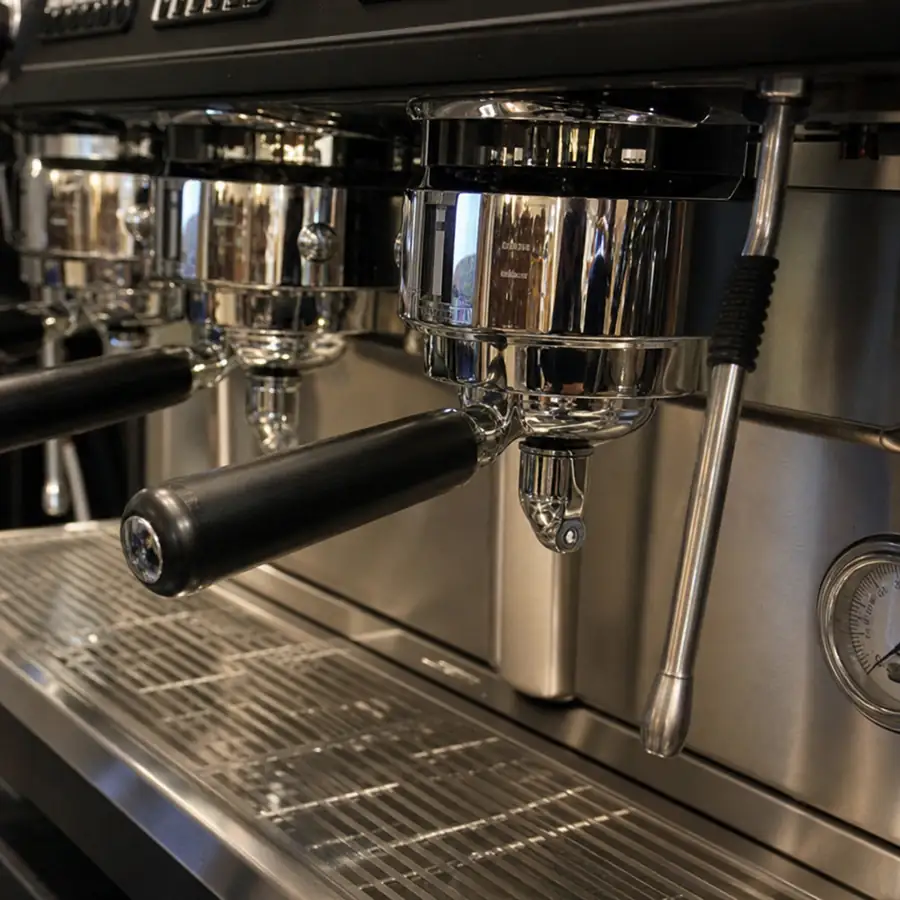
Temperature stability matters because espresso is sensitive to extraction conditions. La Marzocco's Linea PB, for example, lists saturated groups and dual PID control for coffee and steam, giving baristas direct control over brew volume, boiler temperature, hot water dose, and auto-backflush settings.
Steam power and milk workflow
Coffee servers and warmers cover the self-serve side of a mixed menu.
Steam capacity affects cappuccinos, lattes, flat whites, hot chocolate, and chai service. A machine with weak steam may be acceptable for espresso-led menus, but it can create queues in cafes where milk drinks dominate.
Look for comfortable steam levers, cool-touch wands where available, programmable milk assistance if your staff are mixed-skill, and enough boiler recovery for back-to-back pitchers. Rancilio's Classe 5 line includes configurations with programmable presets and, on some versions, iSteam automatic wand functionality for milk heating or frothing.
Size, power, and installation requirements
Before comparing espresso machine reviews, measure the counter, service side, cup clearance, grinder placement, knock box location, water line, drain access, and electrical supply. A machine that fits physically can still fail operationally if baristas cannot move quickly around it.
Power requirements vary by group count and boiler design. Higher-output machines may need dedicated electrical service, proper drainage, water filtration, and professional installation, so involve a technician or supplier before committing.
Technology and controls
Modern commercial coffee equipment may include shot timers, touchscreen controls, programmable recipes, automatic cleaning cycles, energy-saving modes, telemetry, pressure profiling, and app connectivity. These tools can reduce training time and improve consistency.
They also add complexity. Choose technology that supports your workflow rather than buying features your team will ignore. Victoria Arduino's Eagle One, for example, is positioned around compact design, efficiency, Neo Technology, TERS, EasyCream, and VIS, making it relevant to design-conscious cafes and modern high-performance bars.
Matching business needs to machine type
A coffee truck still has to size groups for the rush.
Different hospitality businesses need different equipment. A high-end machine can be wrong if it does not match the service model.
Restaurants, cafes, hotels, bakeries, bars, QSRs, food trucks, and catering operators should also consider who will use the machine. If trained baristas are always present, more manual control may be valuable. If staff rotate often, automation and guided cleaning can protect consistency.
Brand and model examples to understand the market
The best commercial espresso machines are not identical. Espresso machine brands tend to emphasize different strengths, from durability and workflow to precision, design, or automation.
La Marzocco Linea PB is commonly considered a serious cafe workhorse category machine because of its saturated groups, dual PID control, and barista-facing programming options. It fits cafes that want traditional bar workflow with strong temperature control and a recognized premium presence.
Nuova Simonelli Appia Life is positioned for coffee shop chains, large companies, and places needing abundant coffee output, with 1-group, compact 2-group, 2-group, and 3-group configurations. That makes it a practical choice for operators seeking commercial durability without unnecessary complexity.
Rancilio Classe 5 is a traditional single-boiler range available in multiple group configurations, including compact and tank options on some versions. Its appeal is straightforward operation for bars, coffee shops, and restaurants that need approachable performance.
La Cimbali M200 sits in the premium traditional category, with GT1 technology allowing boiler temperature control for recipe flexibility across drinks. It fits cafes that want advanced performance, strong visual impact, and a refined barista-customer experience.
Sanremo Cafe Racer and Synesso-style multi-boiler machines appeal to specialty operators who value thermal precision, distinctive design, and deeper extraction control. Sanremo describes the Cafe Racer as a multi-boiler machine for medium- to high-volume venues, while Synesso highlights independent steam and brew boilers plus individual group heads for demanding volume.
Installation, cleaning, maintenance, and ownership cost
A coffee urn covers batch drip when espresso is only part of the menu.
A commercial espresso machine is not a one-time purchase. Total cost of ownership includes machine price, grinders, installation, water treatment, service calls, gaskets, screens, portafilter baskets, cleaning chemicals, downtime risk, staff training, and eventual replacement parts.
Water treatment is one of the most important post-purchase decisions. Pentair Everpure notes that filtration systems serve coffee and espresso applications and can help minimize service calls by addressing scale buildup and related water issues.
Good espresso machine maintenance usually includes daily backflushing where appropriate, wiping steam wands after every use, purging wands before and after steaming, soaking baskets and portafilters, cleaning drip trays, checking grinder burr condition, and following the manufacturer's service schedule. Preventive care protects flavour, reduces downtime, and extends component life.
When buying, ask about local technician availability, spare parts, warranty terms, installation requirements, and response times. A machine with strong support from a supplier such as The Horeca Store may be a safer business choice than a feature-rich model with poor local service.
A practical buying checklist
The new cafe owner guide lists the buying mistakes that show up after install.
Use this checklist before requesting quotes or reading top rated commercial espresso machines lists:
- Estimate peak-hour espresso drinks, not just daily sales.
- Choose group count based on rush capacity and staffing.
- Match automation level to staff skill and training time.
- Confirm counter space, water, drainage, and electrical supply.
- Decide whether you need single-boiler, dual-boiler, or multi-boiler performance.
- Prioritize steam capacity if milk drinks dominate the menu.
- Check parts availability, technician coverage, and warranty support.
- Budget for grinders, filtration, cleaning supplies, installation, and service.
- Test the machine workflow if possible before purchase.
- Avoid choosing only by brand name, appearance, or online espresso machine reviews.
Frequently asked questions
1. How many groups does a cafe espresso machine need? Most cafes should start by considering a 2-group machine because it balances capacity, footprint, and workflow. Choose 1-group for very low volume or mobile use, and 3-group for sustained high-volume service.
2. Are volumetric machines better than semi-automatic machines? Volumetric machines are better for consistency and faster training. Semi-automatic machines are better when experienced baristas want more direct control over extraction.
3. What features matter most for milk-based drinks? Steam power, boiler recovery, wand ergonomics, pitcher workflow, and bar layout matter most. If lattes and cappuccinos drive revenue, do not undersize the boiler or group count.
4. How important is water filtration? Water filtration is critical because water affects taste, scale, maintenance frequency, and service costs. Always test your site water and follow the machine supplier's filtration recommendation.
5. Should I buy based on espresso machine brands or reviews? Use brands and reviews as starting points, not final proof. The right choice depends on your menu, service volume, available technicians, installation conditions, and long-term support.
Buying decision guidance
If your requirement is a small counter, limited menu, or occasional coffee service -> consider a compact 1-group or compact 2-group volumetric machine.
If your requirement is a standard independent cafe with morning rushes -> consider a full 2-group volumetric machine with strong steam, shot timers, and reliable local service.
If your requirement is specialty coffee precision -> consider dual-boiler, multi-boiler, or gravimetric professional espresso machines with PID control and recipe repeatability.
If your requirement is hotel, office, QSR, or low-training operation -> consider an automatic or super-automatic system with guided cleaning and consistent programmed drinks.
If your requirement is high-volume milk service -> consider a 2- or 3-group machine with powerful steam, fast boiler recovery, and ergonomic wand placement.
If your requirement is lowest lifetime risk -> consider the machine with the best local parts, technician support, warranty clarity, and water treatment plan, even if another model looks better on paper.