
Commercial espresso machines should be chosen around peak demand, drink mix, available utilities, and service support - not appearance alone. This buyer's guide explains how to compare capacity, automation, installation requirements, and ownership costs before committing. Whether you are building a shortlist with The Horeca Store or evaluating another supplier, use these checks to keep the purchase focused on your café's needs.
What should you look for in a commercial espresso machine?
Look for a machine that suits your busiest service period, supports your menu, fits your electrical and plumbing connections, and can be maintained locally. Group count and automation matter, but they belong alongside water treatment, counter layout, and access to qualified technicians. La Marzocco identifies these operational considerations as central to equipment selection.
Before comparing models, write a brief equipment specification. Record your expected busiest ordering window, the drinks you will prepare, and how many people will work behind the bar. For an existing café, use actual order records; for a new location, label forecasts as assumptions rather than treating them as guaranteed demand.
Separate requirements into three categories: essential, useful, and optional. That distinction gives you a sensible way to evaluate upgrades without letting an attractive feature list redefine your budget.
Size capacity around the rush, not the daily total
A daily sales estimate is a starting point, not a complete capacity specification. Manufacturers also consider concentrated demand, ticket times, group count, and automation when matching equipment to a business. Use those factors to frame your demonstration rather than accepting a headline output figure without context.
Build a realistic test order using your planned cup sizes and recipes. Include milk drinks, straight espresso, and any drinks requiring multiple extractions. Ask the demonstrator to prepare that sequence continuously, rather than serving isolated drinks with recovery time between them.
Use group count as a shortlist filter:
- One group: Investigate whether a compact setup can handle your actual rush without an unacceptable queue.
- Two groups: Test your intended division of labor, including whether two baristas have enough working space.
- Three or more groups: Establish what the additional brewing positions would solve before paying for them.
During the test, note where unfinished orders accumulate. If the delay occurs at grinding, milk preparation, or handoff, ask what changes besides a larger machine might help. Buy against an observed bottleneck, not an assumption that bigger automatically means faster.
Choose automation that matches your service model
Professional espresso machines offer different levels of operator involvement. Traditional machines may have semiautomatic or volumetric controls, while fully automatic systems can integrate more beverage preparation and cleaning functions. Check the exact configuration: labels alone do not describe every task the operator must perform.
| Machine type | What to establish during a demonstration |
|---|---|
| Semiautomatic | How staff start and stop extraction, monitor drinks, and coordinate other tasks |
| Volumetric | How programmed doses are set, checked, and adjusted for your recipes |
| Fully automatic | Which preparation steps are automated and which replenishment, cleaning, and milk-handling tasks remain |
For a barista-led café, ask staff to repeat the same drink using the proposed controls. For a counter staffed by people with mixed experience, include a less experienced operator in the demonstration. Judge the complete routine, including corrections and cleanup, rather than the convenience of pressing a beverage button.
Request training details in writing. Ask who receives training, whether recipe setup is included, and how future employees will learn the system. Treat training as part of implementation, not an informal promise attached to delivery.
Compare brewing and steaming performance together
Separate brew and steam boilers allow those functions to have dedicated systems; for example, La Marzocco describes this arrangement in its Linea Classic S. Electronic temperature control is another available feature. These are useful specifications to understand, but they should support - not replace - a demonstration using your menu.
Ask the supplier to explain the proposed machine's boiler arrangement in plain language. Establish how brewing temperature is controlled, what adjustments operators can make, and which settings should be reserved for trained personnel. Avoid paying for adjustment options without deciding who will use them and why.
For a milk-heavy menu, request repeated steaming while espresso is being prepared. For a café emphasizing different coffees, ask how the machine accommodates your intended recipes. Record the results against the same criteria for every shortlisted model.
Keep the comparison practical: drink quality, repeatability, staff comfort, and completed orders. A technically impressive specification is valuable only when it addresses a requirement you have identified.
Confirm the installation before placing an order
Electrical supply can limit the size and model of machine suitable for a location. Water analysis, filtration needs, and bar layout also belong in the purchasing discussion, not just the installation appointment. Confirm these details before making a nonrefundable commitment.
Give your installer the exact model's technical documents and a measured plan of the proposed counter. Ask them to verify the following against the manufacturer's requirements:
- Voltage, phase, amperage, and connection method.
- Water supply, pressure requirements, and treatment arrangement.
- Drainage route and any required supporting work.
- Counter dimensions, load capacity, access holes, and service clearance.
- Delivery access, including doorways and the route to the counter.
Treat water treatment as part of the purchase
Water chemistry can influence whether equipment develops scale or corrosion; hardness alone does not describe the whole picture. La Marzocco's water assessment considers factors including pH, hardness, alkalinity, and temperature. Match treatment to tested water and the selected manufacturer's specifications rather than choosing a generic filter by name.
Request a written treatment recommendation, replacement plan, and explanation of any warranty conditions. Keep the test results with your equipment records. Before installation is signed off, ask who will verify that the treated supply meets the required specification.
Budget for the whole coffee station
Treat the espresso machine as one line in your commercial coffee equipment budget. Build a separate allowance for the grinder, water treatment, refrigeration, scales, pitchers, tamping tools, cleaning supplies, and installation. Ask suppliers to identify what is included so you can compare equivalent packages.
For each traditional machine demonstration, use the grinder you intend to purchase where practical. Ask staff to show adjustment, routine cleaning, and a change between coffees. If decaf is on the menu, specify how it will be prepared rather than leaving that workflow unresolved.
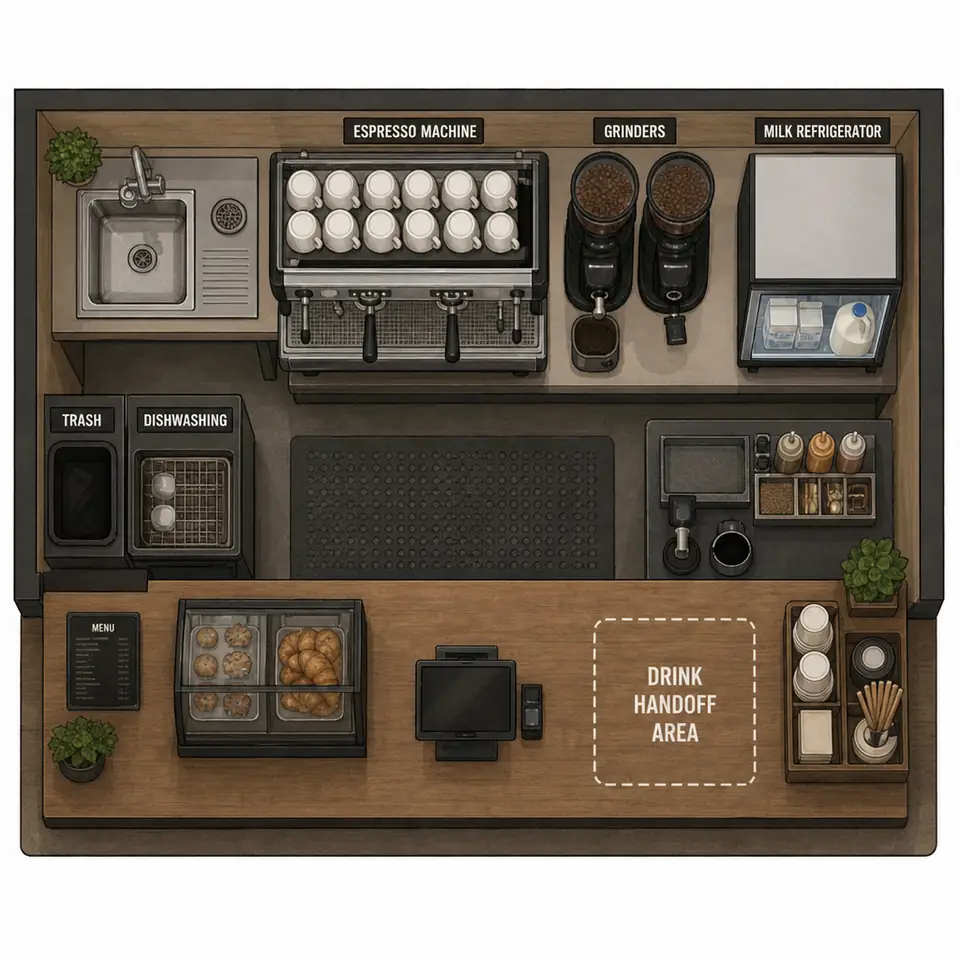
Sketch the movement from grinding and preparation through brewing, milk handling, and handoff. Then have your intended operators walk through it. Check reach, workspace, storage, and access for cleaning before finalizing the counter design.
This exercise should produce a complete opening-day equipment list - not simply a machine order followed by a series of overlooked purchases.
What does a commercial espresso machine really cost to own?
Your ownership budget should include the purchase, site preparation, installation, training, consumables, scheduled service, and a contingency for repairs or interrupted service. Ask for itemized figures rather than relying on the advertised machine price. Use the same ownership period and assumptions when comparing proposals.
A useful planning formula is:
Ownership budget = equipment + setup + operating supplies + planned service + repair contingency.
Request separate explanations of parts coverage, labor, travel charges, exclusions, and claim procedures. Do not assume a warranty covers every expense associated with a fault. For example, Simonelli's published dealer warranty includes specific water-treatment conditions, illustrating why the applicable written terms deserve attention.
For used equipment, make an independent technician's inspection a purchase condition. Request the serial number, service records, water-treatment history, and a written account of refurbishment work. Ask the inspector for an estimate of immediate work before comparing the used price with a new-machine proposal.
Make espresso machine maintenance an operating routine
Espresso machine maintenance includes cleaning coffee-contact components and caring for the steam system. Manufacturer guidance distinguishes routine cleaning from backflushing, which addresses residue within compatible brewing systems. Use the instructions for your exact model and approved cleaning products rather than copying a schedule intended for another machine.
Turn the manual into an assigned checklist:
- During service: Follow the specified steam-wand wiping and purging procedure, and keep baskets and working surfaces clean.
- At closing: Complete the prescribed group, portafilter, basket, tray, and backflushing tasks where applicable.
- At scheduled intervals: Arrange the manufacturer's preventive service and water-treatment checks, recording completion dates.
- When something changes: Log leaks, unusual noises, control errors, or performance changes and contact the service provider as appropriate.
La Marzocco's cleaning guidance specifically calls for wiping and purging the steam wand after use and cleaning accumulated coffee residue from baskets and portafilters. These habits should be taught alongside drink preparation, not left for staff to discover later.
Assign responsibility by shift and have a manager review the log. Ask your technician which tasks staff may perform and which require professional attention. Keep repair instructions and service contacts accessible without encouraging untrained internal repairs.
Read espresso machine reviews for operational evidence
Use espresso machine reviews to develop questions, then verify the answers through documentation and demonstrations. When reading a review, look for the operating context: drink mix, service intensity, machine configuration, operator experience, and length of testing. A conclusion without that context is difficult to apply to your café.
For each shortlisted model, investigate:
- Comparable use: Does the reviewer describe a service pattern resembling yours?
- Repeated performance: Were drinks prepared continuously or only individually?
- Daily usability: Are cleaning, programming, access, and staff comfort discussed?
- Service experience: Are repair details documented rather than reduced to a reliability score?
- Evidence quality: Does the review distinguish observation from manufacturer claims?
Look for specific, checkable concerns rather than treating every complaint as representative. Ask the supplier to address recurring issues and confirm the exact version being quoted. Manufacturer document libraries can help you check manuals, installation information, and maintenance resources independently.
The best commercial espresso machines for your shortlist should satisfy your operating requirements. Treat an award, ranking, or enthusiastic review as a reason to investigate - not a substitute for checking fit.
Complete a final buying checklist
Before authorizing payment, assemble one decision file for each finalist. Include the quotation, specification sheet, installation approval, demonstration notes, warranty, training scope, and service contact. Record any unresolved point as a question requiring a written answer.
Your final signoff should confirm:
- The demonstrated workflow matches your intended menu and staffing.
- The installer has reviewed the exact model and site.
- All essential accessories and setup costs appear in the budget.
- Maintenance responsibilities and service arrangements are clear.
- Delivery, commissioning, and training responsibilities are documented.
Avoid resolving a close decision through appearance alone. Return to your essential requirements and identify which proposal answers them most convincingly.
Buy for the café you intend to run
Choose capacity you can justify, controls your team can use, and a maintenance plan you can follow. Bring your menu, demand assumptions, site measurements, and installation requirements to The Horeca Store when requesting a tailored quotation. The goal is a complete, workable coffee station - not simply an impressive machine on the counter.