

Electricity is a live line item for a fryer purchase, not a footnote. The U.S. commercial average reached 14.53¢/kWh in July 2026, while Texas commercial customers paid 8.47¢ (, released 24 September 2026). At the same time, electric floor fryers are now sold against published nameplate data: voltage, phase, full-load amps and oil capacity appear on the cut sheet before you order. The Horeca Store groups electric fryers by vat size and the service your panel can carry.
That makes an electric fryer a capacity decision and an electrical-service decision at once. Most buying guides cover only the first. The defines production capacity and recovery time, but the sheet in front of you may print neither, and the shows why the second half matters: the same 14 kW fryer draws 67.3 A single-phase and 38.9 A three-phase at 208 V.

This commercial electric fryer buying guide answers six questions: how to size by your busiest hour, which form factor and vat layout fit your menu, what service the fryer needs, what ventilation and clearance apply, what ownership costs, and which certifications an inspector will look for. It is a research-based comparison of published specifications and standards, not a hands-on test of any model.
What a commercial electric fryer buying guide should settle before you shop
Settle two things before you compare models: the throughput you must produce in your busiest hour, and the electrical service your building can deliver. Everything else, including oil capacity, follows from those two.
Oil capacity is a poor first number because it measures the vat, not the output. The evaluates open deep-fat fryers on energy input rate, preheat, idle energy rate, cooking efficiency, and production capacity with frying-medium temperature recovery time, and it applies to counter and floor models with nominal capacity under 60 lb. Larger vats fall under ASTM F2144. Those are the numbers that describe whether a fryer keeps up.
Manufacturer sheets rarely give you the recovery figure. Pitco's Solstice sheet, and publish kW, amps and oil capacity; Vulcan and Henny Penny describe recovery only as "fast recovery" or "recover temperature very quickly." Ask for the number in writing.
Efficiency labels are model-specific, not line-wide. covers open deep-fat gas and electric fryers, countertop and floor, with vats 12 to 24 in wide; closed-vat fryers and vats outside that range are ineligible. Pitco flags only some Solstice SE models as qualified, and Imperial's sheet makes no ENERGY STAR claim at all.
How big does my electric fryer need to be for my busiest hour?
A fry dump station keeps the finished batch out of the oil.
With those two constraints set, sizing starts with the pounds you sell between noon and one, then converts that to a rated output. One manufacturer publishes a figure you can use as a starting point: Frymaster's published rating for the RE14, a 50 lb, 14 kW floor fryer, is about 68 lb of fries per hour. That is one brand's rating, not a class benchmark, and no comparable lb/hr figure is published for the Pitco, Vulcan, Imperial or Henny Penny units in this comparison.
Oil capacity does not predict that output. A 65 lb vat can run on 14.4 kW: lists 65 lb per full vat at 14.4 kW and 39.4 A at 208 V three-phase. Match the rating to your peak batch count, then check the amps.
Sizing turns into an electrical question because output scales with kW, and kW sets the current. The nameplate amps of real 40 to 50 lb electric fryers at 208 V, single-phase against three-phase, show the spread:
- Imperial IFS-40-E, 14 kW: 38.91 A three-phase
- Pitco SE14X, 14 kW: 67.3 A single-phase, 38.9 A three-phase
- Vulcan ER50F, 17 kW: 47 A three-phase
- Pitco SE14, 17 kW: 82 A single-phase, 45 A three-phase
- , 12 kW: 58 A single-phase only
Demand two things from any supplier before you commit: the lb/hr rating and the recovery time, each with the test conditions stated.
Countertop or floor model, single vat or split vat - which fits my menu?
A fryer basket still has to match the vat you size.
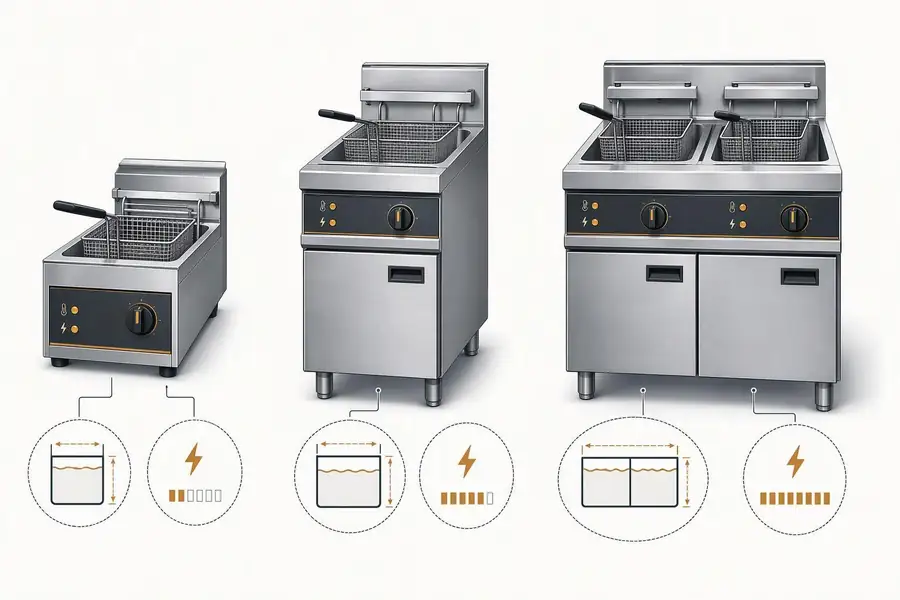
Once the size is set, choose the form factor by the batch you must hold through service, and the vat layout by whether your menu needs separate oil. A split vat lets you keep fish oil apart from fry oil, at the cost of a smaller side: Henny Penny's OFE-321 carries 65 lb in a full vat and 25 lb per side when split .
Floor models in the 40 to 50 lb class draw 12 to 22 kW, and that number drives the rest of the decision. Imperial's 40 lb unit runs 14 kW ; Vulcan's 50 lb unit runs 17 kW ; Pitco's SE14 line offers 14, 17 and 22 kW in the same 40 to 50 lb body . The 22 kW version draws 106 A single-phase at 208 V.
Connection type splits along the same lines. Pitco offers an optional 6 ft cord with a NEMA 15-60-P plug on 14 and 17 kW three-phase 208 or 240 V models only; higher-output and many single-phase units are hardwired to a terminal block. The Frymaster RE14C-SD listing states plainly that it hardwires and does not plug into a standard wall outlet (Frymaster's published rating for the RE14).
Two boundaries matter here. ASTM F1361 covers units under 60 lb of frying medium, so a 60 lb model sits at or above that line and falls under ASTM F2144 instead . And ENERGY STAR's standard-fryer definition requires a vat over 12 and under 18 in wide with shortening capacity over 25 and under 65 lb, which puts an exactly 18 in vat in a boundary the specification and the product page describe differently .
What electrical service does a commercial electric fryer actually need, and can my building support it?
A commercial gas fryer is the other path when the panel cannot carry the load.
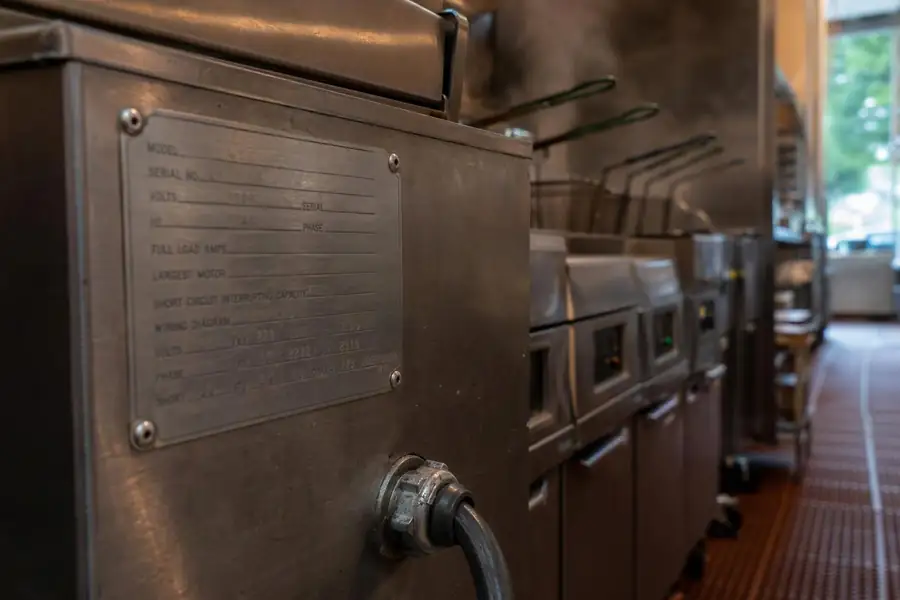
The required service comes from the fryer's listing and nameplate, never from a "typical fryer" number. Read voltage (commonly 208 or 240 V), phase, full-load amps, minimum circuit ampacity and maximum overcurrent protection off the sheet, then hand those to a licensed electrician.
Phase is the biggest lever. At the same 14 kW and 208 V, Pitco's table shows 67.3 A single-phase against 38.9 A three-phase, because three-phase splits the load across three lines . A single-phase 22 kW unit needs 106 A at 208 V. Whether your panel has that capacity, and whether the service entrance can carry it alongside your hood fans and rooftop units, is an electrician's call, not a spec-sheet one.
Receptacle protection is the second item to confirm. requires GFCI protection for receptacles in non-dwelling kitchens supplied by single-phase branch circuits at 150 V to ground or less and 50 A or less, and three-phase circuits at 100 A or less. The rule turns on the branch-circuit rating, not the receptacle, and nearly all commercial kitchen receptacles fall in scope. Confirm which NEC edition your jurisdiction has adopted before you rely on it.
Hand this five-item list to a licensed electrician before you order:
- The model's nameplate voltage, phase and full-load amps
- Minimum circuit ampacity and maximum overcurrent protection
- Whether the unit is cord-and-plug or hardwired
- Available capacity at your panel and service entrance
- The NEC edition your jurisdiction enforces, and the GFCI requirement that follows
What ventilation and clearance does it require - is 'ventless' real?
Clearance comes from the equipment sheet, and it varies by model. Imperial's IFS-40-E allows 0 in to non-combustible surfaces and 6 in to combustible ones . Vulcan's ER50F requires 6 in at both sides and the rear to combustible construction and 16 in minimum to adjacent open-top burner units . Neither number is a rule of thumb you can apply across brands.
Hood and flame separation come from NFPA 96. , as summarized by a hood manufacturer, call for at least 16 in between a deep-fat fryer and surface flames from adjacent appliances, at least 18 in clearance from hoods, grease removal devices, fans and ducts to combustible material, and replacement air that keeps the cooking area above −0.02 in w.c. That summary is an industry document, not the standard text, and the edition year is not stated on it.
On "ventless": none of the sources reviewed here establishes that an electric fryer can be installed without a hood in your jurisdiction. Hood requirements are set by the mechanical and fire codes your authority having jurisdiction enforces, and the Texas Food Establishment Rules excerpt reviewed contains nothing on fryer ventilation. Treat a ventless claim as something to confirm in writing with your AHJ before you delete a hood from the plan.
What will it cost to own - purchase, electricity, oil, filtration, repairs?
Fryer accessories cover the filter and drain parts the nameplate leaves out.
Electricity is the only ownership cost with a defensible published number, and it is easy to compute from nameplate kW and your own rate. A 14 kW fryer at full element draw costs about $2.03 per running hour at the U.S. commercial average of 14.53¢/kWh, $1.46 at the Houston small-business all-in rate of 10.40¢/kWh at 5,000 kWh per month, and $1.19 at the Texas commercial average of 8.47¢ (; ).
Multiply by your real duty cycle, not by the hours you are open. At the Houston all-in rate, 4 running hours a day over 26 days is 1,456 kWh, about $151 a month; 6 hours is 2,184 kWh, about $227; 8 hours is 2,912 kWh, about $303. Houston adds a complication the other sources do not mention: above 10 kVA of peak demand, CenterPoint bills per kVA of demand, and a restaurant that fires ovens, fryers, hood fans and rooftop AC within the same ten minutes can set a peak 40% above real operating demand .
Efficiency thresholds are where the ENERGY STAR label earns its keep, and the controlling document is the specification, not the product page. sets heavy-load cooking energy efficiency above 83% and idle energy rate below 800 W for standard electric fryers, and above 80% and below 1,100 W for large-vat electric. The product page states 80% for standard electric, which matches the large-vat table; the specification, revised December 2020, governs. The same page puts certified standard-vat electric fryers about 17% more efficient than standard models .
matches , while the American Society of Appraisers puts commercial cooking appliances at 8 to 10 years. FEMP prices its federal example at $0.099/kWh, below both the U.S. average and Houston's all-in rate, so its lifetime savings understate what a Houston operator would see. FEMP also notes that efficient models may not be cost-effective in low-use applications or where energy rates are very low.
What certifications and safety features must it have to pass inspection?
Texas does not mandate NSF certification, and an inspector who tells you it does is misstating the rule. makes ANSI-accredited sanitation certification a deeming provision: equipment certified or classified for sanitation by an ANSI-accredited program is deemed to comply with the equipment construction rules in §§228.101-228.106. NSF is not named, and certification is not statutorily required.
What you should confirm on the sheet is the listing. Vulcan's ER50F is NSF listed and CSA design certified ; Avantco's EF40 is ETL Listed and ENERGY STAR qualified . The edition years of NSF/ANSI 4 and UL 197 are not stated in any source reviewed here, so ask the supplier which edition the listing was issued under.
Built-in safety features to look for on the cut sheet: a high-temperature limit switch, a drain valve interlock that cuts power to the elements when the drain opens, and a melt cycle. Pitco's Solstice lists all three as standard ; Vulcan's ER50F lists a drain valve interlock switch and high limit control .
Plan review is a separate gate. call for equipment specifications and elevations for new construction or remodeling that adds or removes floor-mounted equipment, submitted to the Houston Permitting Center. A floor fryer swap can trigger that review; a countertop unit may not.
When is electric the wrong call, and when should I buy used or rent?
A used commercial gas fryer is the fallback when the building cannot feed the amps.
Electric is the wrong call when your panel cannot carry the load or your building cannot support the hood, and those are the two disqualifiers to check first. A 22 kW single-phase unit needs 106 A at 208 V ; if your service entrance has no room for that alongside existing equipment, the fryer is not the problem to solve. If your AHJ will not approve the ventilation arrangement, the same applies.
Electric is also a poor fit when your energy rate is very low or your volume is low. supports paying a premium for efficiency in high-use applications, and FEMP states plainly that ENERGY STAR and FEMP-designated products may not be life cycle cost-effective in low-use applications or where energy rates are very low. A seasonal operation running a fryer two hours a day is not the buyer the efficiency premium was designed for.
On used and rental: no source reviewed here publishes used-fryer pricing, rental rates, or failure rates by age, so this guide cannot put numbers on either. What the sources do support is a checklist for a used unit. Confirm the nameplate amps match your available service, confirm the listing mark is intact, and confirm the high-limit switch and drain interlock function. and the American Society of Appraisers' 8 to 10 years for commercial cooking appliances give you a rough age at which a used unit's remaining life gets short.
Frequently Asked Questions
Is a 40 lb electric fryer enough for a small restaurant?
The restaurant fryer guide walks the menu side of the same choice.
Often yes, but only if you size it against your busiest hour rather than your seating count. Frymaster rates its 50 lb, 14 kW RE14 at roughly 68 lb of fries per hour (Frymaster's published rating for the RE14), so a 40 lb unit lands somewhere below that. Count the pounds of fries, wings and breaded items you sell in your peak 60 minutes, add a margin for recovery, and compare that to the rating. If your peak hour stays under the published figure with room to spare, 40 lb works.
Can a commercial electric fryer run on a standard wall outlet?
No. Pitco offers an optional 6 ft cord with a NEMA 15-60-P plug, and only on its 14 and 17 kW three-phase 208 or 240 V models . A 60 A plug is not a standard wall outlet. Most single-phase units, including the Frymaster RE14C-SD, hardwire to a terminal block instead, so plan on a dedicated circuit either way.
Do all kitchen outlets need GFCI protection?
No, the requirement follows the branch circuit, not the room. covers receptacles in non-dwelling kitchens on single-phase circuits at 150 V to ground or less and 50 A or less, and on three-phase circuits at 100 A or less. A hardwired fryer on a larger dedicated circuit falls outside that scope, while the general-purpose receptacles around it usually do not.
Does ENERGY STAR certification guarantee lower electricity bills?
No. It certifies that the unit clears the program's thresholds, not that your bill falls. The ENERGY STAR Version 3.0 fryer specification sets the bar at 83% cooking efficiency and no more than 800 W idle, so a certified model is the more efficient one on paper. Whether the price premium pays back depends on your utility rate, your hours and your volume. Run the annual kWh difference against your own rate before you assume it does.
Is a split vat worth the extra cost?
A pressure fryer changes the batch math when the menu is breaded chicken.
It usually is when your menu mixes low-volume items with high-volume ones. Henny Penny's OFE-321 data sheet lists a 65 lb full vat and a 25 lb split section (Henny Penny's OFE-321 data sheet), which lets you run one side through a slow lunch and the other through a dinner rush. You spend less oil, less energy and less downtime filtering a vat you did not need to fill. If you sell one product at steady volume all day, a single vat is simpler and cheaper to own.
Conclusion
The used fryer buying guide covers the inspection before you pay for a secondhand vat.
The decision comes down to two numbers you can verify before you order: the pounds your busiest hour demands, and the amps your service can deliver. Everything else, from vat layout to the efficiency label, is a refinement of those two. A 14 kW fryer draws 67.3 A single-phase and 38.9 A three-phase at 208 V, and that gap decides whether a model is installable in your building at all .
The cost side is equally concrete. At the Houston all-in rate of 10.40¢/kWh, a 14 kW fryer running 6 hours a day over 26 days costs about $227 a month in electricity . Purchase price, oil cost and repair history are yours to supply; no source reviewed here publishes them.
Have a licensed electrician confirm your service and the NEC edition your jurisdiction enforces, and request recovery-time and lb/hr data in writing from every supplier before you order. That is the step that separates a fryer that fits your kitchen from one that sits in a crate while you price a panel upgrade.