
Choosing commercial drink dispensers for buffets, cafes, and catering starts with matching the equipment to your menu, busiest service period, and refill routine. This article explains how to compare dispenser styles, estimate capacity, organize drink stations, and plan cleaning before you buy. If you are preparing to discuss options with The Horeca Store, use these considerations to build a brief around your operation rather than appearance alone.
Which commercial drink dispenser fits your service?
The right dispenser is one that suits the beverage, maintains the required serving conditions, and fits how your team works. Start by deciding whether you need a vessel for prepared drinks, an insulated transport server, or powered equipment that mixes and dispenses beverages. Manufacturers offer different systems for these jobs; they should not be treated as interchangeable.
Write down what you intend to serve before comparing finishes or tank sizes. Ask the supplier to confirm compatibility with the complete recipe, including pulp, dairy ingredients, powders, or garnishes. Avoid assuming that equipment suitable for one cold drink can handle every item on your menu.
A useful starting brief includes:
- Beverage and preparation: Identify whether staff will brew, premix, dilute concentrate, or fill from another container.
- Service pattern: Describe self-service, staff-operated pouring, or a combination of both.
- Location: Record whether the dispenser stays on a counter or travels between venues.
- Refill responsibility: Name the role responsible for checking levels and replenishing stock.
- Cleaning arrangements: Identify where components will be washed and who will complete the process.
These details give your equipment conversation a practical focus. A dispenser should fit the work you need done, not require you to redesign an otherwise workable service routine.
Understand the main dispenser styles
Batch servers for prepared beverages
With a batch server, staff prepare the beverage separately and transfer or brew it into a dispensing vessel. BUNN's tea-service instructions, for example, describe brewing into a server and cleaning the reservoir and faucet separately. This format separates beverage preparation from the point where guests or staff pour drinks.
When comparing batch beverage dispensers, ask to see the filling opening, lid, faucet assembly, and cleaning procedure. Check whether your team can comfortably handle the vessel during filling and washing. If the concept relies on swapping containers during service, include that changeover in the demonstration.
Insulated dispensers for mobile service
Insulated beverage servers are designed to retain the temperature of prepared hot or cold drinks during transport and service. Non-electric versions are available, making this a relevant category for catering locations without convenient power. Actual holding performance depends on the selected product and operating conditions, so verify the manufacturer's instructions rather than assuming unlimited holding time.
Assess the whole journey: filling, carrying, vehicle loading, unloading, placement, and return washing. Ask about filled weight and suitable handling arrangements. A vessel that looks convenient on a display table may be less convenient on your delivery route.
Powered beverage systems
Some powered drink machines combine concentrate with water during dispensing. BUNN's JDF range illustrates this approach, with model-dependent options such as push-and-hold operation and portion-control buttons. Those features differ from simply storing a finished beverage in a container.
Before choosing powered beverage systems, request the installation requirements and operating manual. Confirm ingredient compatibility, water connections where required, electrical needs, and cleaning access. Ask the supplier to explain performance under your expected serving conditions rather than relying on a headline capacity figure.
How much capacity do you actually need?
Plan capacity around the amount you expect to serve between realistic refill opportunities, not just total daily sales. Separate the calculation for each beverage, then consider whether several taps will be needed simultaneously. Treat the result as a planning estimate to test against actual service records, not a guaranteed demand forecast.
For a hypothetical event, 80 servings at 10 fluid ounces each would require 800 fluid ounces, or 6.25 US gallons, before allowing for additional demand. That calculation describes beverage volume only. It does not establish the correct dispenser size, account for ice in cups, or predict how quickly guests will arrive.
Use this process:
- Estimate servings by beverage. Split demand across water, tea, juice, or other choices rather than assigning every guest a serving of everything.
- Choose the actual portion. Use your intended beverage pour, not automatically the cup's full stated capacity.
- Set a refill interval. Decide when staff can realistically replenish the station without abandoning another task.
- Check peak output. For powered equipment, request performance information under conditions relevant to your operation.
- Plan a backup. Decide what staff should do if demand exceeds the estimate or a dispenser becomes unavailable.
Ask how rated output changes with incoming water temperature and dispensing pace. Manufacturer performance figures may specify those conditions, as BUNN does for its concentrate dispensers.
Match the setup to the venue
Buffets: plan the guest journey
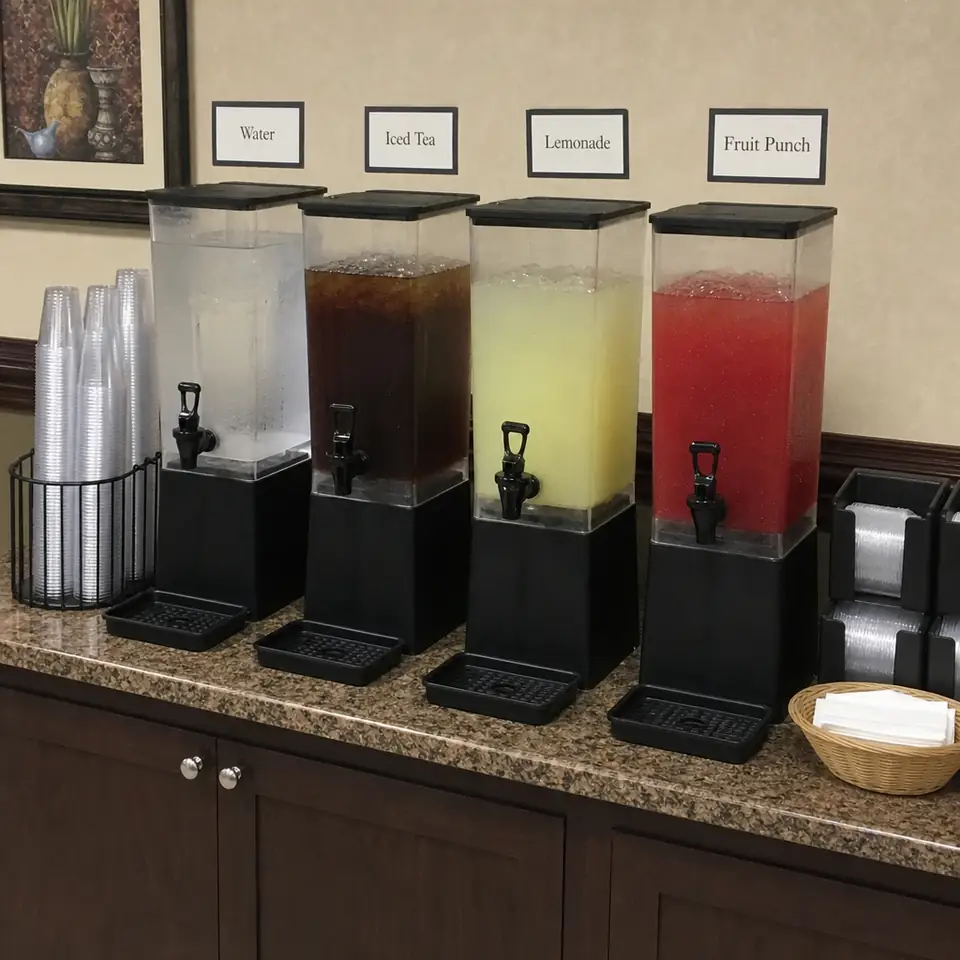
For a buffet, sketch the route from collecting a cup to leaving the station. Consider placing cups before the dispensers and lids or other finishing items after them. Keep the refill route visible on the plan so staff do not have to improvise access through waiting guests.
Use clear labels for beverage names and relevant distinctions, such as sweetened and unsweetened options. During a trial, watch where people pause or reach across one another. Adjust the arrangement before committing to a permanent counter layout.
Cafes: protect the working counter
For a cafe, map the proposed dispenser alongside order collection, payment, and other beverage preparation. Decide whether customers or employees will operate it. Then check whether a person pouring a drink blocks another essential task.
Ask staff to walk through a normal refill and an end-of-day clean. Include space for lids, removable parts, and temporary containers, not only the machine's footprint. Keep the initial commercial beverage menu focused enough that the team can manage preparation and stock consistently.
Catering: plan beyond the serving table
For catering, include transport and venue setup in the buying decision. Record access restrictions, available utilities, table arrangements, and the route from the unloading point. Check equipment suitability against those details before each event.
Build a packing checklist covering labels, drip trays, cleaning supplies, and manufacturer-approved replacement components where appropriate. Assign responsibility for checking the station during service. Your beverage solutions should include a workable handover between the preparation team and the people serving guests.
Make drink stations easy to operate
Measure the proposed setup with the actual cups, glasses, or carafes you intend to use. Check clearance beneath the outlet and whether users can operate the control comfortably. Include the drip tray in the measurement rather than judging usable space from product photographs.
Request a demonstration wherever possible. Try a normal pour, a refill, and removal of the parts that staff will clean. Ask whether the layout remains workable when neighboring equipment and supplies are in place.
Use the trial to answer practical questions:
- Can staff reach the filling point without awkward lifting?
- Is there room to remove the lid or container?
- Can guests identify the beverage before joining the queue?
- Is the drip tray accessible for inspection and emptying?
- Can staff approach the station without carrying supplies through the guest line?
Document any compromises before ordering. If a setup only works when the counter is otherwise empty, revise the plan to reflect the conditions of actual drink service.
Treat temperature control as a separate requirement
Insulation, refrigeration, and attractive presentation are not substitutes for a verified food-safety procedure. For beverages classified as time/temperature control for safety foods, the FDA Food Code generally specifies cold holding at 41°F or below and hot holding at 135°F or above, with defined exceptions and alternative controls. The Food Code is a model adopted by jurisdictions, so confirm the requirements applicable to your operation with your local regulatory authority.
Do not apply those holding limits indiscriminately to every beverage, or confuse them with recommended drinking temperatures. Have your recipes and service methods assessed where classification is unclear. Build monitoring and corrective actions into the operating procedure rather than leaving staff to judge temperature by touch.
When evaluating equipment certification, verify the exact model rather than relying on a general brand statement. NSF explains that its sanitation certification involves independent testing and auditing against applicable standards. Ask your local authority which equipment approvals are acceptable for the intended installation.
Evaluate cleaning before committing
Read the cleaning instructions before you purchase, especially the sections covering faucets and internal beverage-contact surfaces. BUNN's tea guidance calls for cleaning and sanitizing the container and faucet, including disassembly of specified components. A quick exterior wipe is not the same task. Follow the instructions for the exact equipment and approved cleaning products you select.
Ask your team to review the procedure against available facilities. Check whether removable components fit the washing area and whether staff have the specified brushes or other tools. Allocate drying and storage space as part of the equipment plan.
Turn the manual into a model-specific checklist:
- Identify which parts must be removed and in what order.
- Record the required cleaning and sanitizing methods.
- Follow product-label and equipment instructions for chemical use.
- Specify inspection points for worn seals or damaged parts.
- Assign responsibility for reassembly and the pre-service check.
Avoid borrowing a sanitizer concentration or cleaning interval from an unrelated machine. Even instructions within one equipment category can be model-specific. Keep the relevant manual available and train staff using that procedure.
What should you check before purchasing?
Before purchasing, confirm beverage compatibility, usable capacity, installation requirements, cleaning access, and the support arrangements for the exact model. Ask for these details in writing where they affect your decision. A complete comparison should show both what is included and what your operation must provide.
Searches for "drink dispensers commercial" can produce a broad shortlist, but the next step is a side-by-side assessment of actual requirements. Request a complete quotation rather than comparing equipment prices in isolation. Include any required accessories, installation work, delivery arrangements, consumables, and planned servicing in your own budget.
Also establish what happens after purchase. Ask how replacement faucets, seals, and other service parts are identified, what warranty terms apply, and who handles technical questions. Do not assume that two similar-looking units have identical parts or support arrangements.
Bring your menu, estimated peak demand, counter measurements, and refill plan when discussing options with The Horeca Store. Use the conversation to resolve specific gaps in the product information rather than asking for the largest machine within budget.
Choose for the service you intend to deliver
The best starting point is a clear operating plan: what you will pour, how guests will receive it, who will refill it, and how the equipment will be cleaned. Compare dispenser styles against that plan, then verify the selected model's specifications and requirements. A well-prepared brief gives you a stronger basis for choosing equipment that fits your buffet, cafe, or catering operation.