
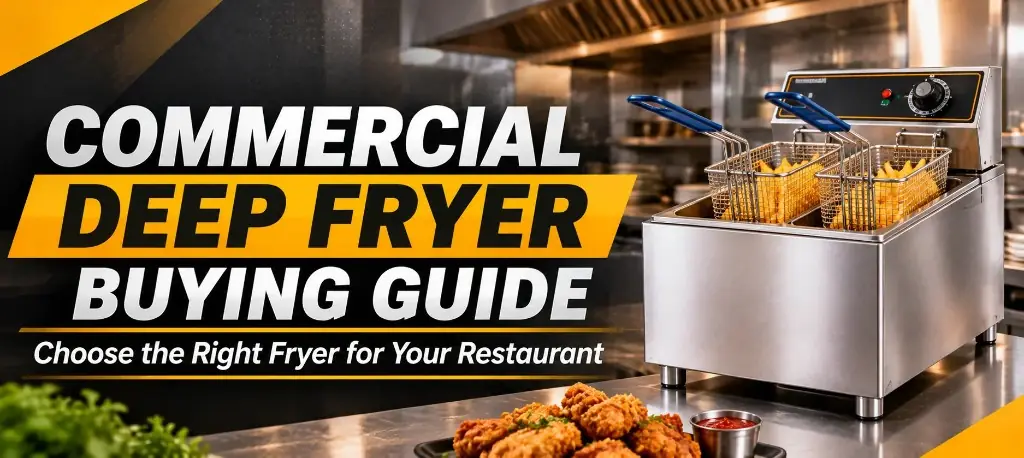
Choosing a commercial deep fryer means matching cooking capacity, energy supply, oil management, and installation requirements to your restaurant's menu. This commercial deep fryer buying guide for restaurants explains how to compare those priorities without getting distracted by tank size or purchase price alone. Use it to prepare a practical shortlist before discussing equipment with The Horeca Store or another supplier.
What size commercial deep fryer does your restaurant need?
The right size depends on your busiest service period, the food you cook, and the fryer's tested production capacity - not simply how much oil its tank holds. Start with peak demand, then ask suppliers to demonstrate that a proposed model can handle your actual menu. Avoid buying substantially more capacity than you need: oversized fryers can increase upfront costs and energy losses.
Build your buying brief around a busy shift rather than a daily sales average. Record orders in short intervals so you can see when fries, appetizers, and main courses compete for basket space. Include planned menu additions, but separate confirmed growth from possibilities.
For example, imagine a restaurant serving burgers with fries while also offering fried chicken sandwiches. Instead of adding the total weight of both products and choosing a tank, ask how the proposed setup would handle simultaneous orders. Request a demonstration using the intended portion sizes and starting food temperatures.
Give each supplier the same information:
- Peak demand: Portions required during your busiest ordering window.
- Product mix: Fries, breaded proteins, battered foods, or specialty items.
- Batch requirements: Portion weights and the number of simultaneous orders.
- Service pattern: Continuous frying or occasional bursts between quieter periods.
- Expansion plans: Specific menu changes the equipment should accommodate.
Look beyond oil capacity
Oil capacity describes the amount of oil a fryer holds; it does not, by itself, establish food output. Heating design, recovery, and recommended batch size also matter. Manufacturer buying guidance emphasizes evaluating output and recovery rather than assuming that fuel type alone determines performance.
Ask for production figures with their test conditions. Was the test performed with frozen fries, chilled chicken, or another product? Treat a figure without those details as a starting point for questions, not proof that the fryer suits your kitchen.
Match the fryer format to your workflow
Before comparing kitchen appliances, sketch the station around the work itself: loading baskets, draining food, seasoning, plating, and cleaning. Include the employee's working position and the route to the pass. Then compare equipment dimensions against that layout rather than squeezing a preferred model into the remaining space.
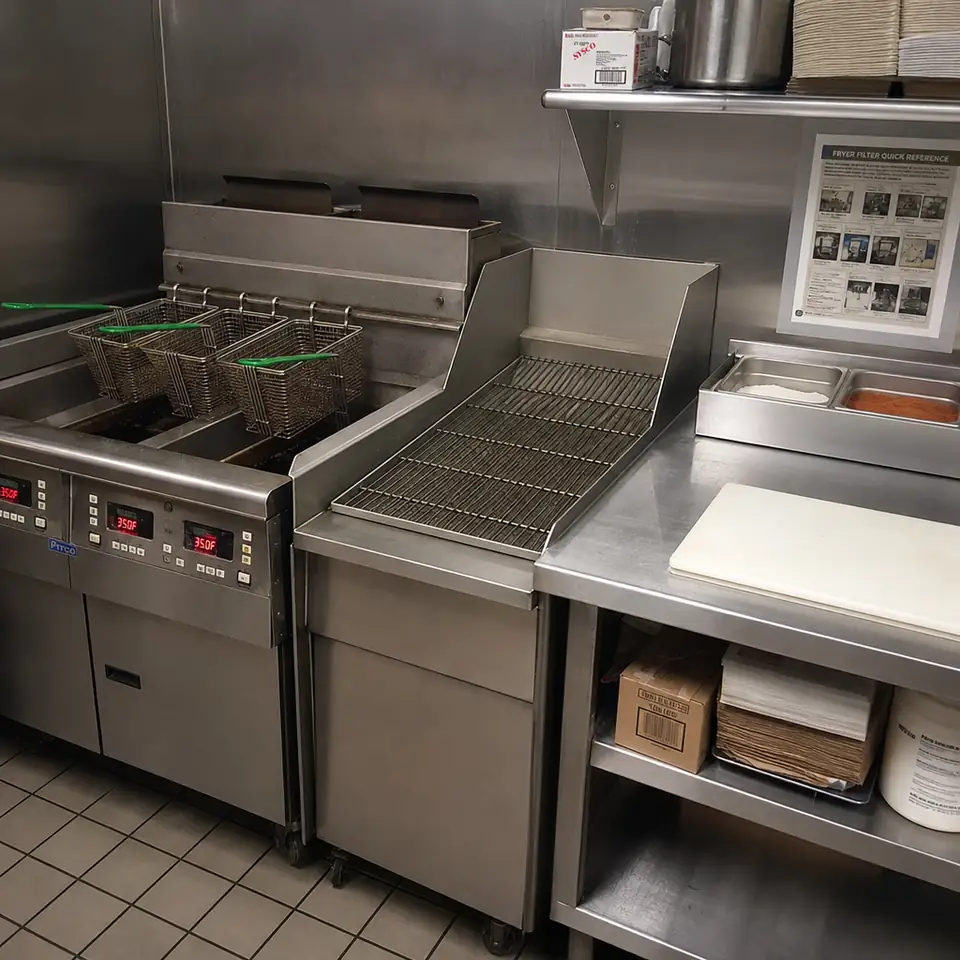
Countertop and floor-standing options
Include a countertop fryer in your shortlist when preserving floor space is a priority, but verify its output rather than assuming that compact equipment will cover your demand. Request the same performance information you would for a floor-standing model. ENERGY STAR's commercial fryer category includes both countertop and floor-type equipment, so format alone does not establish efficiency eligibility.
For either format, request the complete installed footprint. Ask where baskets hang, how the drain is accessed, and what must move during servicing. Have the installer confirm the proposed arrangement before treating the available counter or floor area as sufficient.
Single vats, split vats, and multiple fryers
Split vats can provide separate cooking environments for smaller batches of different foods. Multiple wells also offer flexibility when products need separate settings or workflows. Manufacturer specifications should identify whether a proposed configuration offers independent controls and how its filtration system operates.
Write down what you want separation to achieve before selecting a configuration. If allergen control is part of that goal, do not assume separate vats alone establish a safe process; ask a qualified food-safety adviser to assess the full workflow. Include baskets, utensils, filtration, storage, and staff handling in that review.
Should you choose a gas fryer or an electric model?
Choose between gas and electric by comparing compatible utilities, model-specific performance, installation costs, and expected operating costs. Neither fuel automatically guarantees better recovery or higher output. Compare equivalent equipment using documented performance data and your own utility rates, rather than relying on a blanket preference for one fuel.
For a gas fryer, have the installer confirm the specified fuel, connection requirements, and available supply. For an electric model, confirm voltage, phase, and electrical capacity against the equipment documentation. Manufacturer instructions make clear that installation, ventilation, and electrical connections require attention to the particular appliance and applicable requirements.
Ask for two separate quotations: the equipment price and the work required to make it operational. Include any proposed utility changes in the second quotation. That gives you a fairer comparison than placing two appliance prices side by side.
Also ask whether the controls or filtration equipment need electrical service on a gas model. Obtain written confirmation of every connection required, rather than assuming the main heating fuel tells the whole story.
Choose the cooking vessel around your menu
Ask suppliers to explain why a particular frypot design suits your products. Commercial fryers use different heating arrangements, including immersed electric elements and gas heat transferred through vessel walls or tubes. Those physical differences deserve inspection when you evaluate access for cleaning and the usable cooking area.
A flat-bottom design may be relevant for free-floating products; Pitco, for example, identifies free-float frying as an application for its flat-bottom equipment. That does not make one design universally preferable. Use your food, basket requirements, and cleaning demonstration to evaluate the proposed match.
Be equally specific when a listing uses the term industrial fryer. Ask for the exact model, intended application, batch limits, and installation documentation. Treat the label as a prompt for verification, not a substitute for measurable suitability.
During a demonstration, ask the operator to show how crumbs are removed and which components must be lifted or detached. Invite the employee responsible for closing the station to watch. Their questions can make the assessment more useful than a sales demonstration focused only on cooking.
Make oil management part of the purchase
Filtration deserves attention before you order, not after the first oil change. Regular skimming and filtration remove food debris and help maintain oil quality. Follow the selected manufacturer's procedures and schedule, since filtration requirements and operating sequences vary by model.
Ask to see the entire process, including preparation and cleanup. A useful demonstration should show how the filter pan is positioned, which consumables are required, and how staff know the cycle is complete. Also request the procedure for safely taking the equipment out of service when filtration does not work correctly.
Compare oil-management options using a short checklist:
- Staff involvement: Which steps require an operator to remain present?
- Consumables: What filter media, seals, or other supplies must you stock?
- Service interruption: Can another vat remain available during filtration?
- Cleaning access: Can staff reach the areas identified in the cleaning instructions?
- Oil disposal: What equipment and procedure are specified for removing used oil?
Do not evaluate built-in filtration solely by its purchase premium. Ask your team to assess the demonstrated workload alongside the equipment quote. Keep any projected labor or oil savings clearly labeled as estimates until you can support them with your own operating records.
What will your restaurant fryer cost to own?
Ownership cost includes the purchase, installation, energy, oil, consumables, maintenance, and repairs over your chosen planning period. A lower equipment price is therefore only one part of the decision. The Department of Energy's purchasing guidance evaluates efficient fryers using lifetime energy costs, illustrating why operating expenses belong in the comparison.
Build a worksheet with one column per shortlisted model. Use written quotations where available and mark assumptions clearly. Apply the same operating hours and utility rates to every option so differences remain meaningful.
Include these categories:
- Equipment and delivery: Fryer, accessories, freight, and receiving arrangements.
- Installation: Utility connections, positioning, commissioning, and any required site work.
- Energy: Estimated cooking and idle consumption using local rates.
- Oil and filtration: Initial fill, replacement oil, and filter consumables.
- Routine care: Scheduled service and staff time for specified maintenance.
- Repair exposure: Callout terms, parts availability, and warranty exclusions.
For energy comparisons, look at both cooking efficiency and idle energy use. ENERGY STAR evaluates these separately because maintaining operating temperature also consumes energy. Check certification for the exact model, and investigate available utility rebates without assuming that every purchase qualifies.
Verify installation and safety before ordering
A fryer that fits physically may still be unsuitable for its proposed location. Manufacturer installation instructions address ventilation, clearances, restraint, and positioning relative to nearby equipment. Have qualified installation professionals review the exact model and site, including applicable local requirements, before you authorize the purchase.
Arrange a site review that covers the delivery route as well as the final cooking position. Ask the installer to identify required changes in writing. Resolve responsibility for those changes before delivery day rather than leaving the supplier and contractor to negotiate around an unopened crate.
Your pre-order review should cover:
- Doorways, corridors, and access to the installation position.
- Manufacturer-specified clearances and service access.
- Hood, ventilation, and fire-protection review by appropriate professionals.
- Compatibility with nearby cooking equipment.
- Utility connections and any required restraints.
- Commissioning, operator training, and documentation handover.
Do not assume that choosing an electric or countertop unit removes the need for a ventilation review. Ask the responsible professional to confirm the requirements for the selected appliance and cooking application. Keep that confirmation with the installation records.
Plan for commercial deep fryer repair
Commercial deep fryer repair should be part of your buying discussion, even when purchasing new equipment. Request the manufacturer's maintenance schedule and identify qualified service support before installation. Manufacturer guidance calls for trained personnel and model-specific procedures rather than improvised servicing.
Ask who handles warranty claims, what documentation is needed, and whether travel or labor charges have exclusions. Request contact details for service providers covering your location. Also ask about parts ordering and what information technicians will need when you report a fault.
Create an equipment file containing the model and serial numbers, installation records, warranty documents, manuals, and service history. Give staff a clear reporting process for faults and an escalation contact. Keep troubleshooting within the operator instructions; leave repairs and safety-related adjustments to appropriately qualified professionals.
Buy for the shift you actually run
The strongest shortlist is one you can explain: each model matches a documented workload, fits an approved installation plan, and has understandable operating and service requirements. Avoid paying for features without identifying who will use them and why. Equally, do not remove useful capacity or maintenance features simply to reach the lowest opening price.
Before contacting The Horeca Store, prepare your menu, peak-demand notes, station measurements, and available utility details. Request a model-specific comparison and a complete installed-cost quotation. Choose the fryer that meets the brief - not the one with the largest tank or the most persuasive headline.