
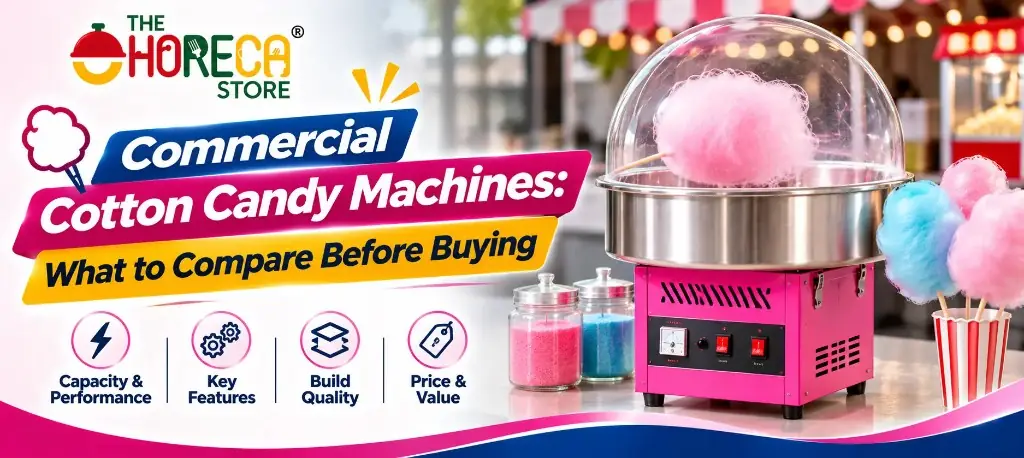
Commercial cotton candy machines should be compared on production capacity, operating controls, electrical requirements, cleaning, and ownership costs-not just purchase price. This buying guide explains how to evaluate those details against your venue, staffing, and service schedule. Use it to prepare a focused shortlist and useful questions for The Horeca Store before committing to equipment.
What should you compare first when buying a commercial cotton candy machine?
Start with your busiest service period, available workspace, and power supply. These establish the requirements a machine must meet before accessories or appearance enter the decision. Write them down first so every model gets measured against the same needs.
Describe how you expect to operate. Will one employee make cones continuously, or will a café team prepare occasional orders between other tasks? For an event business, add transport, setup, and storage to the comparison rather than treating them as afterthoughts.
Build your shortlist around these priorities:
- Peak demand: Estimate orders during your busiest interval, not simply total daily sales.
- Serving format: Decide whether you will hand over fresh cones, fill bags, or do both.
- Staffing: Identify who will operate, refill, clean, and move the machine.
- Installation: Record counter dimensions and have the available electrical supply checked against each model's requirements.
- Support: Request the operating manual, warranty terms, and replacement-parts information before ordering.
Match production capacity to the whole service process
Treat advertised output as a comparison point, not a promise about your completed transactions. Gold Medal, for example, lists different serving rates across its machines alongside differences in heating systems, controls, and electrical specifications. Compare model-specific documentation rather than assuming all commercial units offer similar performance.
Ask what serving size the quoted rate represents and whether the manufacturer specifies test conditions. Then consider your own workflow: collecting floss, presenting the cone, taking payment, and refilling supplies. A machine demonstration is more useful when it follows that complete sequence rather than showing only sugar spinning.
For planning, imagine a rush of 40 orders arriving within 20 minutes. This is a hypothetical workload, not a machine rating. Ask whether your proposed equipment and staffing arrangement can handle it while allowing for the pauses required by its operating instructions.
When comparing the best commercial cotton candy machines for your business, prioritize documented suitability for that workload. Avoid paying for extra output unless you can explain when you will use it.
Compare heat controls and operator involvement
Manual and automatic controls deserve attention because they change what employees must manage. Gold Medal's range includes manual heat adjustment as well as models with automatic heat adjustment, cooldown, and shutoff. Those features are model-specific, so verify them on the exact unit under consideration.
For a hands-on owner, consider whether manual adjustment fits your working style. For rotating staff, ask a demonstrator to explain the automatic sequence and show what happens when production stops. Neither approach removes the need to train employees using the manufacturer's instructions.
Request a demonstration covering startup, normal production, refilling, and shutdown. Watch the controls employees must monitor, and ask how they should recognize an incorrect setting. This gives you a practical basis for comparing ease of operation instead of relying on a vague "user-friendly" description.
Will the machine fit your counter and electrical supply?
A suitable machine must fit the complete operating space and match the available electrical supply, including voltage and plug requirements. Manufacturer listings distinguish pan size, overall dimensions, wattage, and plug configuration; do not substitute one measurement for another. For example, Gold Medal's Super Floss listing specifies a particular plug alongside its voltage and wattage.
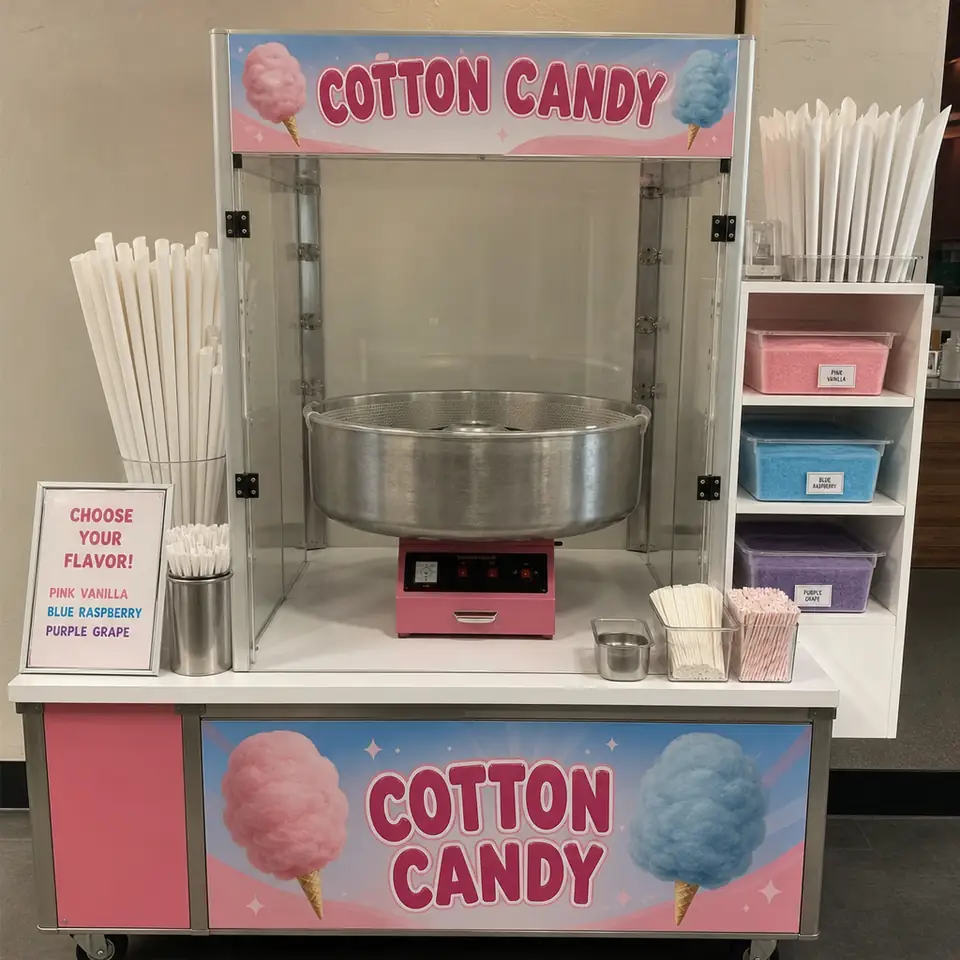
Measure the assembled setup rather than just the cabinet. Include the bowl, any enclosure, accessory storage, and the room your operator needs to work comfortably. If you plan to use a cart, compare its assembled dimensions with doorways, loading space, and storage access.
Use this site-check list before purchase:
| Check | What to confirm |
|---|---|
| Counter or cart | Assembled footprint, working height, and suitable support |
| Electrical supply | Exact voltage, current requirements, plug, and manufacturer instructions |
| Operator access | Space to collect candy and reach controls without obstruction |
| Transport | Equipment weight, removable components, and loading arrangements |
| Storage | Protected space for the machine, bowl, enclosure, and supplies |
Look beyond exterior materials when assessing cleaning
Request the cleaning instructions before choosing cotton candy equipment. For its 3015 model, Gold Medal instructs users to unplug the machine and allow the head to cool before cleaning; it also distinguishes cleaning the removable pan and enclosure from caring for the head. That distinction matters when estimating closing duties.
Ask which components can be removed, which tools are needed, and what cleaning products are permitted. Do not assume a removable bowl means every part can be washed the same way. Compare the documented procedure with your available sink space, cleaning area, and staffing.
Also ask for a parts diagram. Identify the components the manufacturer expects an operator to maintain and those requiring service. A clear maintenance process is worth evaluating alongside cabinet finish because your team will need to follow it throughout ownership.
Plan cotton candy supplies alongside the machine
Prepare a separate supply list covering approved sugar, cones, bags if needed, storage containers, and cleaning materials permitted by the manual. Ready-to-use floss sugar is one option: Gold Medal describes its Flossugar as a prepared blend that requires no mixing. Confirm ingredient compatibility with your chosen machine rather than assuming every sugar product is suitable.
Start with a manageable flavor selection and a defined serving size. Then record actual supply use during trial service before placing larger recurring orders. This gives you a purchasing baseline without relying on an unsupported servings-per-container estimate.
When browsing bulk candy machines, keep the search focused on the task: spinning fresh cotton candy for service. Include candy floss machines as an alternate search term, but compare the actual equipment specifications rather than category labels. For search phrases such as "cotton candy machines commercial," the useful next step is always a model-level check.
Evaluate safety features and the operating environment
Ask how the proposed setup separates customers from the operating area and which protective accessories the manufacturer recommends. Gold Medal's operating guidance warns against touching the spinning head or adding sugar while it rotates. Its instructions also emphasize reading the applicable manual before setup and use.
Treat an enclosure as one part of the setup, not a replacement for staff training or appropriate positioning. Have employees demonstrate the correct refill and shutdown sequence before opening service. Keep the model's instructions accessible so temporary staff do not have to improvise.
For event use, discuss the intended environment with the supplier. Gold Medal notes that excessive humidity affects cotton candy production, so an indoor demonstration may not answer every question about your event conditions. Ask what operating limitations apply to the specific model and proposed location.
What does the total cost of ownership include?
Your buying budget should include the machine, required accessories, starting supplies, delivery, setup, cleaning labor, and provision for maintenance. Treat this as a planning checklist rather than assuming every expense applies equally. Request itemized quotations so you can distinguish essential equipment from optional additions.
When reviewing commercial cotton candy machines for sale, ask each seller the same questions:
- What is included? Confirm the bowl, enclosure, cart, and starter accessories individually.
- What requires separate purchase? List supplies and any components needed for your intended setup.
- What does the warranty cover? Obtain written terms for the exact model, including exclusions and the claims process.
- How will repairs work? Identify service contacts, parts ordering procedures, and transport responsibilities.
- What are the delivery and return conditions? Clarify inspection, damage reporting, and any applicable restrictions before paying.
Avoid estimating profitability from sugar cost alone. Build your calculation around your own selling price, portion size, packaging, staffing, and operating schedule. Where a figure is unknown, mark it for verification rather than filling the gap with an optimistic guess.
Choose the machine that fits your operation
The strongest shortlist connects each feature to a real requirement: rush-period capacity, usable controls, a compatible installation, manageable cleaning, and clear support arrangements. Keep your comparison sheet beside the quotations so attractive extras do not displace essentials. Before ordering through The Horeca Store, confirm the exact model, included accessories, electrical specifications, and written terms; buy only when those details match your plan.