

Commercial coffee urns and hot beverage dispensers support batch brewing, hot holding, and self-service in hospitality settings. The right setup depends on how much coffee guests actually drink, where service happens, and how staff will replenish the station. This article explains how to compare capacity, electric and insulated designs, practical features, and maintenance before choosing coffee equipment from The Horeca Store or another supplier.
Which coffee urn or dispenser fits your service?
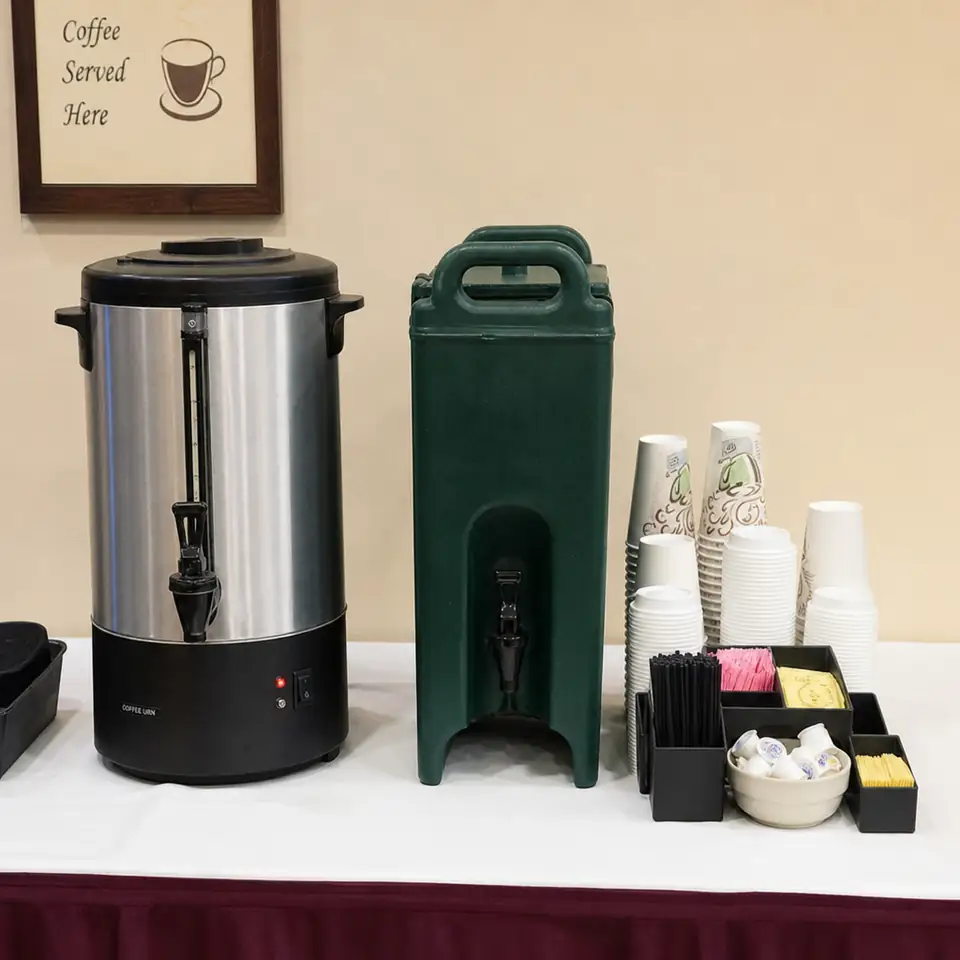
Choose an electric brewing urn when you need to make and hold coffee at a powered service location; choose an insulated dispenser when coffee will be brewed elsewhere and served without electricity. These are different jobs, even when the containers look similar. Manufacturer documentation illustrates the distinction: electric urns may switch from brewing to warming, while insulated beverage carriers hold prepared drinks without a power connection.
Start by describing your busiest service period rather than browsing by appearance. A breakfast meeting with a fixed start time needs a different replenishment plan from an office station used throughout the day. Write down when guests arrive, how long the break lasts, and whether someone can monitor supplies.
Use these scenarios to frame your shortlist:
- Hotel conference breaks: Consider separate serving points for regular coffee, decaf, and hot water. Plan replenishment around the scheduled break rather than the total conference attendance alone.
- Off-site catering: Assess the complete route from brewing kitchen to vehicle to serving table. Prioritize equipment approved for the intended transport and serving arrangement.
- Office self-service: Match batch sizes to actual consumption across the day. Assign responsibility for refreshing coffee and closing down the station.
- Permanent breakfast buffets: Check counter space, available power, cleaning access, and where replacement batches will wait.
Treat these as planning priorities, not universal equipment prescriptions. The best choice is the one your team can operate consistently under real service conditions.
Size capacity around servings, not the label
A stated cup capacity does not necessarily match your guest cup. For example, Hamilton Beach Commercial's operating instructions define one cup as five ounces for the covered urns. Check the manufacturer's serving definition before comparing large coffee makers or estimating how many attendees a batch will serve.
For planning, use this calculation:
Expected servings × actual poured ounces = required beverage volume.
Suppose you expect 60 guests to drink one eight-ounce serving each. That is 480 fluid ounces before accounting for second servings or any reserve you decide to prepare. This is a hypothetical planning example, not a recommended allowance for every event.
Then divide demand into service windows. Ask how much coffee must be ready when doors open, how much will be needed during the busiest break, and when another batch can realistically arrive. Include decaf separately rather than assuming every guest will use the main urn.
Avoid choosing the largest container simply because it offers the most capacity. Compare one large batch with a staged plan using smaller batches or multiple dispensers. During a trial service, record what was prepared, what was consumed, and what remained; use those observations to refine future orders.
Electric brewing urns and insulated dispensers do different work
Electric coffee urns can combine brewing and warming in one appliance. Insulated coffee dispensers instead provide a separate holding and serving stage. Some operations may find a combination useful: brew at a controlled preparation point, then move prepared coffee into suitable servers for guest service. Confirm compatibility and handling instructions for every component.
| Equipment approach | Role in the service plan | What to verify |
|---|---|---|
| Electric brewing urn | Prepare a batch and keep it ready at a powered location | Brewing instructions, batch limits, electrical requirements, and warming operation |
| Insulated dispenser | Hold and serve prepared beverages away from a power outlet | Capacity, closure design, permitted beverages, transport instructions, and cleaning access |
| Separate brewer and servers | Divide production from guest-facing dispensing | Brewer-to-server compatibility, replacement batch timing, and space for spare servers |
Electrical requirements need an early check
Read the specification sheet before committing to an electric model. A Hamilton Beach Commercial catalog, for example, lists several urn sizes with the same 120-volt, 1,440-watt electrical specification but different stated brewing rates. Capacity and wattage alone therefore do not tell you exactly how quickly a particular urn will prepare its batch.
Give the venue or facilities team the exact equipment specifications and proposed station layout. Ask them to confirm the intended electrical arrangement, including other equipment planned for that location. Do this before event day rather than assuming an available outlet settles the question.
Mobility needs a complete handling plan
For catering coffee service, check more than whether a dispenser has handles. Review how its lid secures, how it must remain positioned, and whether the manufacturer permits movement while filled. Cambro's insulated beverage range, for example, uses secured lids and recessed faucets, but those features should not replace reading the model's handling instructions.
Walk the route before purchasing. Include doorways, elevators, loading areas, storage shelves, and the final serving surface. Ask staff to assess the proposed handling method rather than judging portability from an empty showroom unit.
Features worth checking before you buy
Look beyond a polished exterior. Commercial urn designs may include locking lids, level indicators, removable brew baskets, dispensing controls, and separate brew and warm lights. Hamilton Beach Commercial lists these features across its urn range; availability still needs checking against the exact model you are considering.
Turn each feature into a practical purchasing question:
- Dispensing control: Can a guest operate it comfortably while holding the cup you actually provide? Test the action rather than relying on a photograph.
- Cup clearance: Will your tallest cup fit beneath the outlet without tilting? Include the drip tray or approved stand in the measurement.
- Level visibility: Can staff check the remaining volume from their normal working position? Consider how the urn will face during service.
- Cleaning access: Can the team reach the interior and remove the parts identified in the cleaning instructions?
- Replacement components: Before ordering, ask about compatible faucets, seals, lids, and other service parts. Request model-specific information rather than assuming interchangeability.
Stainless steel deserves consideration, but it is not a complete quality specification. Hamilton Beach describes smooth stainless steel interiors as resistant to stains and buildup, while Cambro offers insulated carriers with molded shells. Compare the whole construction and maintenance routine, not just the material named in the listing.
How do you keep coffee service smooth during a rush?
Plan brewing, replenishment, and guest movement as one workflow. Set out enough serving capacity for the anticipated peak, assign a staff member to monitor the station, and decide when a replacement batch should be ready. Then test the arrangement with the cups, condiments, and equipment you intend to use.
Walk through the station as a guest. Pick up a cup, find the correct beverage, dispense it, add condiments, and locate a place for waste. If any step requires doubling back or reaching across another person, revise the layout before service.
A practical starting arrangement is cups first, clearly labeled beverages next, and lids, stirrers, and condiments farther along. Keep replenishment access in mind so staff do not have to carry replacement supplies through the main queue. Where space permits, test whether separate regular and decaf positions make the station easier to navigate.
Assign tasks explicitly. Someone should check beverage levels, someone should know when the next batch starts, and the closing team should know what must be cleaned. In a small operation, one person may cover all three responsibilities; the important point is that they are not left to assumption.
Protect flavor with a batch routine
Standardize the recipe before evaluating equipment performance. Record the coffee quantity, water quantity, grind specified for the brewer, and preparation steps. Hamilton Beach's percolator instructions recommend an appropriate coarse grind and warn that finely ground coffee can overflow the basket and leave grounds in the drink.
For separate thermal servers, follow the prescribed preparation routine. Nestlé Coffee Partners' equipment card for a BUNN thermal server instructs operators to preheat that server and keep its lid closed after brewing. Those instructions are model-specific, so do not transfer the same timing or procedure automatically to every dispenser.
Create a simple batch record showing when coffee was prepared and who checked it. Taste-test your planned recipe during a realistic service rehearsal, including near the end of your intended serving window. Set an internal refresh standard from the equipment guidance and your quality expectations rather than treating "still warm" as the only test.
When evaluating other coffee machines, keep the service role clear. An urn for batch coffee is not a substitute for every beverage on a café menu. List the drinks you intend to offer, then confirm that each selected appliance is designed for its assigned job.
Build a beverage station beyond regular coffee
Include decaf and hot water in the planning conversation from the start. Decide whether each needs its own dedicated vessel, label, and replenishment schedule. Cambro supplies beverage identification labels with its Camtainer range, illustrating the importance of distinguishing contents at the serving point.
Do not assume a hot beverage dispenser accepts every hot drink. Before planning cocoa, milk-based drinks, or other specialty beverages, ask for confirmation that the exact model supports the intended product and cleaning method. Keep unverified menu ideas off the equipment's duty list until you have that answer.
Build a station packing list alongside the equipment order. Include compatible serving accessories, labels, cups, drip management, cleaning supplies, and any approved stands. For off-site events, use that list at both loading and return so missing small items do not undermine an otherwise complete setup.
Make cleaning and troubleshooting part of ownership
Obtain the operating manual before buying, not after a problem appears. Review which parts come apart, which cleaning products are permitted, and which components must stay out of water. Hamilton Beach's instructions, for example, warn against immersing the electric urn, cord, or plug and require cooling before cleaning.
Build your closing checklist around the exact manual:
- Follow shutdown instructions and allow the equipment to cool before handling internal parts.
- Remove and wash only the components identified for that cleaning method.
- Clean dispensing pathways, not just the visible tank surfaces.
- Rinse, dry, and store according to the manufacturer's directions.
- Schedule the specified mineral-deposit removal procedure separately from routine washing.
When performance changes, use the troubleshooting section rather than improvising repairs. The Hamilton Beach manual identifies power connection, switch position, mineral buildup, and coffee quantity among checks for particular symptoms. Record what happened and what approved checks were completed; escalate unresolved faults through the appropriate service channel.
Choose the setup your team can run confidently
A useful shortlist connects each piece of coffee equipment to a defined job: brewing, holding, transport, or dispensing. Before ordering, verify actual serving volume, preparation time, installation needs, handling arrangements, and the full cleaning routine. Review these details with the staff who will use the equipment.
When comparing options at The Horeca Store, bring your guest count, cup size, peak service window, venue details, and beverage menu. Use that information to request model-specific documentation and compare suitable options. Choose the setup that fits the service you can deliver consistently - not simply the biggest urn on the page.