

Commercial coffee grinders should be selected around three things: the coffee you serve, your busiest service period, and the workflow your team can maintain. Burr design, usable grinding capacity, and dosing controls deserve closer attention than hopper size alone. Whether you are considering equipment from The Horeca Store or preparing a broader shortlist, the practical approach below will help you compare specifications, ask better questions, and avoid buying capacity you cannot use.
Which burr type is right for your commercial coffee grinder?
Neither flat nor conical burrs are automatically the right choice for every business. Both appear in professional coffee grinders, and burr geometry, material, adjustment, and the complete grinder design matter alongside shape. Baratza, for example, offers both steel and ceramic flat burrs with different intended cup characteristics, illustrating why shape alone is an incomplete buying shortcut.
Flat burrs: compare the complete design
Flat burr grinders use opposing, disc-shaped grinding surfaces. Commercial examples include espresso-focused machines and multipurpose shop grinders, so "flat burr" does not identify one particular application. Compare the manufacturer's intended brewing methods, adjustment system, and output before deciding that two flat-burr machines are interchangeable.
For a useful demonstration, bring your own coffee and ask the operator to establish a working recipe. Taste the result, then repeat several doses using the same settings. Your goal is to judge whether the machine produces coffee your business wants to serve through a process your staff can repeat.
Conical burrs: evaluate them without assumptions
Conical burr sets pair a cone-shaped inner burr with an outer grinding ring. They are not restricted to domestic equipment: Mazzer's Kony S platform, for example, uses commercial conical burrs. Avoid assuming that a conical grinder must be an entry-level option simply because many home grinders use this configuration.
Ask the same questions you would ask about a flat-burr machine: How does it perform with your recipe? Can staff make controlled adjustments? Does the dosing arrangement suit your service? Treat claims about superior flavor, quietness, or lower heat as model-specific points to verify, not guaranteed consequences of burr shape.
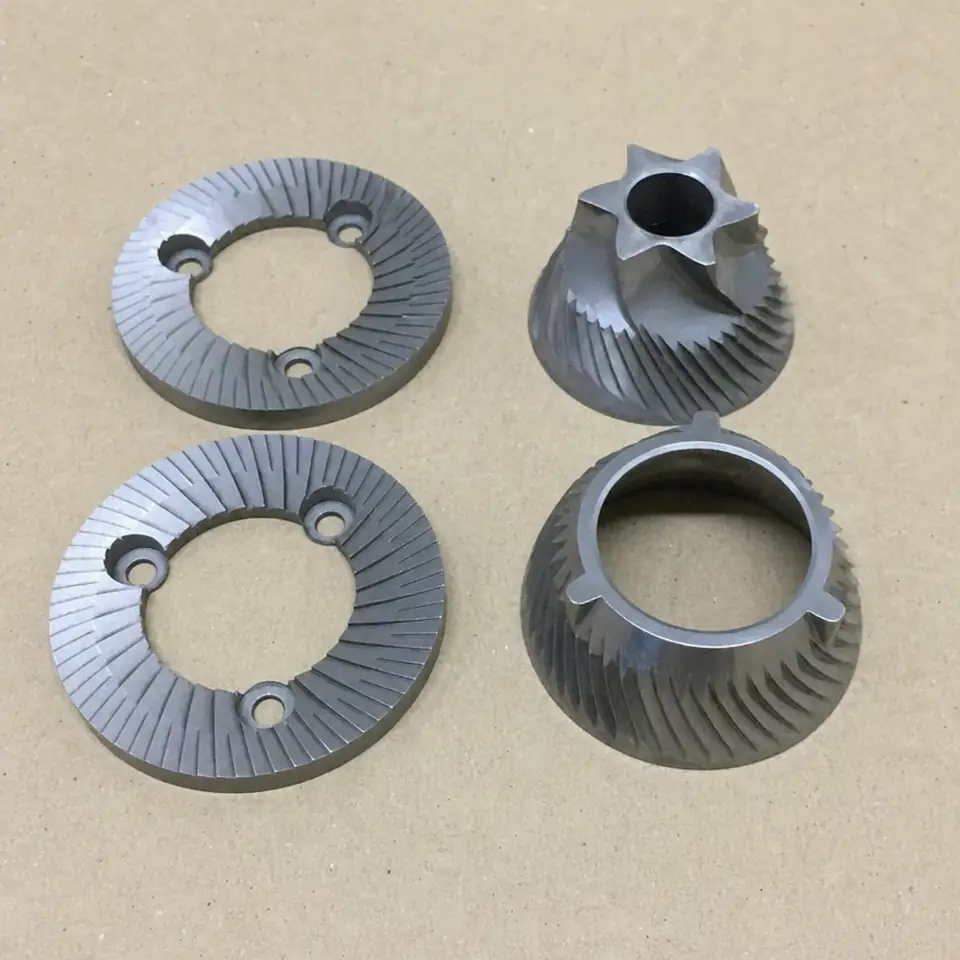
Burr diameter and material need context
Burr diameter is useful when comparing specifications, but it is not a standalone performance score. Manufacturer specification tables show grinders with different burr sizes, motor ratings, and grinding capacities; they also show that machines sharing a burr diameter can have different physical configurations. Read these specifications together rather than choosing the largest number.
Ask which replacement burrs the exact model requires and how their expected life is defined. Manufacturers may qualify burr-life estimates by grind setting, making a headline kilogram rating less universal than it first appears. Confirm replacement costs and availability before treating an upgraded burr material or coating as essential.
How much grinding capacity does your business actually need?
Your required capacity is the amount of coffee you must grind during peak demand while staying within the machine's permitted operating cycle. Hopper capacity, grams per second, and daily output describe different things. Manufacturer manuals list these separately, sometimes including required pauses between grinding cycles, so none should substitute for the others.
Start with a simple demand calculation. Suppose your busiest hour includes 100 espresso drinks, each using an 18-gram dose. That represents 1.8 kilograms of ground coffee, before allowing for dialing in, purging, remakes, or other coffee orders. This is an illustrative planning example, not a recommended equipment rating.
Then examine how those orders arrive. One hundred drinks spread evenly across an hour present a different workflow challenge from a concentrated queue after a meeting ends. Record your busiest short interval as well as your hourly total, and ask the supplier to assess both.
Use these four capacity checks:
- Grinding speed: Request output at your intended grind setting and with a comparable coffee, rather than relying on an unexplained maximum.
- Operating cycle: Check how long the grinder may run and what pauses the manual requires between cycles.
- Hopper capacity: Calculate a practical refill schedule instead of treating bean storage as proof of grinding capability.
- Daily workload: Include every intended task, such as espresso service, batch brewing, and retail bag grinding.
The distinction is practical: Mahlkönig's E65S GbW manual specifies grinding output, hopper capacity, daily output, and permitted operating cycles individually. Its figures also vary with operating conditions and electrical version. Ask for the manual covering the exact unit being quoted.
Match the grinder to the job
Before comparing features, write down what the grinder must do. A useful purchasing brief might specify espresso service as the primary task, occasional decaf as a separate requirement, and no retail bag grinding. Another business might need batch-brew preparation and packaged-coffee sales without serving espresso at all.
Use the following applications to organize your shortlist:
| Application | What to verify during selection |
|---|---|
| Espresso service | Fine adjustment, portafilter fit, repeatable dosing, and peak-period operating limits |
| Batch brewing | Suitable grind range, receiving-container clearance, and output at your actual batch size |
| Retail bag grinding | Bag support, available grind settings, practical bag throughput, and cleanup between orders |
| Roastery production | Sustained output, cooling provisions, electrical supply, collection, and service access |
Multipurpose shop grinders and industrial coffee grinders are distinct purchasing categories, even where their applications overlap. Mahlkönig positions the EK43 for multiple brewing methods and shop use, while Ditting describes its 1403 Industrial for small to medium-sized roasteries. The latter also specifies three-phase electrical configurations, demonstrating why installation requirements belong in the initial comparison.
If one machine must perform several jobs, request a changeover demonstration. Have the demonstrator move between your proposed settings, collect the coffee, clean up, and return to the original recipe. Decide whether that process remains sensible when customers are waiting.
Dosing controls should support your team
Dosing controls deserve their own comparison because they determine how staff request and verify each portion. Timed grinding uses a programmed duration to determine the quantity dispensed. Grind-by-weight systems instead use weight control to stop grinding when the programmed amount reaches the portafilter.
For a timed grinder, ask staff to weigh a sequence of doses during the demonstration. Record the results, make a normal grind adjustment, and repeat the exercise. This gives you a clearer basis for judging the checking routine your business would need than simply watching one successful dose.
For a grind-by-weight model, test your actual portafilters and ask to see calibration and recipe programming. Do not stop at the display: inspect the placement of the controls, the ease of inserting the portafilter, and how staff recover from an interrupted dose. Choose controls that your team can understand without a lengthy explanation during service.
Also decide how you want to handle lower-volume coffees. Before assigning decaf or rotating beans to the main grinder, ask for a demonstration of emptying, changing coffee, and restoring the original recipe. Compare that procedure with a separate grinder or a dedicated single-dose workflow, including the counter space each option requires.
Read coffee grinder reviews for evidence, not rankings
Useful coffee grinder reviews explain the conditions behind their conclusions. Prioritize reviews that identify the coffee, brewing method, dose, test duration, and workload. A review based on occasional drinks may still offer helpful observations, but ask how closely those conditions resemble your business before applying its verdict.
When evaluating a claim, look for the underlying test:
- "Fast" should come with a dose, grind setting, and measured grinding time.
- "Consistent" should be supported by repeated measurements or a clearly described tasting method.
- "Easy to clean" should show the access procedure, tools, and reassembly involved.
- "Good value" should identify the buyer's workload and what costs were included.
Treat searches for the best coffee grinders as a starting point, not a final purchasing decision. Build a shortlist from your operating requirements first, then use reviews to identify questions for a demonstration. A compelling overall rating should not override an unresolved issue with capacity, installation, or service support.
Apply the same discipline to reports about the commercial coffee bean grinders market. Unless you need market research for a separate business decision, prioritize the facts relevant to ownership: exact specifications, local service arrangements, replacement parts, and written purchase terms. Broad market positioning does not answer whether a particular grinder suits your counter.
Budget for ownership, maintenance, and downtime
Request an itemized ownership estimate alongside the purchase quote. Include delivery, installation, any electrical work, replacement burrs, approved cleaning supplies, and routine service. Ask which tasks your staff may perform and which require a technician, then assign responsibility before the equipment arrives.
Cleaning procedures and intervals should come from the exact grinder's manual, not a universal schedule copied from another machine. For example, Mahlkönig's E65T GbS instructions call for daily hopper cleaning and give a separate interval for cleaning the grinding mechanism. They also specify a cleaning method, reinforcing the need to distinguish routine wiping from internal maintenance.
Make the service discussion concrete. Who diagnoses a fault, where does the machine go, and how are parts ordered? Ask for warranty exclusions, labor coverage, transport responsibilities, and expected support procedures in writing rather than assuming the purchase price includes every eventuality.
Finally, decide what happens if the main grinder becomes unavailable. Your contingency might be a suitable backup, an agreed repair arrangement, or a temporary reduction in the coffee menu. Price that plan before an interruption forces a rushed decision.
A practical checklist before you order
Take a written brief to the supplier and ask them to confirm suitability against it. Keep unresolved items visible rather than allowing an attractive feature to distract from a basic requirement. The following checklist provides a practical final review:
- Define demand: List daily coffee use, the busiest hour, the busiest short interval, and each brewing method.
- Confirm capacity: Obtain the exact model's output specifications, operating-cycle limits, and relevant test conditions.
- Measure the site: Check footprint, overhead refill clearance, collection-container space, cleaning access, and electrical requirements.
- Run a realistic demonstration: Use your coffee, recipes, portafilters, and receiving containers wherever possible.
- Test the whole workflow: Include adjustments, refilling, coffee changes, dose verification, and cleanup - not just grinding.
- Verify support: Obtain written information on warranty, service contacts, spare parts, and replacement burrs.
- Review the quote: Confirm the model variant, included accessories, delivery arrangements, and purchase terms.
If comparing several machines, give each supplier the same brief. Record strengths, limitations, and unanswered questions in a shared comparison sheet. This keeps the decision focused on operating fit rather than whichever demonstration was most persuasive.
Choose for the busiest shift, not the specification headline
The strongest shortlist connects burr design, usable capacity, dosing, and maintenance to a clearly defined workload. Start with the coffee you want to serve, verify performance under realistic conditions, and resolve installation and support questions before ordering. When discussing options with The Horeca Store, bring that operating brief and request model-specific answers: a well-matched grinder should make sense on your counter, not just on paper.