
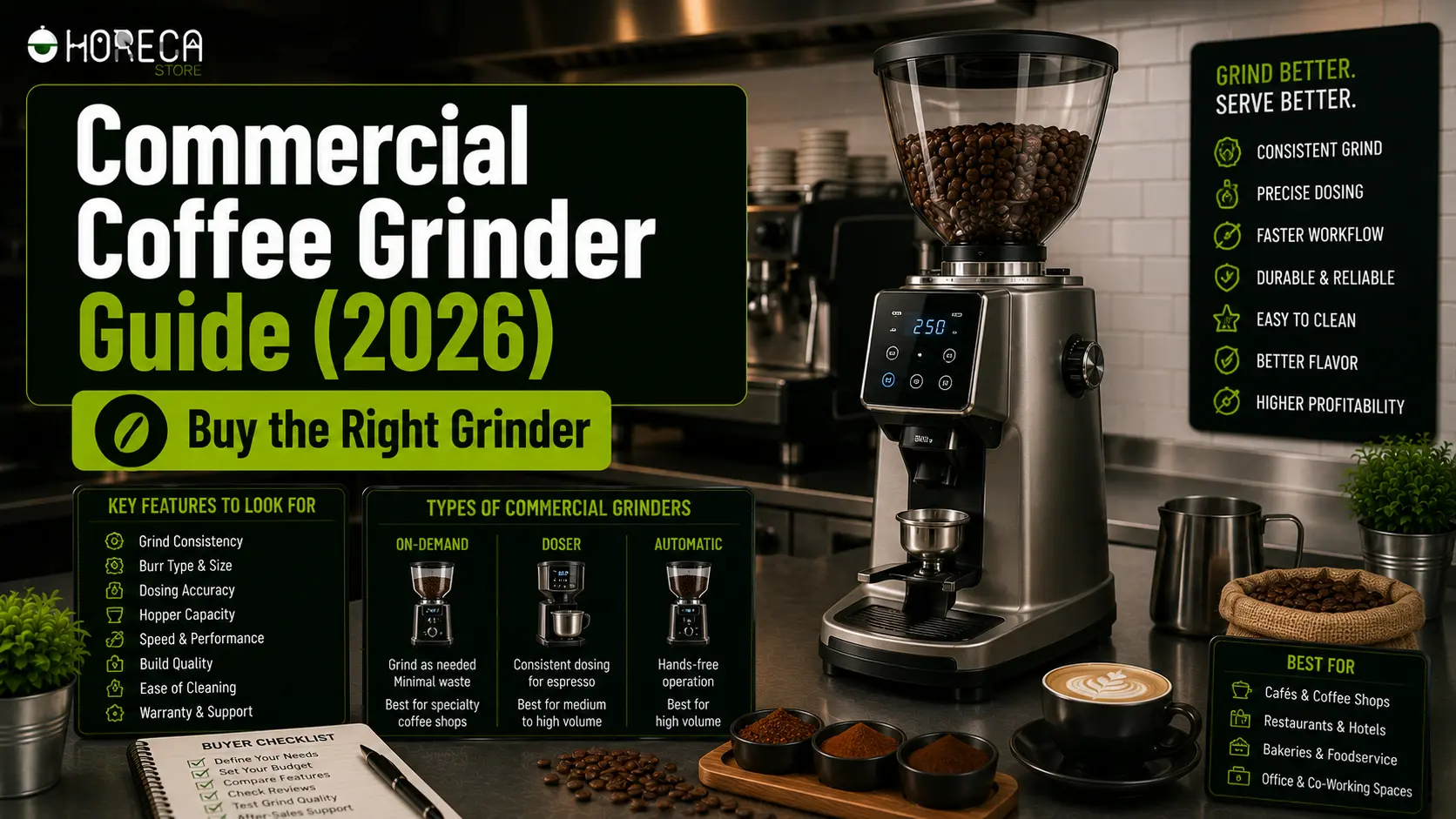
Welcome to the most comprehensive Commercial Coffee Grinder Buying Guide 2026. If you are opening a new cafe, upgrading your current equipment, or scaling up to a high-volume coffee roasting business, you already know one fundamental truth of the specialty coffee industry: your espresso machine is only as good as the grinder feeding it.
In 2026, the technology surrounding coffee extraction has reached unprecedented heights. We are no longer just looking at simple spinning blades or basic burrs; we are looking at hyper-precise, data-driven, climate-controlled pieces of engineering. Investing in a high-quality coffee grinder machine is the single most impactful decision you will make for your beverage quality, workflow efficiency, and bottom line.
This guide will walk you through everything you need to know to select the best commercial coffee grinder for your specific needs, diving deep into burr geometry, motor wattage, heat management, smart diagnostics, and much more.
Chapter 1: Assessing Your Cafe’s True Needs
Before diving into the technical specifications of a professional coffee grinder, you must take a hard look at your business model. The grinder that works perfectly for a quiet neighborhood bakery will completely fail in a high-traffic downtown commuter cafe.
Calculating Daily Coffee Throughput Requirements
The first step in how to choose a grinder for a busy coffee shop is understanding your volume. You need to engage in accurate calculating daily coffee throughput requirements.
Here is a simple formula to help you determine your needs:
- Estimate Peak Hourly Cups: How many milk-based and black coffees will you serve during your busiest hour (e.g., 8:00 AM to 9:00 AM)? Let’s say 120 cups.
- Determine Dose per Cup: Most modern specialty cafes use a double shot (around 18 to 20 grams) for standard drinks.
- Do the Math: 120 cups × 20 grams = 2,400 grams (2.4 kg) of coffee ground per hour during peak times.
If your grinder cannot effortlessly process 2.5 to 3 kg of coffee per hour without stalling or overheating, you will face massive bottlenecks.
- Low Volume (Under 5kg/day): A compact coffee grinder machine for commercial use with 64mm to 75mm burrs will suffice.
- Medium Volume (5kg - 10kg/day): Look for 75mm to 80mm burrs with active cooling fans.
- High Volume (10kg+ per day): You require the best high-volume espresso grinders for cafes, featuring massive 80mm+ burrs, dual-cooling systems, and high-wattage motors.
Chapter 2: The Core Mechanics – Burrs, Motors, and Lifespans
At the heart of any commercial burr coffee grinder are the burrs and the motor that drives them. The geometry of your burrs will literally dictate the flavor profile of your coffee, while your motor determines your speed and resilience.
Flat vs Conical Burr Flavor Profiles
One of the longest-standing debates in the coffee world is flat versus conical burrs. By 2026, the industry has largely mapped out the exact flat vs conical burr flavor profiles, allowing you to choose a grinder based on the specific coffee you intend to serve.
- Flat Burrs: These burrs consist of two symmetrical, horizontally aligned rings. They produce a highly uniform, "unimodal" grind distribution.
- Flavor Profile: Flat burrs excel at highlighting clarity, acidity, and specific tasting notes (like florals and bright fruits). If you are serving light-roast, single-origin espressos, a flat burr is generally considered the best coffee grinder for espresso commercial applications.
- Conical Burrs: These feature a cone-shaped inner burr spinning within a stationary outer ring. They create a "bimodal" distribution, meaning there are two distinct sizes of coffee particles (slightly larger boulders and finer dust).
- Flavor Profile: The bimodal distribution creates a thicker mouthfeel, heavier body, and enhanced sweetness. Conical burrs are incredible for traditional medium-to-dark roasts, milk-heavy menus, and highlighting chocolate or nutty notes.
The Impact of Motor Wattage on Grind Speed
Do not overlook motor. The impact of motor wattage on grind speed and consistency is massive.
A standard entry-level grinder might feature a 300W to 400W motor. While this works for decaf or low-volume guest blends, it will struggle during a morning rush. The beans will grind slower, the motor will strain, and the RPM (revolutions per minute) may fluctuate, leading to inconsistent particle sizes.
For a primary espresso grinder commercial setup, look for a motor pushing 700W to 900W+. High-wattage motors provide the torque necessary to chew through dense, light-roast beans at high speeds (often outputting 5 to 7 grams per second) without losing RPM. This ensures your barista can dose a 20-gram portafilter in under three seconds.
Titanium Coated Burr Lifespan and Replacement
Burrs wear down over time. Dull burrs crush rather than cut the coffee, leading to excess fines, muddy flavor, and erratic extraction times.
Standard hardened steel burrs typically need replacing after grinding about 400kg to 500kg of coffee. However, investing in advanced coatings alters the math entirely. Understanding titanium coated burr lifespan and replacement schedules is crucial for modern cafe maintenance.
Titanium Nitride (TiN) coated burrs (often recognizable by their gold color) or Red Speed (Aluminum Titanium Nitride) coatings dramatically reduce friction. These burrs can easily grind 1,500kg to 3,000kg of coffee before requiring replacement. While the upfront cost is higher, a titanium-coated industrial coffee grinder burr set pays for itself rapidly by reducing maintenance downtime and preserving cup clarity for months on end.
Chapter 3: Mastering the Elements – Heat and Humidity
Coffee is an agricultural product, and it is highly susceptible to environmental changes. The two biggest enemies of a barista during a 12-hour shift are grinder heat and ambient humidity.
Preventing Heat Buildup During Peak Service Hours
When metal burrs spin at 1,400 RPM and crush dense coffee beans, they generate immense friction. This friction turns into heat. If your grinder gets too hot, the metal burrs actually expand, which closes the gap between them and makes your grind finer—even if the barista hasn't touched the adjustment dial. Furthermore, excess heat bakes the coffee oils before the water even hits them, resulting in bitter, ashy espresso.
Preventing heat buildup during peak service hours is a hallmark feature of the best commercial coffee grinder models in 2026. Look for these technologies:
- Dual Cooling Fans: Active ventilation systems that pull cool air from the bottom and expel hot air from the top.
- Heat Sinks: Cast aluminum chassis designed to absorb and dissipate heat away from the grind chamber.
- Climate-Controlled Chambers: The absolute bleeding edge of coffee grinding equipment now features peltier cooling units that keep the burr chamber at a constant, programmable temperature (e.g., exactly 35°C/95°F) all day long.
Maintaining Grind Consistency in High Humidity
If you operate a cafe in a coastal city, the tropics, or an area with wild seasonal swings, you know how humidity ruins espresso. High ambient moisture causes coffee grounds to clump together and stick to the exit chute. Conversely, extremely dry winter air causes static electricity, making grounds fly everywhere.
Maintaining grind consistency in high humidity requires modern anti-static technology. Top-tier grinders now feature built-in ionizers in the exit chute. As the coffee passes through, the ionizer neutralizes the static charge. This results in fluffy, clump-free coffee falling perfectly into the center of the portafilter basket, regardless of whether it is raining outside or bone-dry.
Chapter 4: Precision, Dosing, and Workflow
Speed is nothing without accuracy. If your barista has to constantly manually weigh and adjust every single shot, your drive-thru or morning line will grind to a halt.
Stepped vs Stepless Adjustment Mechanisms
When you do a coffee grinder comparison, you will immediately notice two types of grind adjustment mechanisms: stepped and stepless.
- Stepped Grinders: These have pre-set notches (or "steps") on the adjustment collar. You click from setting 3 to setting 4. The problem? Often, setting 3 makes the espresso pour too fast (20 seconds), but setting 4 makes it pour too slow (35 seconds). The perfect shot exists somewhere between the notches, but you cannot access it.
- Stepless Grinders: These operate on a smooth, infinite thread (like a worm gear). You can make micro-millimeter adjustments to the burr gap.
For commercial espresso, there is no debate. Understanding stepped vs stepless adjustment mechanisms leads to one conclusion: a stepless grinder is mandatory. You must have infinite control to dial in your espresso perfectly as the beans age and de-gas throughout the day.
On-Demand vs Doser Coffee Grinders
A decade ago, almost every cafe used a doser grinder—the machines with a large plastic chamber on the front and a lever you pulled to dispense grounds. Today, dosers are obsolete for specialty coffee.
The debate of on-demand vs doser coffee grinders has been firmly settled. On-demand grinders grind the exact amount of coffee needed, directly into the portafilter, precisely when the barista pushes a button. This guarantees absolute freshness. Doser grinders require pre-grinding coffee, meaning the coffee sits in the chamber staling and losing its aromatic volatile compounds within minutes. Always choose on-demand.
Grind-by-Weight Technology for Dosing Accuracy
Historically, on-demand grinders were timed. You set the grinder to run for 4.2 seconds, hoping it would dispense exactly 18 grams. But as the hopper empties, the downward pressure of the beans changes, meaning 4.2 seconds might yield 18 grams at 8:00 AM, but only 16.5 grams by 10:00 AM.
The most revolutionary advancement in the best coffee grinder for commercial use is grind-by-weight technology for dosing accuracy.
These grinders feature high-precision load cells built directly into the portafilter forks. The barista inserts the portafilter, and the grinder tares the weight and grinds until it hits exactly 18.0 grams, dynamically adjusting in real-time. This eliminates the need for a standalone scale, saves the barista 5 to 10 seconds per drink, and guarantees absolute consistency. If you want the best coffee grinder, a grind-by-weight model is the ultimate investment for 2026.
Chapter 5: Smart Tech and Acoustics in 2026
The modern cafe is a sensory experience. It should sound pleasant, look clean, and operate with the efficiency of a tech startup. Modern grinder manufacturers have adapted to these demands.
Integrated IoT Diagnostics for Cafe Equipment Maintenance
Welcome to the era of the smart cafe. Coffee roasters and cafe managers can now manage their fleets of grinders remotely. Integrated IoT diagnostics for cafe equipment maintenance allow grinders to connect to the cafe’s Wi-Fi network and beam data to a cloud dashboard.
What does this mean for you?
- Burr Wear Tracking: The grinder tracks every gram it processes and sends you an alert when it is time to order replacement burrs.
- Performance Monitoring: Managers can log in from home to see exactly how many shots were pulled, the average grind time, and if baristas are secretly wasting coffee by purging too often.
- Firmware Updates: Just like a smartphone, grinders can now receive over-the-air updates to improve software algorithms and load cell responsiveness.
For businesses looking for all-in-one solutions, especially in high-end self-serve or corporate environments, a commercial automatic coffee machine with grinder systems now heavily relies on IoT to alert technicians before a breakdown even occurs.
Noise Reduction Technology for Open-Concept Cafes
In 2026, cafe design heavily favors open concepts—low countertops, minimal barriers between the barista and the customer, and hard surfaces like concrete floors and exposed brick. While this looks beautiful, it creates an acoustic nightmare.
A roaring 900W motor grinding dense beans can easily hit 85+ decibels, drowning out customer orders and ruining the ambient music. Therefore, noise reduction technology for open-concept cafes is a major selling point.
Manufacturers are now utilizing:
- Rubber Motor Mounts: Isolating the motor from the chassis to prevent vibration transfer.
- Acoustic Foam: Lining the interior panels of the grinder to absorb high-frequency sound waves.
- Thicker Cast Hulls: Heavy-duty aluminum and steel bodies that naturally dampen sound.
When reading coffee grinder reviews, pay close attention to the decibel ratings if customer ambiance is a priority for your brand.
Chapter 6: Bulk Grinding vs. Espresso Grinding
It is a common mistake for new cafe owners to assume one grinder can do it all. You cannot use your primary espresso grinder to grind a 12-ounce bag of retail coffee for a customer. You need specialized tools for specialized jobs.
The Role of the Bulk Coffee Grinder
A bulk coffee grinder (often referred to as a shop grinder or retail grinder) is designed for high-volume, continuous grinding at various particle sizes—from ultra-coarse cold brew to fine paper-filter drip.
While an espresso grinder is designed to perfectly dose 18 grams into a small metal basket, a bulk grinder is designed to chew through an entire pound of coffee in under a minute without jamming.
Retail Bag Grinders with Heavy-Duty Motors
If you sell beans by the bag, you need retail bag grinders with heavy-duty motors. These machines feature massive, vertically aligned flat burrs (often 98mm to 120mm).
Key features of a proper retail grinder include:
- Bag Clips: A physical clamp that holds the customer's retail bag in place under the chute, freeing up the barista's hands.
- Knockers/Thumpers: A lever that taps the exit chute to ensure zero ground coffee is retained inside the machine, preventing flavor contamination between different coffees.
- Massive Clearance: Enough physical space under the chute to fit large batch-brew baskets or 2-pound bags.
Attempting to grind a retail bag on a standard commercial coffee grinder meant for espresso will overheat the motor, prematurely dull the burrs, and take an agonizingly long time. Always separate your espresso workflow from batch/retail workflow.
Chapter 7: Compliance, Reviews, and Making the Choice
You’ve calculated your volume, chosen your burrs, prioritized heat management, and decided on a grind-by-weight system. Before you swipe your credit card, there are a few final administrative and research steps.
NSF Certification Requirements for Commercial Grinders
Health inspectors in almost every major municipality require that food service equipment meets specific sanitation and safety standards. This is where NSF certification requirements for commercial grinders come into play.
NSF (National Sanitation Foundation) certification ensures that the grinder is built using food-safe materials (no toxic plastics or heavy metals that can leach into the coffee). It also dictates cleanability—meaning the hopper and grind chambers must be designed without deep crevices where rancid coffee oils and bacteria can hide and fester.
Never buy an uncertified, cheap domestic grinder for commercial use. If a health inspector spots it, they can force you to remove it from your shop immediately. Always look for the NSF stamp (or equivalent CE/UL marks depending on your region) on your coffee grinding equipment.
Conducting a Coffee Grinder Comparison
The market is flooded with incredible options in 2026. How do you find the absolute best?
- Read Reputable Coffee Grinder Reviews: Look for reviews from working baristas, coffee technicians, and roasting professionals. Avoid generic tech blogs; look for niche specialty coffee publications.
- Attend Trade Shows: Events like the SCA (Specialty Coffee Association) Expo allow you to test drive machines in person. You can physically feel the build quality and test the workflow of the best commercial coffee grinder contenders side by side.
- Talk to Your Roaster: Your wholesale coffee roaster is your best resource. They often have bulk purchasing agreements with major grinder manufacturers and can recommend the perfect machine to extract the best flavors from their specific roast profiles.
Commercial Coffee Grinder Buying Guide 2026
The Horeca Store a commercial coffee grinder is an essential investment for cafés, restaurants, hotels, and coffee shops that want fresh, consistent beverages. Choosing the right grinder depends on factors like grind size adjustment, motor power, burr quality, grinding speed, capacity, and daily coffee volume. A reliable grinder helps improve espresso quality, maintain flavor consistency, and support efficient coffee preparation during busy service periods.
Selecting the right coffee grinder can enhance beverage quality, reduce waste, and improve workflow. The Horeca Store offers commercial coffee equipment, including coffee grinders, espresso machines, beverage solutions, and restaurant supplies designed for professional operations. With quality products, competitive pricing, and dependable support, The Horeca Store helps cafés and foodservice businesses create efficient coffee stations built for long-term success.
Conclusion: Securing Your Cafe's Future
Choosing the best coffee grinder is not just an equipment purchase; it is a foundational investment in the quality of your product and the efficiency of your staff.
The landscape of 2026 demands precision. From understanding how flat vs conical burr flavor profiles dictate your menu's taste, to utilizing grind-by-weight technology for dosing accuracy, the modern commercial coffee grinder is an absolute marvel of engineering.
By taking the time to assess your daily throughput, prioritizing heat management, and embracing IoT diagnostics, you ensure that your cafe runs smoothly even during the most chaotic morning rushes. Whether you need the best coffee grinder for commercial use to pull thousands of espresso shots, or a rugged bulk coffee grinder for retail bags, let data, workflow, and cup quality be your guiding lights.
Invest wisely in your coffee grinder machine, maintain it diligently, and it will reward you with years of perfectly extracted, delicious coffee that keeps your customers coming back day after day.