
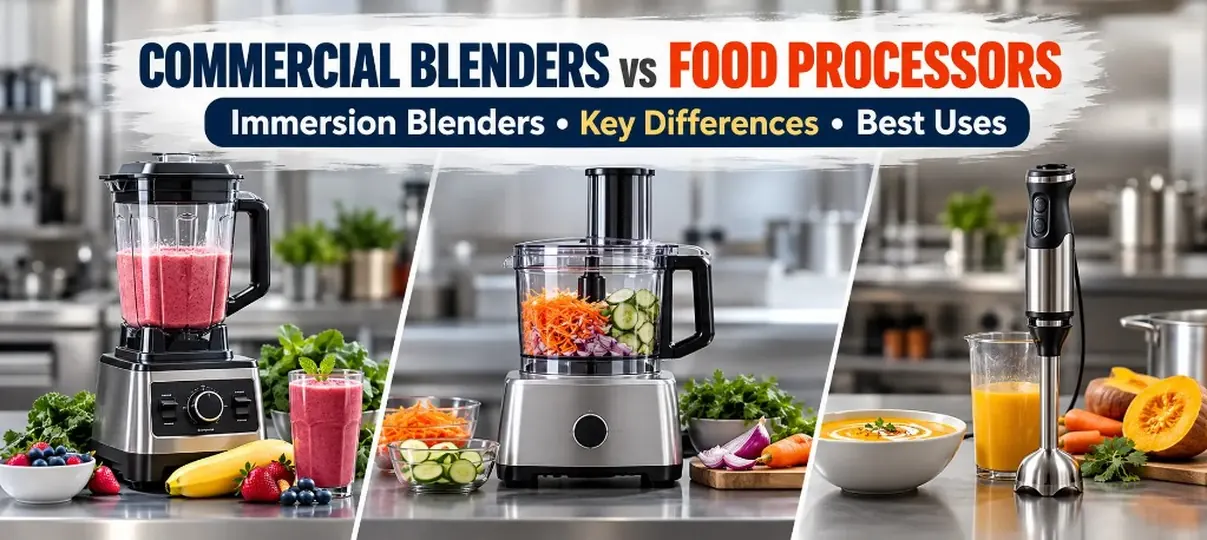
Choosing between a commercial blender, a food processor, and an immersion blender comes down to the job. Use a commercial blender when you need smooth drinks, soups, sauces, nut bases, frozen cocktails, or purees at speed. Choose a food processor for chopping, slicing, shredding, and some dough work. Choose an immersion blender when you need to blend directly in a stockpot, kettle, or deep container.
A commercial blender is a high-power countertop blending machine built for foodservice use. It has a motor base, blade assembly, and jar designed to turn wet or semi-wet ingredients into a smooth, pourable result. In the broader topic of Commercial Blenders vs. Food Processors and Immersion Blenders, the key difference is simple: blenders create smooth flow, processors create cut texture, and immersion units bring blending to the container. A commercial food processor is the bowl machine, not the drink machine.
Which tool should your business choose?
Your business should choose the tool that matches the texture, batch size, and service speed you need. A smoothie bar needs high-performance blenders that can crush ice and frozen fruit many times per hour. A prep kitchen may need a food processor for vegetables and a heavy-duty blender for sauces. A hotel, caterer, or commissary may need all three because each machine solves a different problem.
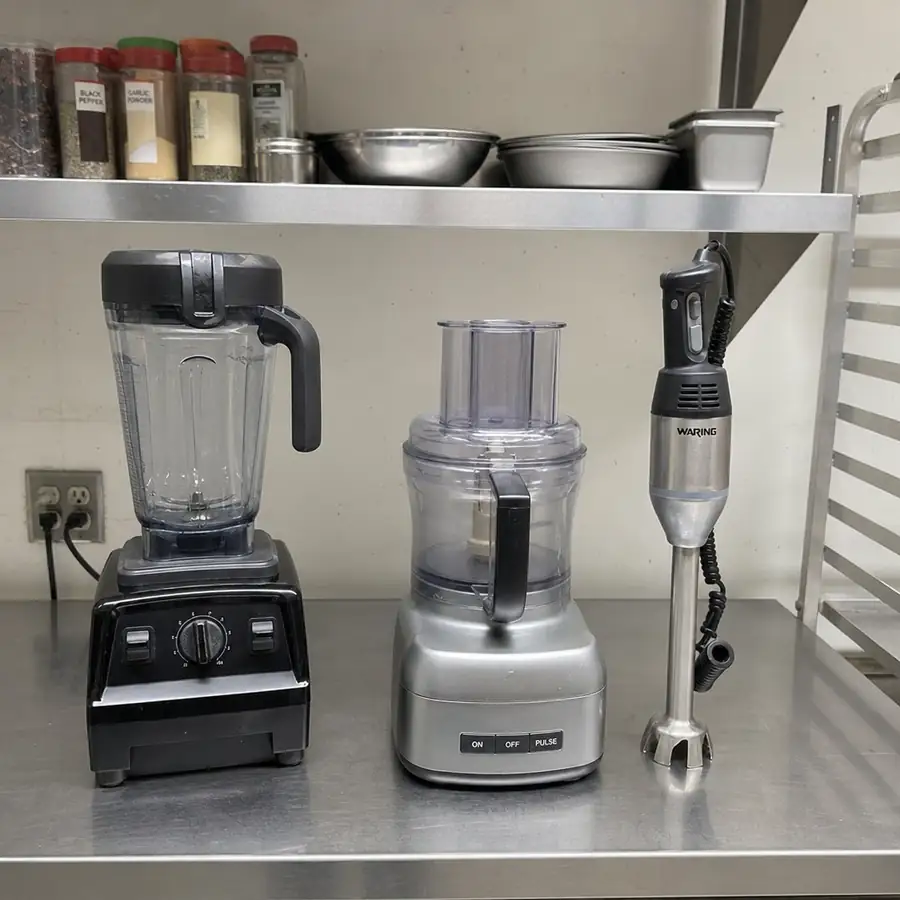
Here is the fast way to compare them:
- Commercial food blenders: Best for smooth drinks, purees, dressings, soups, emulsions, and frozen blends.
- Food processors: Best for chopping, shredding, slicing, grating, and mixing thicker items with less liquid.
- Commercial immersion blenders: Best for blending in large pots, soups, sauces, and batch prep.
- Commercial mixers: Best for dough, batter, whipped cream, mashed potatoes, and bakery prep. They are not a replacement for blenders.
The main equipment types and where they fit
Blender parts are the cost that shows up after the first jar.
Commercial kitchens often need more than one style of machine. The right choice depends on menu, volume, staff flow, noise limits, and cleaning time. It also depends on whether the product must be very smooth or only evenly chopped.
Countertop commercial blenders
These are the most common restaurant blenders. They sit on a work surface and use a jar that locks or rests on the motor base. Many are used as smoothie blenders, bar blenders, and sauce blenders.
They work well in cafes, QSRs, bars, hotels, juice shops, and restaurants. A cafe may use one for frappes and fruit drinks. A bar may use one for frozen cocktails. A restaurant kitchen may use one for vinaigrettes, curry bases, pepper sauces, or soup finishing.
Heavy-duty and industrial blenders
A dough mixer stays with bakery batches, not with drinks.
Heavy-duty blenders and industrial blenders are made for tougher use. They may have stronger motors, larger containers, stronger drive parts, or controls built for repeat cycles. Some are countertop units. Others are larger batch systems for production kitchens.
These fit commissaries, catering operations, high-volume QSRs, central kitchens, and food manufacturing prep areas. The main benefit is endurance. If staff blend thick mixtures all day, a light kitchen blender can slow service and wear out early.
Commercial immersion blenders
Commercial immersion blenders are handheld blending motors with long shafts. Staff place the shaft into a pot or container and blend in place. They are ideal for soup, sauce, bean puree, gravy, and large batches.
They save transfer time. They also reduce burn risk because hot liquid does not need to be moved into a jar. For restaurants, hotels, catering teams, and institutional kitchens, that can be a major workflow win.
Food processors
Food processors use a bowl and blade or discs. They are designed for cutting, shredding, slicing, and grating. They do not usually create the same fine, drinkable texture as professional blenders.
A bakery may use one for nuts, fillings, or pastry prep. A restaurant may use it for slaws, diced vegetables, herb mixes, or breadcrumbs. A cafe may use it for small prep, but it will not replace a smoothie blender.
Features and specifications that matter
A blender is more than a motor with a jar. The details affect speed, texture, labor, and long-term cost. When you compare commercial blenders for restaurants, look at how each feature changes daily work.
Power and torque
Power matters because frozen fruit, ice, fibrous greens, seeds, and thick sauces resist the blade. Torque matters because the blender must keep the blade moving under load. A weak unit may leave chunks or overheat.
For a smoothie shop, strong power means faster drinks and fewer remakes. For a kitchen, it means smoother purees and less straining. For a bar, it helps frozen drinks stay consistent during rush periods.
Capacity and jar size
The commercial blender types guide goes further on jar size.
Common commercial blender jars often sit in the small-to-medium batch range, such as drink jars and prep jars. Larger kitchens may use higher-capacity units or immersion blenders for stockpots. Capacity matters because it affects batch speed and waste.
A bar may prefer smaller jars for single or double servings. A catering kitchen may want larger capacity to prep sauces ahead of service. A QSR may need more than one jar so staff can move from dairy drinks to fruit drinks without delay.
Blade design and jar shape
The blade and jar must create a strong vortex. This pulls food down into the blade path. If the vortex is weak, staff must stop and tamp, shake, or scrape more often.
For drinks, a well-shaped jar can improve speed and texture. For thicker sauces, jar shape helps prevent air pockets. For businesses, that means less labor and more steady output.
Controls and programs
Simple toggles work well for prep cooks who want direct control. Programmed cycles help bars and cafes produce the same drink with less guesswork. Timed programs also free staff to grab cups, lids, or garnishes.
This is important in high-volume service. Consistent cycles reduce training time. They also help protect margins because drinks are less likely to be over-blended, under-blended, or remade.
Noise control
Noise matters in front-of-house spaces. A loud blender can make ordering hard and disturb guests. Sound enclosures are useful for cafes, hotel breakfast areas, juice bars, and open bars.
For back-of-house prep, noise may be less important. In a quiet cafe, it may be a top buying factor. This is where premium vitamix commercial blenders and other quiet beverage units often enter the discussion.
How do Vitamix commercial blenders fit into the mix?
Vitamix is a major commercial blender brand with machines aimed at beverage service and kitchen prep. Its commercial range includes models such as The Quiet One, Drink Machine Advance, and Vita-Prep 3, shown in current Vitamix commercial product listings. The Quiet One is positioned for quiet beverage blending, Drink Machine Advance for drink programs, and Vita-Prep 3 for demanding kitchen prep.
The Quiet One is a fit for cafes, hotel bars, smoothie counters, and front-of-house stations where sound control matters. Drink Machine Advance suits beverage menus that need speed and repeatable drink quality. Vita-Prep 3 is better aligned with kitchens that blend purees, sauces, soups, and thicker prep items. Vitamix also states that Vita-Prep and Vita-Prep 3 are intended for commercial kitchens, while its beverage blender FAQ discusses programmable use for the Drink Machine Advance.
This does not mean every business needs a premium unit. If your cafe only blends a few drinks a day, a basic commercial unit may be enough. If blending is central to sales, better controls, jar design, support, and durability can protect service speed.
Matching equipment to business type
A smoothie truck still plans around the same drink speed.
Different businesses have different pain points. Buying the wrong machine creates delays, noise, waste, or poor texture. The best choice is the one that removes the most friction from your day.
- Restaurant: Use a prep blender for sauces and purees. Add a food processor for vegetable prep.
- Cafe: Use smoothie blenders or quiet bar blenders for drinks. Keep extra jars for rush times.
- Hotel: Use quiet beverage blenders for breakfast and bar areas. Use immersion blenders for banquet soups.
- Bakery: Use commercial mixers for dough and batters. Use food processors for nuts, crumbs, and fillings.
- Bar: Use bar blenders for frozen cocktails. Noise covers matter if the blender sits near guests.
- QSR: Use programmable high-performance blenders for repeat drinks and fast training.
- Food truck: Choose compact professional blenders with simple cleaning and stable power needs.
- Catering: Use commercial immersion blenders for large soups and sauces. Add countertop blenders for finishing.
Retailers such as the horeca store often group these tools by use case, which can make it easier to compare commercial blenders for sale against processors, mixers, and immersion units.
Cleaning, maintenance, parts, and support
A planetary mixer is a different service plan from a drink jar.
Cleaning affects speed as much as blending power does. A blender that is hard to rinse can slow a busy station. Removable jars, clear lids, durable seals, and easy access to replacement parts all matter.
Basic cleaning usually means rinsing the jar right away, running warm water with a small amount of cleaner, then sanitizing based on your local process. Staff should not leave sticky syrups, dairy, or nut mixtures to dry inside the jar. Dried residue takes longer to remove and can affect flavor.
Maintenance is also part of total cost of ownership. Check drive sockets, blade assemblies, seals, jars, cords, switches, and sound covers. A cheaper blender can cost more if jars crack often or if downtime stops sales. Warranty and service support matter because a broken blender during breakfast or happy hour can hurt revenue fast.
Installation is usually simple for countertop kitchen blenders. You still need the right counter space, air flow, and outlet. Large immersion blenders need safe storage, a cleaning sink plan, and staff training. Bigger production units may need more planning before purchase.
What should you compare before buying?
Before buying, compare the menu item, batch size, daily volume, texture goal, cleaning time, sound level, and support plan. The best blender is not always the most powerful one. It is the one that handles your real workload without slowing staff or hurting consistency.
Use this checklist before you buy:
- Menu: Are you making smoothies, cocktails, soups, sauces, dips, or chopped prep?
- Texture: Do you need silky smooth results or a coarse chop?
- Volume: How many blends will you run per hour at peak time?
- Capacity: Are you blending single drinks, prep batches, or large pots?
- Noise: Will guests hear the machine?
- Controls: Do staff need programs, timers, or simple manual speed?
- Cleaning: Can the jar, lid, shaft, or bowl be cleaned fast between tasks?
- Parts: Are jars, blades, seals, and drive parts easy to replace?
- Support: Is warranty service clear and practical for your location?
- TCO: Will the machine save labor, reduce waste, and last under your workload?
Commercial Blenders vs. Food Processors and Immersion Blenders in daily use
In daily use, the biggest difference is how food moves through the machine. A blender pulls ingredients down into a high-speed blade and works best with enough liquid. A food processor moves food around a bowl and cuts it into pieces. An immersion blender works inside the cooking vessel.
That difference changes output. A commercial blender can turn fruit, ice, milk, and syrup into a smooth drink. A food processor can shred cabbage for slaw. An immersion blender can finish twenty liters of soup without moving the pot.
It also changes labor. Blenders need jar handling and rinsing. Food processors need bowl, blade, and disc cleaning. Immersion blenders need careful shaft cleaning and safe handling around hot liquid.
FAQ
1. Can a food processor replace a commercial blender? No. It can chop, slice, and shred, but it usually will not make drinks, smooth sauces, or frozen blends as well as a commercial blender.
2. Can an immersion blender replace a countertop blender? Sometimes, but only for certain jobs. It is great for pots of soup or sauce. It is not ideal for most smoothies, frozen drinks, or small precise blends.
3. Are professional blenders worth it for a small cafe? Yes, if blended drinks are a regular menu item. If blending is rare, a lighter commercial model may be enough.
4. Do bars need special bar blenders? Bars benefit from fast, durable blenders that handle ice well. A sound cover helps if the blender is near guests.
5. What is the main cost after purchase? The main costs are jars, blades, seals, staff time, cleaning time, repairs, and downtime. These are part of total cost of ownership.
Final buying guide
A good buying decision starts with the menu, not the catalog. Match the machine to the work your team does every day. Then compare power, capacity, controls, cleaning, parts, and support.
- If your requirement is smooth drinks at high speed, consider high-performance blenders or dedicated smoothie blenders.
- If your requirement is frozen cocktails in a guest-facing bar, consider quiet bar blenders with strong ice performance.
- If your requirement is sauces, soups, and purees in a restaurant kitchen, consider heavy-duty blenders such as kitchen-focused professional blenders.
- If your requirement is large hot batches, consider commercial immersion blenders.
- If your requirement is slicing, shredding, chopping, or grating, consider a food processor instead of a blender.
- If your requirement is dough, batter, or whipped items, consider commercial mixers.
- If your requirement is long daily use across many menu items, consider durable restaurant blenders with easy parts support and a clear warranty path.