
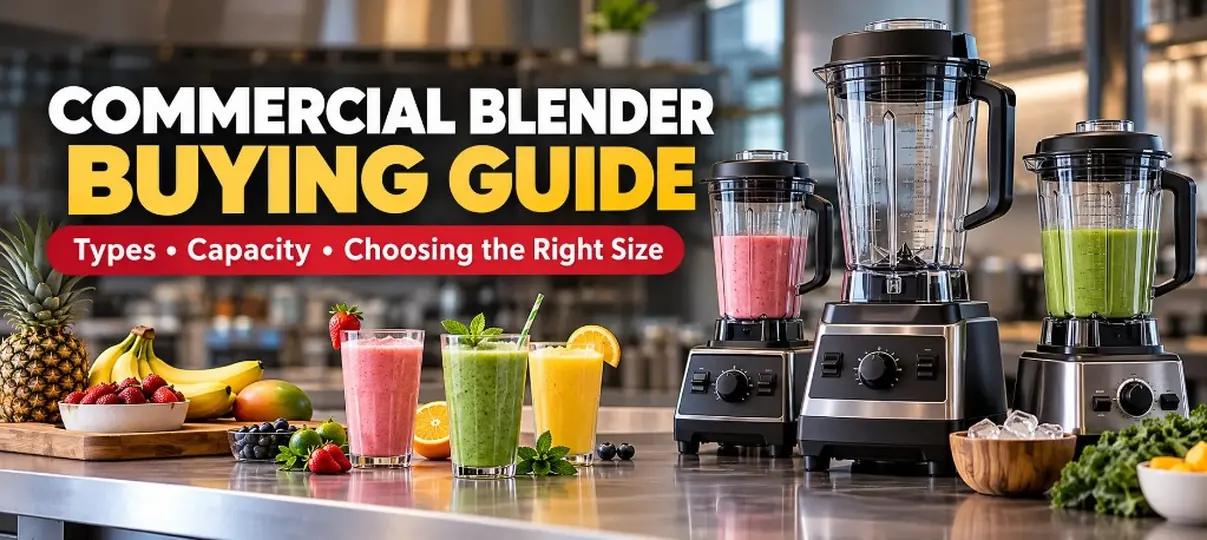
The right commercial blender is the one that matches your menu, batch size, peak-hour volume, counter space, and cleaning routine-not simply the biggest or most powerful unit available. For most cafes, bars, and smoothie counters, a 48-64 oz. beverage blender is the practical workhorse; for prep kitchens, commissaries, hotels, and catering teams, a large capacity commercial blender in the 1-gallon to 1.5-gallon range can reduce batch counts and labor.
A commercial blender is a foodservice-grade blending machine designed for repeated daily use in restaurants, cafes, hotels, bars, bakeries, QSRs, food trucks, catering operations, and institutional kitchens. Unlike a home blender, it is selected around duty cycle, jar capacity, motor strength, controls, sound management, spare parts, sanitation, and support.
What size commercial blender do you actually need?
A smoothie truck and a coffee truck both live on a small counter, so jar height matters.
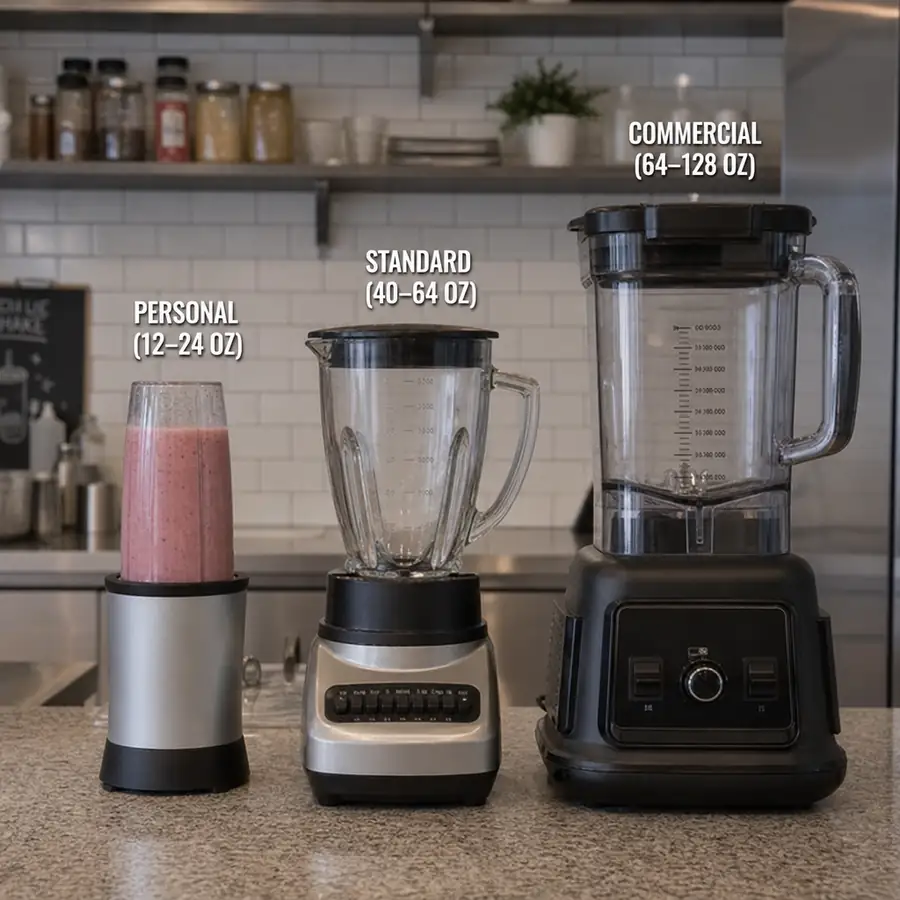
You need a blender size that handles your normal batch without forcing staff to overfill the jar or run too many repeated cycles. A small drinks menu may only need a quiet 48 oz. countertop unit, while a sauce-heavy restaurant may benefit from a 64 oz. or 1-gallon food blender, and a production kitchen may need a high capacity commercial blender with a 1.5-gallon container.
The key is to separate container capacity from usable working capacity. Dense hummus, nut butter, frozen fruit, and thick purees often require smaller loads than thin soups or juices because the motor, blade, and vortex need room to move product efficiently. If staff are blending the same base ten times before lunch service, capacity is probably too small. If they constantly blend half-empty jars, the blender may be oversized for daily use.
Main commercial blender types and where they fit
Food prep equipment and a refrigerated beverage dispenser sit beside the jar, not inside it.
Commercial Blender Types, Capacity, and Choosing the Right Size becomes easier when you start with the job the blender must perform. Most foodservice buyers fall into one of these categories.
Beverage blenders
A citrus juicer and a juice extractor cover fresh juice that a jar should not handle.
Beverage blenders are built for smoothies, frappes, milkshakes, cocktails, iced coffee drinks, and blended juices. They usually prioritize speed, texture consistency, pre-programmed cycles, and noise control. A sound enclosure is especially useful for front-of-house cafes, hotel breakfast areas, juice bars, and open QSR counters.
Examples include Vitamix The Quiet One, which has a 48 oz. capacity, a 3 peak horsepower motor, sound-reduction design, and programmed blend settings for beverage service. Blendtec Stealth 885 is another quiet beverage-focused option; its commercial literature highlights a 90 oz. WildSide+ jar and sound enclosure design.
Food prep blenders
An immersion blender stays on the pot, while this jar stays on the counter.
Food prep blenders handle sauces, dressings, marinades, soups, salsa bases, dessert fillings, and purees. They are common in restaurants, bakeries, hotels, catering kitchens, and commissaries where the blender works behind the scenes rather than at the customer counter.
A 64 oz. jar is often the flexible middle ground because it can process moderate batches without taking over the prep table. Waring's MX1500XTX, for example, is a 64 oz. commercial blender with a sound enclosure, making it suitable where prep performance and noise reduction both matter.
Large-capacity countertop blenders
A commercial food processor is the next step when the batch is chopped, not blended.
A commercial blender large capacity setup is useful when the kitchen needs fewer batches of the same recipe. Think banquet sauces, soup bases, smoothie prep for a busy breakfast buffet, or bulk purees for a central production kitchen.
The Vitamix XL is a classic example of a large capacity heavy duty commercial blender category. It uses a 1.5-gallon container for large batches and also offers a 64 oz. container for smaller work, while the motor is listed at about 4.2 peak output horsepower.
One-gallon food blenders
A planetary mixer still owns batters that a jar will overheat.
One-gallon food blenders suit kitchens that need bulk capacity but still want a countertop footprint. They are commonly used for soups, sauces, batters, dressings, and institutional prep. Waring's CB15T, for instance, is listed as a 1-gallon blender with a 3.75 HP commercial motor and stainless steel container options.
Blender-mixers and specialty puree machines
A milkshake maker is a spindle, not a jar.
Some kitchens need more than a standard blender. Healthcare kitchens, large catering operations, and specialty food producers may use machines such as Robot Coupe Blixer models for texture-modified meals, emulsions, and high-volume purees. Larger Blixer models are specified by bowl capacity and production volume rather than drink jar size, so they fit a different use case than a bar blender.
Capacity, power, and performance features that matter
An ice machine and ice supplies keep the frozen load coming.
A blender spec sheet can feel technical, but every detail affects daily labor, consistency, or ownership cost.
- Jar capacity: 48 oz. works well for single or small grouped beverages; 64 oz. supports mixed beverage and prep work; 1 gallon or 1.5 gallons reduces batch counts for bulk prep.
- Motor strength: Higher horsepower helps with frozen fruit, ice, thick sauces, and long runs, but blade design and jar shape also matter. A powerful motor in the wrong jar may still blend poorly.
- Controls: Variable speed gives chefs control over texture, while programmed cycles help cafes and QSRs produce consistent drinks with less training.
- Sound enclosure: Important for customer-facing counters, hotel buffets, offices, and open kitchens where blender noise can affect the guest experience.
- Jar material: Clear copolyester or polycarbonate jars make it easy to see texture; stainless steel jars are durable and useful for hot or stain-prone ingredients.
- Footprint and height: A blender that does not fit under shelving, near outlets, or beside mise en place slows the line. Always check lid-open clearance.
- Electrical requirements: Many high-output units use standard commercial 120 V, 15 A circuits, but buyers should verify compatibility before ordering.
- Parts availability: Containers, lids, blade assemblies, drive sockets, centering pads, and gaskets are wear items. Easy access to parts reduces downtime.
If your team is searching for a commercial kitchen large capacity blender-sometimes mistyped as "commercial kitchen lare capacity blender"-focus first on the actual recipe load. A 1.5-gallon container is helpful only if your recipes, storage process, and staff workflow can use that output efficiently.
Matching blender options to business needs
A food truck still needs a spare jar, and bar refrigeration stays on its own circuit.
The best blender depends on how often it runs, what it blends, and where it sits. Use this quick mapping before comparing models.
For many buyers, The Horeca Store can be a practical place to compare categories side by side: quiet beverage units for front counters, heavy-duty food prep blenders for kitchens, and large-capacity options for higher-volume operations.
Brand and model examples by use case
A commercial coffee machine and a coffee bean grinder should not share the blender circuit.
Vitamix The Quiet One fits cafes, smoothie bars, and hotel counters where noise and repeatable beverage texture matter. Its 48 oz. container, 3 peak HP motor, sound-reduction features, and programmed settings are designed around fast drink production.
Blendtec Stealth 885 is also positioned for quiet commercial beverage service. Its sound enclosure and high-capacity WildSide+ jar make it relevant for smoothie shops, coffee chains, and high-volume drink programs that want automated cycles and reduced counter noise.
Waring MX1500XTX suits operations that want a 64 oz. jar and an enclosure in a powerful prep or beverage unit. It can be a good middle path for restaurants that make both drinks and kitchen prep items.
Waring CB15T is better for bulk food prep because its 1-gallon capacity and heavy-duty motor are aimed at larger loads and longer blending times. That makes it more appropriate for sauces, soups, and production batches than for a quiet cafe counter.
Vitamix XL is for kitchens that truly need a high capacity commercial blender. With a 1.5-gallon container plus a smaller 64 oz. container, it gives prep teams flexibility for large and moderate batches.
Installation, cleaning, maintenance, and ownership cost
A hand wash sink, a 3 compartment sink, and an undercounter refrigerator should sit on the rinse and hold path.
Commercial blenders are usually countertop machines, so installation is mostly about space, clearance, power, ventilation, and workflow. Place the blender close to ingredients, rinse sinks, and portion containers, but away from wet edges and congested pass areas. Check the full height with the lid open, especially when buying an enclosed sound model.
Cleaning should be built into the shift routine. Many beverage jars can be rinsed by blending warm water with a small amount of detergent, then sanitizing according to local procedures. Sticky purees, dairy, nut mixtures, and oily sauces need more careful cleaning around the lid, gasket, blade area, and jar threads.
Maintenance is where commercial ownership differs from home use. Inspect drive sockets, pads, jars, lids, blades, and seals regularly. Replace worn parts before they fail during service. Vitamix notes that commercial care includes routine inspection of parts such as drive sockets and centering pads, which is a useful reminder for any brand.
Total cost of ownership includes the purchase price, spare jars, blades, lids, downtime, labor saved, energy use, training, and warranty support. For example, Vitamix lists The Quiet One with a three-year warranty on motor base parts and one-year coverage on labor and certain container components, while the Vitamix XL page lists three-year motor base parts coverage and one-year container and blade assembly coverage.
Common buyer questions
Frozen fruit belongs in a commercial freezer, then a reach in refrigerator for the thawed base.
1. Is bigger always better for a commercial blender? No. A larger jar saves time only when you regularly blend large batches. For small drinks, dressings, or test batches, an oversized jar can blend inefficiently and waste product.
2. What is the best capacity for a cafe? Most cafes do well with 48-64 oz. beverage blenders, especially if they have sound enclosures and programmed cycles. High-volume smoothie cafes may use multiple units rather than one oversized machine.
3. When should I choose a 1-gallon blender? Choose 1 gallon when your kitchen repeatedly makes sauces, soups, batters, or purees in batches larger than 64 oz. It is a strong fit for restaurants, hotels, and caterers with predictable prep lists.
4. Do I need a sound enclosure? If the blender runs near guests, staff workstations, or an ordering counter, a sound enclosure is usually worth considering. In a back prep kitchen, capacity and durability may matter more.
5. How many blender jars should a business buy? Many operations benefit from at least one spare jar, and busy beverage programs often need several. Extra jars reduce washing bottlenecks, prevent flavor crossover, and keep service moving.
Final buying guidance
Restaurant equipment planning still includes blender parts and a commercial refrigerator for finished puree.
If you run a coffee shop, smoothie bar, hotel breakfast station, or QSR counter, then choose a quiet 48-64 oz. beverage blender with programs and a sound enclosure. If you run a restaurant, bakery, or bar that blends sauces, soups, dressings, and occasional drinks, then choose a 64 oz. heavy-duty commercial blender with variable speed and durable jars.
If your prep team blends the same recipe in repeated batches every day, then step up to a 1-gallon model. If you manage catering, banquet, commissary, or institutional production, then choose a large capacity heavy duty commercial blender such as a 1.5-gallon unit or a specialty mixer designed for bulk purees. The right choice is the blender that cuts labor, protects consistency, fits your station, and can be cleaned and serviced without slowing the business down.