
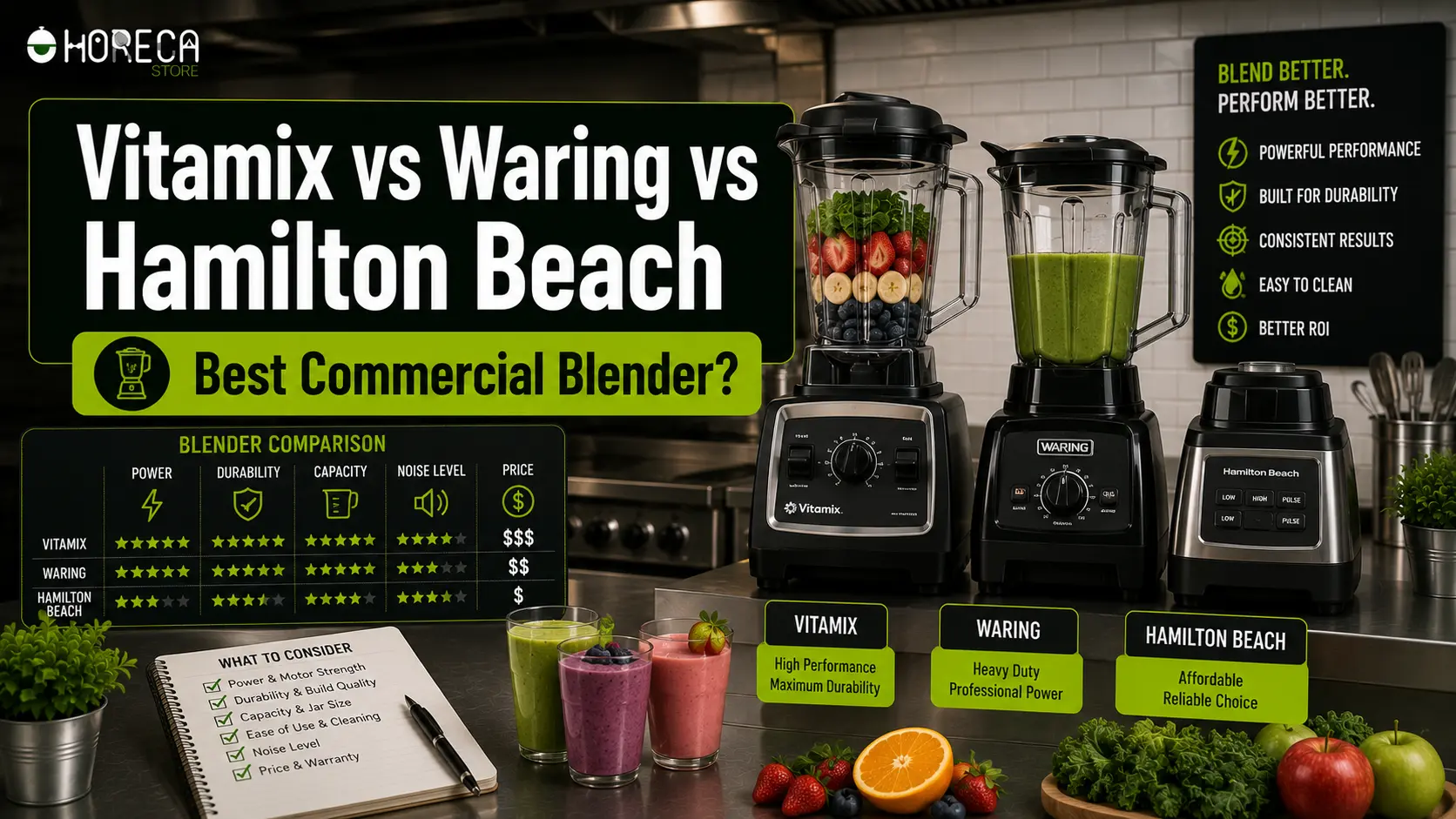
If you’re buying for a café, bar, school kitchen, restaurant, hotel, or commissary, a residential blender is not the right benchmark. The better question is which commercial blender brand fits your menu, volume, staff workflow, noise tolerance, and service expectations. Vitamix, Waring, and Hamilton Beach Commercial all make credible heavy-duty blenders, but they are not identical tools with different logos. Each brand has a different strength: Vitamix leans toward premium consistency and operator familiarity, Waring offers one of the broadest duty-cycle ranges, and Hamilton Beach Commercial emphasizes practical foodservice features, quiet blending options, and service-minded warranties.
This commercial blenders comparison is designed as a practical blender buying guide, not a one-size-fits-all ranking. The “best” choice depends on whether you are blending 200 smoothies a day, preparing gallon batches of sauce, building a craft cocktail program, or giving line cooks a reliable prep tool.
Quick verdict
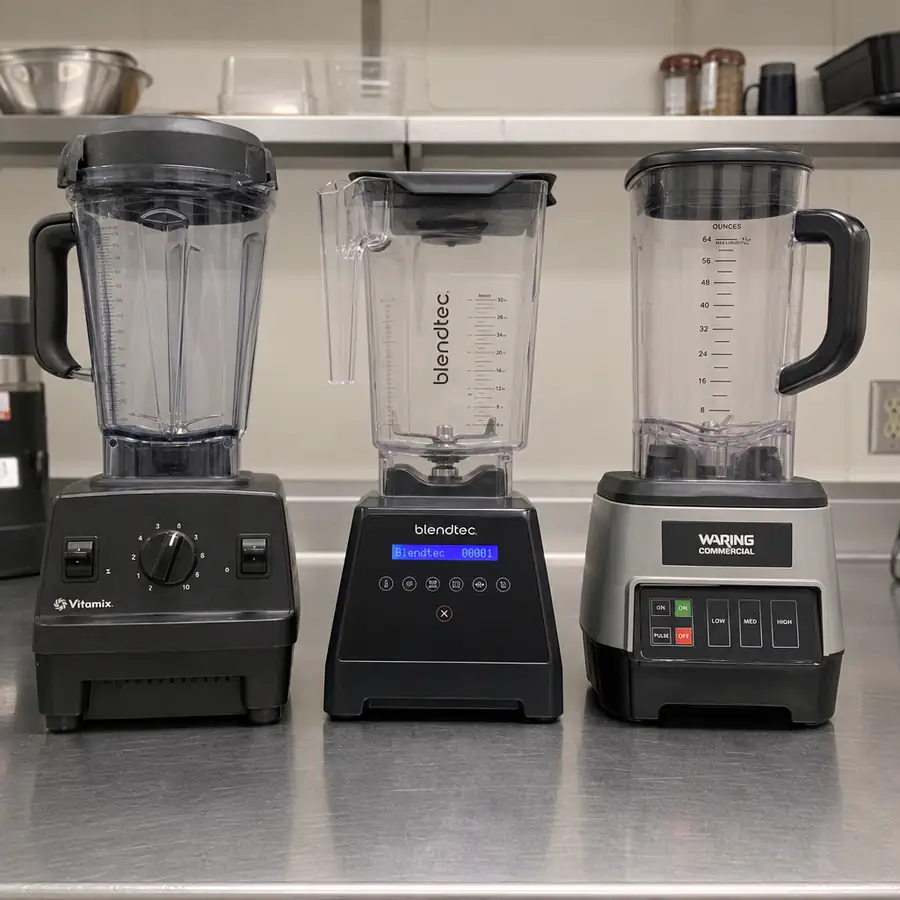
Choose Vitamix if you want a premium commercial blender for smooth beverage programs, culinary prep, and staff-friendly consistency. The brand’s commercial lineup includes beverage-focused models such as The Quiet One and Drink Machine Advance, plus culinary workhorses such as the Vita-Prep 3. The Vita-Prep 3 is listed with an approximately 3 peak output horsepower motor, a 64-ounce container, variable speed control, a tamper, and a commercial warranty structure that covers the motor base differently from the container and blade assembly.
Choose Waring if you want the widest spread of commercial options, from light-duty bar blenders to ultra-heavy-duty one-gallon food and beverage machines. Waring’s own comparison materials organize blender lines by usage level, including light-duty beverage prep, medium-duty beverage prep, heavy-duty food and beverage prep, and 100-plus-cycle-per-day one-gallon blending.
Choose Hamilton Beach Commercial if you want practical restaurant features, strong front-of-house quiet-blending options, and service support that can be especially appealing for multi-unit operations. Hamilton Beach Commercial highlights features such as QuietBlend technology on the Eclipse, Auto Blend on Summit models, and Express Care service on selected products in the United States.
Best fit for:
- Smoothie shops that need consistent texture and fast staff training
- Restaurants that need a reliable prep blender for sauces, dressings, purées, and frozen mixtures
- Cafés and juice bars that want a recognizable premium brand
- Operators who prefer straightforward controls over a large number of SKU choices
Potential drawbacks:
- Premium commercial Vitamix models often sit in a higher budget tier than entry-level commercial blenders
- Some models are specialized, so beverage units and culinary units should not be treated as interchangeable without checking container and program compatibility
- Warranty terms vary by model and component, so buyers should review the exact warranty for the unit they purchase
Waring: broadest range and duty-cycle segmentation
Waring is a strong choice when you want to match blender duty level to a very specific job. Instead of treating every commercial blender as the same category, Waring’s product guidance separates machines by application and cycle volume. Its reference materials list options ranging from light-duty bar blenders for 1 to 25 cycles per day to ultra-heavy-duty one-gallon blenders for 100-plus cycles per day.
That makes Waring especially useful for operators who know their production pattern. A hotel bar making occasional frozen cocktails does not need the same blender as a school cafeteria preparing breakfast smoothies by the batch. A commissary making sauces or refried beans in large quantities has different needs again.
Best fit for:
- Operators who want a clear step-up path by volume and application
- Bars, smoothie shops, coffee shops, schools, healthcare kitchens, and large restaurants
- Kitchens needing large-capacity blending, including one-gallon jars on select lines
- Buyers who want multiple control styles, jar materials, and duty levels
Potential drawbacks:
- The wider product range can make selection more complex
- Some Waring lines are designed for light or medium duty, so choosing only by price can lead to underbuying
- Buyers should verify whether the chosen model includes a sound enclosure, programmable controls, or the warranty length they expect
Hamilton Beach Commercial: practical features and operator support
Hamilton Beach Commercial is often compelling for operators who want a balance of performance, usability, and service. The brand’s blender lineup includes beverage machines such as the Eclipse and Tempest, along with culinary EXPEDITOR models for back-of-house prep. The Eclipse is promoted with QuietBlend technology, an advanced Quiet Shield enclosure, a 3 peak horsepower motor rating, and access to numerous pre-programmed cycles.
For culinary production, Hamilton Beach Commercial’s EXPEDITOR HBF1100S is listed as a 4-liter, 1-gallon blender with a 3.5 horsepower motor, lid interlock, CHOP function, and lifetime warranty coverage on the motor drive coupling and stainless steel blades.
Best fit for:
- Cafés, bars, and restaurants that care about noise control
- Operators who value service programs and practical warranty support
- High-volume prep kitchens needing larger culinary blending capacity
- Multi-location foodservice teams seeking repeatable drink or prep programs
Potential drawbacks:
- The Hamilton Beach name also appears on consumer appliances, so buyers must make sure they are selecting Hamilton Beach Commercial equipment, not a household unit
- Some features are model-specific, so Auto Blend, QuietBlend, Express Care, and lifetime blade or coupling coverage should not be assumed across every blender
- Operators comparing premium beverage texture should test recipes against Vitamix and Waring before standardizing
Best commercial blenders by use case
Best for high-volume smoothie shops
For commercial smoothie blenders, the strongest contenders are Vitamix beverage models, Waring heavy-duty beverage models, and Hamilton Beach Commercial’s quiet high-performance beverage units.
Vitamix is a top contender when the goal is a smooth drink with minimal staff learning curve. The Drink Machine Advance is designed around a 48-ounce Advance container and includes programs for smoothie and shake applications, including a thick smoothie program and hard-pack shake program described in Vitamix documentation.
Waring is a strong option when smoothie volume varies by location. Its lineup includes heavy-duty and medium-duty tiers, with different daily cycle ranges and jar options. If one location needs 75-plus cycles a day and another needs 25 to 49, Waring’s segmentation can help prevent overspending or underbuying.
Hamilton Beach Commercial is worth serious consideration when smoothies are made in customer-facing spaces. The Eclipse is designed around quiet operation features, while the Summit family is associated with programmable drink cycles and Auto Blend sensor blending in Hamilton Beach Commercial’s buying guidance.
Recommended direction:
- Choose Vitamix for premium texture and straightforward consistency.
- Choose Waring for volume-matched duty cycles and a broad equipment ladder.
- Choose Hamilton Beach Commercial for quiet smoothie stations and service-friendly operation.
Best for bars and frozen cocktails
Bars need a different balance than smoothie shops. Speed matters, but so do footprint, control simplicity, noise, and the ability to survive sticky, repetitive drink service.
Waring is especially strong here because its lineup includes light-duty and medium-duty bar options in addition to heavier beverage models. Its lower-duty tiers are specifically positioned for frozen drinks, cocktails, and blended beverages, while heavier tiers can handle more demanding frozen fruit smoothies and iced coffee drinks.
Hamilton Beach Commercial also has strong bar appeal. The Tempest is documented with a 64-ounce container, 3 horsepower motor rating, two speeds, pulse, jump cycle, timer with automatic shutoff, and a jar pad sensor that turns the motor off when the container is not in place.
Vitamix remains a good option for bars with premium frozen cocktail programs, especially when drink texture is part of the brand promise. The key is choosing a beverage-focused commercial model rather than assuming a kitchen prep blender is the best bar tool.
Recommended direction:
- Choose Waring for a wide range of bar-specific price and duty levels.
- Choose Hamilton Beach Commercial for operator-friendly beverage controls and quiet front-of-house options.
- Choose Vitamix for premium frozen drink consistency.
Best for restaurant prep kitchens
Back-of-house blending is different from beverage service. Cooks may need to purée soups, emulsify vinaigrettes, process herbs, blend sauces, prepare batters, or handle thick frozen mixtures. Variable speed, container size, tamper support, heat management, and easy cleaning matter more than customer-facing noise.
Vitamix Vita-Prep 3 is one of the most relevant models in this category because it is built for commercial kitchens and includes variable speed control, a tamper, a 64-ounce BPA-free container, and an advanced cooling fan.
Hamilton Beach Commercial’s EXPEDITOR line is also a strong kitchen-prep option, especially for high-volume batches. The HBF1100S is documented with a 1-gallon stainless steel jar, a 3.5 horsepower motor, lid interlock, CHOP function, and touchpad-style controls on the high-volume culinary version.
Waring’s larger food and beverage lines, including one-gallon options, are a strong fit for high-volume institutions, commissaries, schools, and restaurants that need batch prep. Waring’s own guide lists one-gallon ultra-heavy-duty machines for foods such as sauces, soups, dressings, salsas, refried beans, doughs, desserts, and smoothies.
Recommended direction:
- Choose Vitamix for precision, thick blends, and culinary versatility.
- Choose Waring for larger batch options and clear heavy-duty categories.
- Choose Hamilton Beach Commercial for large-capacity culinary blending and safety-focused features.
Noise comparison
Noise is one of the most overlooked buying factors in professional blender reviews. A loud blender in a closed prep kitchen may be acceptable. A loud blender beside a café register can damage the customer experience.
Vitamix’s The Quiet One is built as a commercial beverage blender with a compact enclosure and 48-ounce Advance container. That makes it a strong candidate for front-of-house smoothie, coffee, or quick-service environments where noise reduction matters.
Hamilton Beach Commercial’s Eclipse is another strong quiet-blending contender. Its product sheet highlights QuietBlend technology and a Quiet Shield enclosure, positioning it for operators who need power without turning the service counter into a noise problem.
Waring also offers noise-control pathways on select models. Its MX Series materials note that sound enclosures are available or included on certain versions, which can make Waring more flexible if you want to choose from multiple duty levels while still addressing sound.
The practical takeaway: if customers can hear the blender, compare enclosed beverage models first. If the machine lives in the prep kitchen, prioritize durability, capacity, controls, and service access before noise.
Controls and staff training
Controls can determine whether a blender performs consistently across shifts. A highly skilled bartender may prefer manual speed control and pulse. A busy smoothie shop may prefer programs that allow new employees to press one button and move on. A prep cook may need variable speed for texture control.
Vitamix tends to excel when you want intuitive operation and repeatable output. Models such as the Vita-Prep 3 give cooks variable speed control and a tamper, while beverage models such as Drink Machine Advance support programmed drink applications.
Waring offers more variety. Depending on the line, operators can choose simple toggle controls, countdown timers, variable speed controls, electronic keypads, or reprogrammable settings. That flexibility is useful, but it also means you should choose based on staff skill level and menu complexity.
Hamilton Beach Commercial places a clear emphasis on operational workflow. Its guidance notes that different control types fit different jobs, from simple bar controls to touchpad controls and advanced programmable drink cycles.
Capacity and jar options
Capacity is not just about how many ounces fit in the container. It affects batch size, vortex formation, cleaning time, ingredient waste, and consistency.
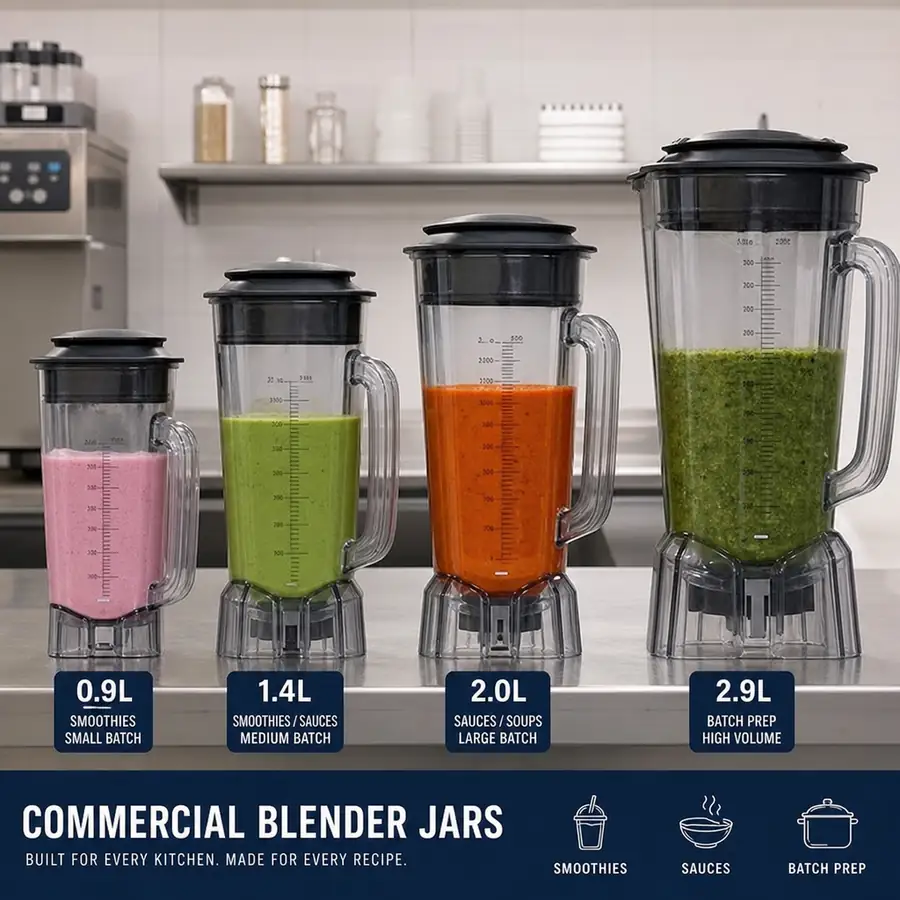
For single-serve beverages, 32-ounce and 48-ounce jars can be efficient. For larger smoothies, frozen coffee drinks, or batch cocktails, 48-ounce and 64-ounce containers are common. For schools, commissaries, healthcare kitchens, and large restaurants, 1-gallon jars may be more efficient than repeating small batches.
Vitamix covers both beverage and kitchen prep capacities, including 48-ounce beverage containers and 64-ounce culinary containers on models referenced above.
Waring has one of the clearest capacity ladders in this comparison, with jar options ranging from smaller bar containers to 64-ounce jars and 1-gallon copolyester or stainless steel containers on heavy-duty lines.
Hamilton Beach Commercial also covers the range from beverage jars to large culinary jars. Its EXPEDITOR family includes models with up to 1-gallon capacity, while beverage models such as Tempest use 64-ounce containers.
Warranty and service considerations
When comparing the best commercial blenders, do not stop at horsepower and price. Warranty structure matters because blender failures often involve different parts: motor bases, blades, jars, couplings, seals, bearings, and control panels may not all be covered the same way.
Vitamix’s Vita-Prep 3 warranty, for example, distinguishes between motor base parts, labor, and components such as the blade assembly and container.
Waring’s reference chart shows warranty differences by line, including longer coverage on certain heavy-duty and ultra-heavy-duty machines than on lighter-duty bar models.
Hamilton Beach Commercial highlights warranty and service as a buying factor. Its buying guidance says several high-performance blenders include overall parts-and-labor warranty coverage, while selected models include longer motor coverage or lifetime coverage on the stainless steel blade and motor drive coupling.
Before you buy, confirm:
- Whether the warranty covers commercial use in your country
- Whether labor is included or only parts
- Whether jars, blades, gaskets, bearings, or drive couplings are treated as wear items
- Whether replacement equipment is available during repair
- Whether local service centers stock parts
- Whether the model is appropriate for your expected daily cycle count
Price and total cost of ownership
The cheapest commercial blender is rarely the cheapest long-term choice if it is underpowered for your use case. At the same time, the most expensive model is not automatically the smartest purchase if your volume is low.
Think in terms of total cost of ownership:
- Initial purchase price
- Replacement jars and blade assemblies
- Downtime during repair
- Staff time spent re-blending inconsistent drinks
- Warranty coverage and service speed
- Noise impact in customer-facing environments
- Whether one high-capacity blender can replace multiple small-batch blends
Vitamix may justify a higher investment when texture quality and brand familiarity matter. Waring may offer the most precise cost matching because its lineup spans many duty levels. Hamilton Beach Commercial may stand out when service programs, quiet operation, and practical restaurant features reduce operational friction.
Buying checklist
Use this blender buying guide before comparing individual models:
- Define the job first. Smoothies, frozen cocktails, hot soup prep, sauces, dressings, nut blends, and gallon batches do not require the same machine.
- Estimate daily cycles. A blender used 15 times a day can be very different from one used 100 times a day.
- Choose beverage or culinary design. Beverage blenders prioritize speed and repeatable drinks. Culinary blenders prioritize texture control, thicker mixtures, and prep versatility.
- Check capacity honestly. A 64-ounce jar may not replace a 1-gallon jar in a school or commissary.
- Evaluate noise at the installation point. If customers are nearby, compare sound enclosures and quiet-blending models.
- Match controls to staff skill. Programmed cycles help new staff. Variable speed helps chefs. Simple toggles help bartenders who want direct control.
- Review warranty details by component. Motor base, labor, jar, blade, and coupling coverage may differ.
- Plan for replacement parts. Extra jars, lids, blade assemblies, and drive components can prevent downtime.
- Test your real recipes. Ice, frozen fruit, nut butters, hummus, thick purées, and fibrous vegetables reveal differences that spec sheets cannot.
- Avoid consumer models for commercial use. Commercial kitchens need equipment designed and warrantied for foodservice conditions.
Final recommendation
For many buyers, Vitamix is the safest premium pick. It is a strong choice when smooth texture, training simplicity, and commercial kitchen versatility matter more than finding the lowest purchase price. If your brand depends on consistent smoothies, frozen drinks, sauces, or purées, start your shortlist with Vitamix.
Waring is the best fit for buyers who want the most granular equipment matching. Its lineup makes it easier to choose by duty cycle, capacity, jar type, and control style. If you operate multiple venues with different blending volumes, or you need anything from a light bar blender to a one-gallon workhorse, Waring deserves close attention.
Hamilton Beach Commercial is the strongest practical all-rounder for many foodservice teams. It is especially appealing when noise control, service support, operator-friendly features, and commercial warranties are central to the decision. Cafés, bars, schools, and restaurants that want capable machines with thoughtful workflow features should include Hamilton Beach Commercial in their final commercial blender reviews.
The smartest approach is to narrow the choice by use case: Vitamix for premium consistency, Waring for range and duty-cycle matching, and Hamilton Beach Commercial for quiet operation, practical features, and service-minded foodservice support. Once you know your menu, volume, and installation environment, the right blender becomes much easier to identify.
Commercial Blender Comparison: Vitamix vs Waring vs Hamilton Beach
Choosing the right commercial blender depends on your menu, daily blending volume, and performance requirements. Vitamix is known for premium blending power and durability, making it ideal for smoothies, frozen drinks, and high-volume cafés. The Horeca Store Waring offers versatile, commercial-grade blenders with strong performance for restaurants and bars, while Hamilton Beach provides reliable, budget-friendly models suitable for cafés, quick-service restaurants, and businesses with moderate blending needs. Comparing motor power, container capacity, speed controls, noise levels, and warranty can help you select the best blender for your operation.
Whether you need a high-performance blender for busy beverage service or an affordable option for everyday food preparation, choosing the right equipment improves efficiency and consistency. The Horeca Store offers a wide range of commercial blenders, beverage equipment, food preparation machines, and restaurant supplies from trusted brands. With quality products, competitive pricing, and dependable support, The Horeca Store helps foodservice businesses invest in equipment that delivers reliable performance and long-term value.