
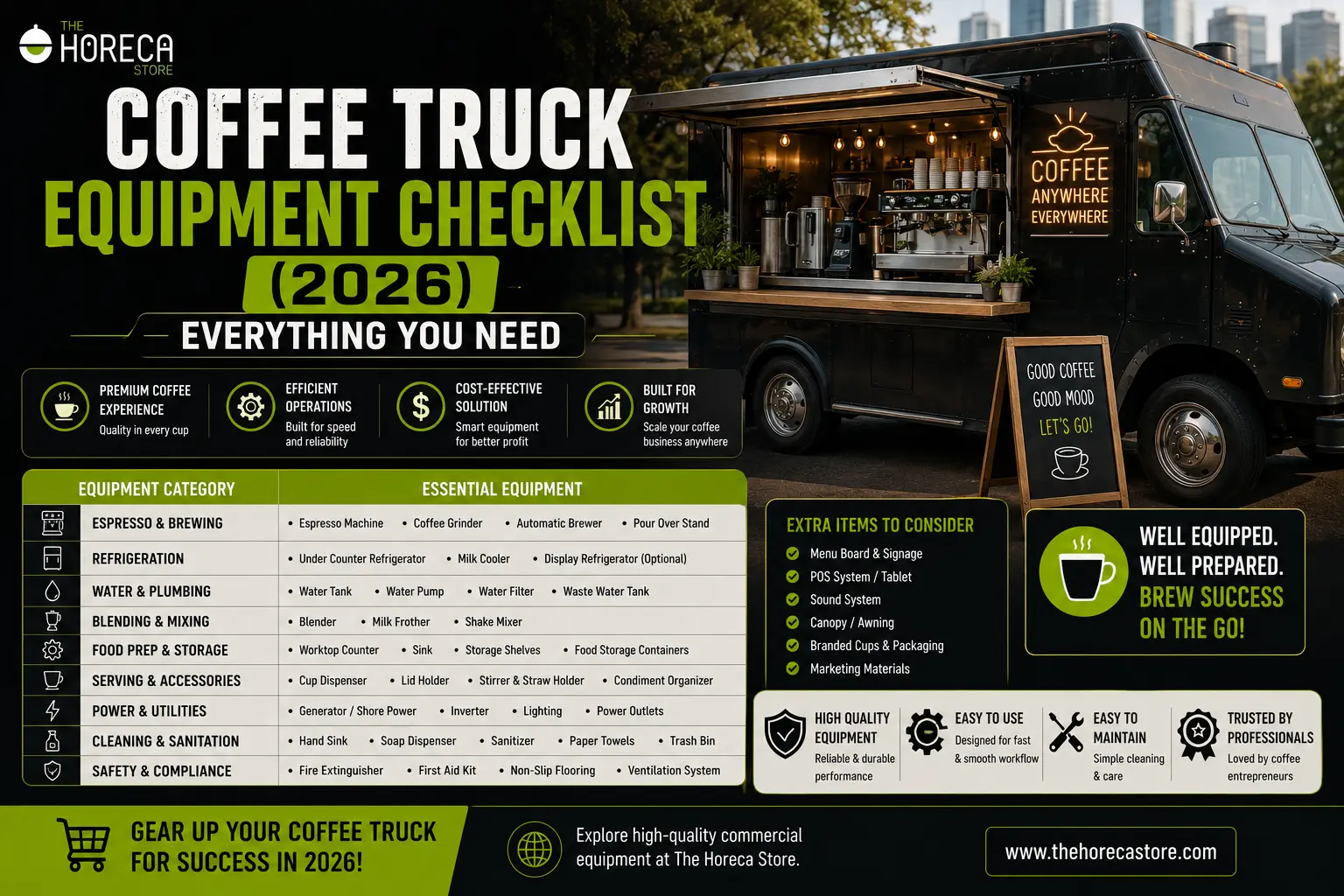
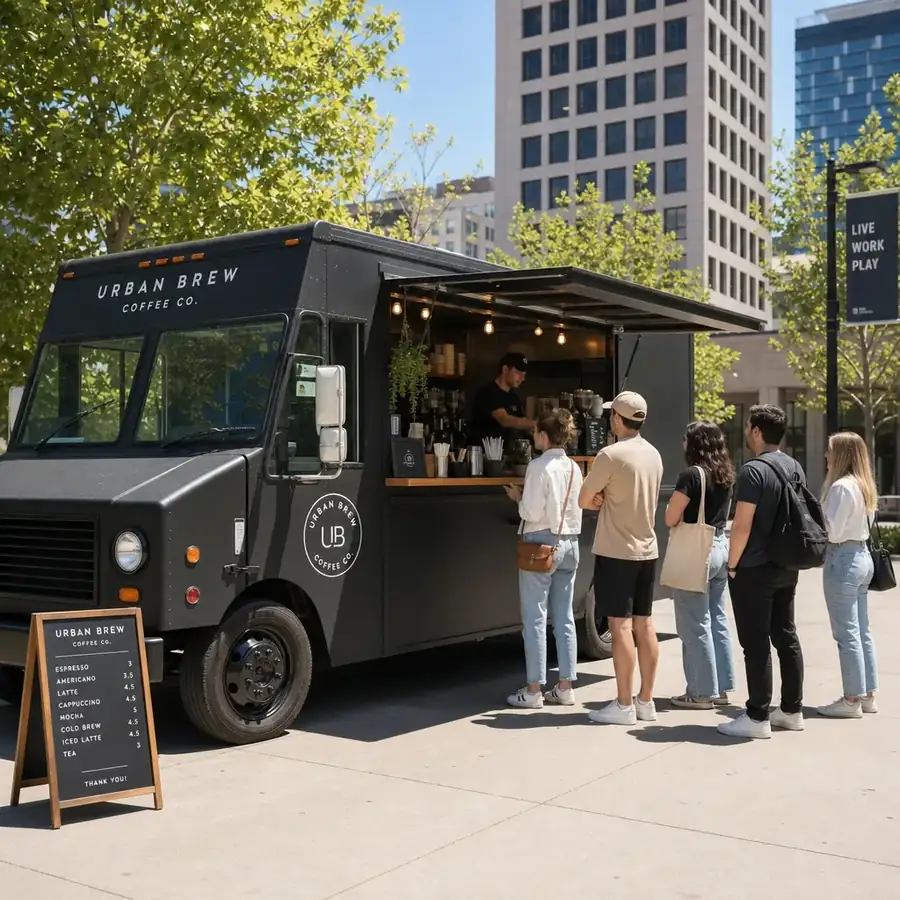
The mobile coffee industry is evolving at a breakneck pace. As we approach 2026, consumer expectations for specialty coffee have never been higher, and local health and safety regulations are becoming increasingly stringent. If you are planning to launch a new mobile café or upgrade your existing rig, relying on outdated lists simply won’t cut it. You need a comprehensive, forward-thinking strategy to ensure your business is efficient, profitable, and compliant.
Building out a coffee truck requires a delicate balance of electrical engineering, plumbing, spatial design, and culinary expertise. You have limited space, limited power, and a fast-paced environment where every second counts. To help you navigate this complex process, we have compiled the ultimate Coffee Truck Equipment Checklist for 2026.
This guide dives deep into the modern coffee cart essentials, exploring everything from silent power solutions to high-tech brewing systems. Whether you are outfitting a vintage Airstream, a compact transit van, or a custom-built trailer, this comprehensive coffee equipment list will serve as your blueprint for success.
The Heart of the Operation: Coffee Brewing Equipment
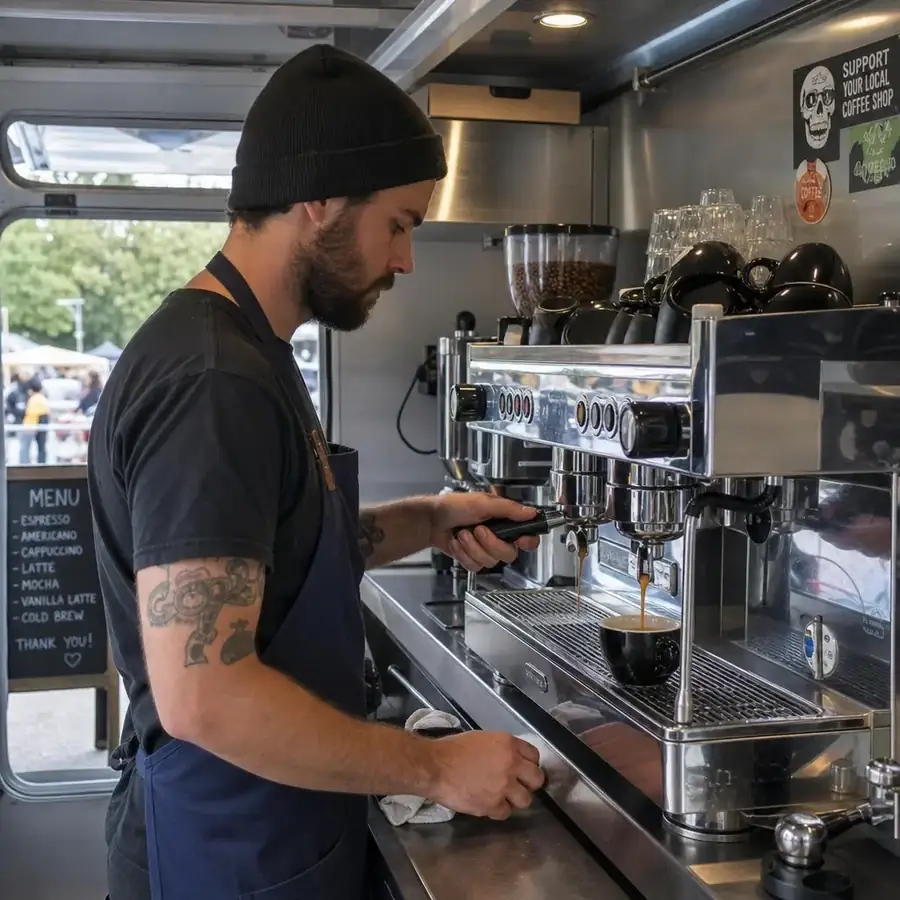
Your brewing equipment is the engine of your business. In a mobile environment, you cannot afford equipment failure, nor can you sacrifice drink quality. Selecting the right gear requires balancing power consumption, footprint, and output capacity.
Choosing the Right Espresso Machine
The anchor of any mobile coffee business is the espresso machine. When sourcing a commercial espresso machine for mobile business operations, you must consider power draw, boiler size, and weight. Most standard commercial machines run on 220V power, which requires a robust electrical setup. However, some manufacturers are now producing high-performance 110V machines specifically tailored for low-power mobile setups.
One of the biggest decisions you will make is choosing between traditional vs super automatic espresso machines.
- Traditional Espresso Machines: These require a trained barista to grind, tamp, and extract the espresso, as well as manually steam the milk. They offer complete control over the extraction process, allowing you to dial in specialty roasts perfectly. Furthermore, the theatrical element of a barista pulling a shot adds to the artisanal vibe that many coffee truck patrons expect. The downside is that they require more training and can slow down service if you have an inexperienced operator.
- Super Automatic Espresso Machines: These machines handle the grinding, tamping, brewing, and milk frothing at the push of a button. For high-volume locations where speed is the primary concern—such as busy commuter hubs or large festivals—a super automatic machine guarantees consistency and rapid service. By 2026, the technology in these machines has advanced significantly, producing micro-foam and espresso shots that rival seasoned baristas. However, they lack the "craft" aesthetic, have a higher initial price point, and can be more difficult to repair on the fly.
Grinding for Perfection
An exceptional espresso machine is useless without an equally capable grinder. In a fast-paced truck, you need high capacity commercial burr grinders that can handle back-to-back orders without overheating the beans. Look for grinders with cooling fans, minimal grind retention, and precise micrometric adjustments.
Actionable Tip: Consider investing in a "Grind-by-Weight" grinder. These innovative grinders use built-in scales to dispense the exact dose of coffee every time, eliminating the need for a separate scale and saving precious seconds on every drink.
Batch Brewing Solutions
While espresso-based drinks yield high profit margins, classic drip coffee remains a staple for morning commuters. When deciding on your drip coffee setup, you will likely weigh the benefits of air pot vs satellite brewing systems.
- Air Pot Brewers: Ideal for lower-volume operations or trucks with limited counter space. You brew directly into thermal, pump-action carafes (air pots) that keep the coffee hot for hours without a heating element. This saves electricity and prevents the coffee from tasting burnt.
- Satellite Brewing Systems: If you are catering a massive event or serving hundreds of cups an hour, satellite brewers are the way to go. These systems brew large batches (1.5 to 3 gallons) into detachable, insulated servers (satellites). You can brew at a central station and move the satellite to your serving window for rapid, high-volume dispensing.
Powering Your Mobile Cafe: Electrical & Generator Solutions
Perhaps the most critical—and often most misunderstood—aspect of outfitting a coffee truck is the power supply. A standard coffee shop can simply plug into the municipal grid; a mobile café must carry its own power plant.
Calculating Your Power Needs
Before purchasing a single piece of equipment, you must answer a vital question: how much power does a coffee truck need? The answer lies in calculating your total running wattage and your starting (surge) wattage.
Here is a rough estimation of power draws for standard 2026 equipment:
- Commercial 2-Group Espresso Machine: 3,500W – 5,000W
- Espresso Grinder: 300W – 500W
- Batch Coffee Brewer: 1,500W – 2,500W
- Undercounter Refrigerator: 400W – 800W
- Water Pump and Heater: 1,000W – 1,500W
- Lighting and POS system: 200W
If everything runs simultaneously, a typical coffee truck requires between 8,000 and 12,000 watts of continuous power. Always build in a 20% buffer to prevent tripping breakers during unexpected surges.
Generators and Green Alternatives
Historically, coffee trucks relied on loud, gas-guzzling generators. In 2026, sustainability and noise reduction are paramount.
1. The Dual Fuel Generator A dual fuel generator for food trucks is an excellent transitional power source. These units run on either standard gasoline or liquid propane (LP). Propane burns cleaner, smells less, and has a longer shelf life than gasoline. Furthermore, if you run out of one fuel source during a busy festival, you can easily switch to the other, ensuring your operation never goes dark.
2. The Silent Revolution: Battery Power The most exciting trend in the 2026 mobile coffee industry is the shift toward lithium battery banks for silent power. Utilizing advanced LiFePO4 (Lithium Iron Phosphate) technology, combined with a robust inverter system and rooftop solar panels, trucks can now operate for 6 to 8 hours completely silently and emission-free.
While the upfront cost of a lithium battery bank is higher than a generator, the benefits are immense:
- Access to indoor events and zero-emission zones.
- No engine noise, allowing for better customer interaction and music ambiance.
- Zero fuel costs and significantly less maintenance.
Water Systems and Plumbing Compliance
Water makes up 98% of a cup of coffee. Therefore, your water management system dictates not only your compliance with local laws but also the taste of your product and the lifespan of your equipment.
Delivering the Perfect Water Profile
You cannot just pump municipal tap water from a holding tank directly into an $8,000 espresso machine. Hard water leads to scale buildup, which is the number one cause of espresso machine failure.
Implementing integrated water filtration for mobile espresso is a non-negotiable part of your coffee truck equipment checklist. At a minimum, you need a multi-stage system that includes:
- Sediment Filter: Removes dirt, rust, and particulates.
- Carbon Filter: Removes chlorine and improves taste and odor.
- Reverse Osmosis (RO) or Cation Exchange: Removes scale-causing minerals like calcium and magnesium. (Note: If using RO, ensure you have a remineralization cartridge, as pure RO water is corrosive and lacks the minerals needed for proper coffee extraction).
Wastewater Management and Compliance
Managing grey water (wastewater) is highly regulated. Before building, you must research the specific health department plumbing requirements for trucks in your municipality.
Most jurisdictions require the following standard compliance rules:
- Your grey water holding tank must be at least 15% to 50% larger than your fresh water tank (to account for liquids dumped by customers or melting ice).
- Tanks must be sloped for proper drainage.
- You must have a three-compartment sink for washing, rinsing, and sanitizing, plus a separate, dedicated handwashing sink.
- A certified food-grade hose must be used for filling fresh water.
How to Install a Grey Water Tank: If you are doing a custom build, understanding how to install a grey water tank properly is crucial.
- Location: Mount the tank beneath the truck chassis to save interior space and utilize gravity for drainage.
- Venting: Install a vent pipe that extends to the roof of the truck. Without a vent, air pressure will prevent your sinks from draining.
- Plumbing: Use flexible, vibration-resistant PVC or PEX tubing to route the drains from your sinks and the drip tray of your espresso machine into the tank.
- Dump Valve: Install a heavy-duty RV-style termination valve at the lowest point of the tank, easily accessible from the exterior of the truck, so you can connect a sewer hose and drain it at approved commissary facilities.
Refrigeration and Food Prep Appliances
Coffee trucks rarely survive on beverages alone. Expanding your menu to include pastries, breakfast sandwiches, or chilled grab-and-go items significantly boosts your average ticket size.
Keeping Things Cool
Space is at a premium, so bulky, residential-style refrigerators are out of the question. You need NSF certified refrigeration for small spaces. NSF certification guarantees that the appliance meets strict commercial food safety standards, is easy to clean, and can maintain food-safe temperatures even when the truck door is constantly opening and closing in the summer heat.
Look for:
- Undercounter Worktop Refrigerators: These kill two birds with one stone, providing cold storage below and a durable, stainless steel food prep surface above.
- Glass Door Merchandisers: A small countertop glass-door fridge facing the customer is perfect for upselling bottled water, cold-pressed juices, and cold brew cans.
Food Warming and Baking
If you plan to offer hot food, avoid appliances that require massive ventilation hoods, like flat-top grills or deep fryers, as these drastically complicate your build and permit process.
Instead, outfit your truck with energy efficient countertop convection ovens. These ovens utilize a fan to circulate hot air, baking pastries and heating breakfast sandwiches 25% faster than conventional ovens. Modern 120V models are highly insulated, meaning they won't heat up the already-warm interior of your coffee truck, and they have a low enough power draw to run seamlessly alongside your coffee gear.
Designing a Smart, Ergonomic Workspace
A well-designed truck maximizes speed and minimizes barista fatigue. When you are rushing to serve a line of 30 people, every step matters.
Layout Strategies
When brainstorming space saving mobile cafe layout ideas, lean heavily on the concept of the "workflow triangle." In a coffee truck, your primary triangle consists of the espresso machine, the grinder, and the refrigerator (for milk).
- Linear Workflow: Design your counter so the drink creation moves in one logical direction. Order taking/POS → Cups/Syrups → Espresso Machine/Grinder → Milk fridge/Steaming → Handoff window. The barista should not have to cross paths or walk backwards to complete a drink.
- Vertical Space: Utilize wall space aggressively. Install heavy-duty magnetic strips for knives and tools, mount syrup racks on the walls, and use ceiling-mounted shelving for lightweight items like paper cups and lids.
- Knock Box Placement: Install an in-counter knock box (for dumping used espresso pucks) directly beneath the espresso grinder. Cut a hole in the counter so the pucks drop straight into a large trash can concealed in the cabinetry below. This saves counter space and eliminates frequent trips to the garbage bin.
Point of Sale and Tech
The way customers pay has changed drastically. Cash is becoming rare, and speed at the checkout is vital. In 2026, implementing modern technology is a cornerstone of your coffee equipment list.
You must utilize contactless POS systems for mobile vendors. These cloud-based systems operate on tablets and offer vital features for food trucks, including:
- Offline Mode: Essential for when you are catering at a rural festival with zero cellular or Wi-Fi service. The system securely stores encrypted card data and processes the payments once you reconnect to a network.
- Tap-to-Pay Integration: Built-in RFID readers for Apple Pay, Google Wallet, and tap-enabled credit cards ensure transactions take seconds.
- QR Code Ordering: Display a QR code outside your truck. Customers can scan it, view your menu, and place an order from their phone while waiting in line, drastically reducing the bottleneck at your ordering window.
Maintenance and Longevity
Investing in the items on this Coffee Truck Equipment Checklist for 2026 is a major financial undertaking. Protecting that investment through rigorous maintenance is the only way to ensure long-term profitability. Mobile equipment undergoes constant vibration, temperature fluctuations, and dust exposure that brick-and-mortar cafes never experience.
Protecting Your Investment
Establishing a strict schedule for preventative maintenance for mobile coffee gear will save you thousands of dollars in emergency repairs and lost revenue.
Daily Maintenance Checklist:
- Backflush the espresso machine with water every few hours, and with specialized espresso detergent at the close of business.
- Empty and sanitize the grey water tank to prevent foul odors from permeating the truck.
- Wipe down the steam wands meticulously and purge them to prevent milk from calcifying inside.
- Brush out the burrs of your coffee grinder.
Weekly/Monthly Maintenance Checklist:
- Water Filters: Check the pressure gauges on your integrated water filtration system. Replace carbon and sediment cartridges every 3 to 6 months depending on volume.
- Generator Servicing: If using a dual fuel generator, check the oil levels weekly. Change the oil and spark plugs according to the manufacturer's operational hours guidelines.
- Grinder Burrs: High capacity commercial burr grinders lose their edge over time. Depending on the size of the burrs and your volume, expect to replace them every 6 to 12 months. Dull burrs lead to inconsistent extraction and bitter coffee.
- Winterization: If you operate in a cold climate and store your truck outdoors during the winter, you must winterize your plumbing. Water freezing inside an espresso machine boiler or a water pump will cause catastrophic, irreparable damage. Drain all tanks, blow out the lines with compressed air, and pump non-toxic RV antifreeze through the system.
The Ultimate 2026 Coffee Truck Equipment Checklist
To ensure you don't miss a single detail, here is a consolidated checklist to use as you plan your mobile cafe build:
Brewing & Grinding:
- [ ] Commercial Espresso Machine (Low wattage/110V or standard 220V depending on power plan)
- [ ] High-Capacity Commercial Espresso Grinder (Flat or Conical Burr)
- [ ] Retail/Drip Coffee Grinder
- [ ] Batch Brewer (Air Pot or Satellite system)
- [ ] Precision Coffee Scales (Water-resistant)
- [ ] Tampers, Frothing Pitchers, Knock Box, and Tamping Mats
Power & Utilities:
- [ ] Lithium Battery Bank System OR Dual-Fuel Generator
- [ ] Pure Sine Wave Inverter (to protect sensitive electronic equipment)
- [ ] Shore Power Cord and various adapters (30 Amp / 50 Amp)
- [ ] LED Interior and Exterior Lighting (Low draw)
Plumbing & Water:
- [ ] Fresh Water Tank (Food-grade, BPA-free)
- [ ] Grey Water Tank (Appropriately sized per local health codes)
- [ ] 12V or 110V On-Demand Water Pump with Accumulator Tank
- [ ] Commercial Point-of-Use Water Heater
- [ ] Integrated Multi-Stage Water Filtration System (Sediment, Carbon, RO/Softener)
- [ ] 3-Compartment Sink with Drainboards
- [ ] Dedicated Handwashing Sink with Splash Guards
Refrigeration & Food Prep:
- [ ] NSF Certified Undercounter Worktop Refrigerator
- [ ] Countertop Glass-Door Merchandiser Fridge
- [ ] Energy-Efficient Countertop Convection Oven (if serving hot food)
- [ ] NSF Certified Stainless Steel Prep Tables
- [ ] Commercial Blender with Noise Enclosure (if serving frappes/smoothies)
Tech & Operations:
- [ ] Contactless POS System with Offline Capabilities
- [ ] Heavy-Duty Tablet Mount and Receipt Printer
- [ ] Cellular Wi-Fi Hotspot Router
- [ ] Fire Extinguisher (Class K and ABC) and First Aid Kit
Shop Coffee Truck Equipment at The Horeca Store
Planning your mobile coffee business? The Horeca Store offers a range of professional coffee shop and commercial foodservice equipment to help you build an efficient coffee truck setup. From coffee and beverage equipment to refrigeration, food preparation equipment, and essential restaurant supplies, explore The Horeca Store to find equipment that fits your truck's space, power capacity, menu, and expected service volume.
Conclusion
Launching a mobile coffee business is an exhilarating journey that offers freedom, community connection, and high profit margins. However, the line between a thriving mobile café and a stressful, money-draining project often comes down to the quality and suitability of your equipment.
By following this Coffee Truck Equipment Checklist for 2026, you are setting a foundation built on efficiency, compliance, and top-tier product quality. Embracing modern trends—from silent lithium power banks and space-saving layouts to advanced water filtration and contactless POS systems—will place you miles ahead of the competition.
Take the time to carefully research each item on your coffee equipment list, consult with local health inspectors early in the process, and never compromise on the machinery that brings your coffee to life. With the right gear, a solid preventative maintenance routine, and a passion for great coffee, your mobile truck will be well-equipped to serve incredible experiences to your community for years to come.