66% of American adults drank coffee in the past day, more than any beverage other than bottled water, according to . That daily habit is what makes coffee shop equipment a capital decision rather than a shopping list: the machines you choose set your peak-hour capacity, your utility requirements, your inspection timeline and your five-year service bill.
In 2026, a working two-group bar runs $31,400 to $81,800 in new equipment, itemized in . That figure covers espresso, grinding, brewing, filtration, refrigeration, ice, dishwashing, sinks, smallwares and POS hardware, and it excludes installation, freight and taxes. The same source puts a used or budget build at $15,600 to $37,700, which is the range most first-time operators actually spend.
This guide treats coffee shop equipment as a system sized from peak demand, then constrained by code and utilities, then priced. You will get a complete coffee shop equipment list with 2026 price bands, the electrical and plumbing figures to hand a contractor, the Food Code sections that decide plan review, and the trend-driven choices worth paying for when you open a cafe this year.
Capacity & layout planning
Capacity planning comes before equipment selection because group count, grinder size and ice output are fixed at purchase and tied to the electrical service you install. Sizing from seat count produces a bar that either queues at 8 a.m. or idles the rest of the day.
Size for peak demand
put a 2-group espresso machine at roughly 60 to 120 drinks per hour and a 3-group at 120 to 180 or more. The same guidance gives the siting method: count orders in your busiest hour, multiply by 60 for a per-minute rate, then add a 20% buffer for rushes and remakes.
Manufacturer ratings sit inside that envelope. A Victoria Arduino Black Eagle Maverick 2-group is rated at 128 cups per hour for roughly 4 oz drinks, at 220 V, 30 A and 6,900 W on a NEMA L6-30P plug. One model's rating is not a category norm, but it shows where a well-specified 2-group lands.
Group count is a purchase decision, not an upgrade. lists the Linea PB in 2, 3 and 4 groups only, and the Linea Classic S in 1 through 4 groups with steam boilers of 3.5, 7, 11 and 15 L. A 40-seat room with a two-person bar and a morning peak of 90 orders fits a 2-group machine with buffer; a 3-group buys throughput you cannot add later without a new circuit.
Grinder count belongs in the same calculation. Two grinders (regular and decaf) are the standard line in a 2026 equipment budget, and burr size sets the practical ceiling on espresso output: a 17 g dose takes about 3.1 s on a 65 mm-burr E65 S and about 2.4 s on an 80 mm E80 S or 98 mm EK-43, per . A commercial coffee grinder that cannot keep pace becomes the bottleneck before the espresso machine does.
Pro Tip: Count peak-hour orders before you choose group size. A 2-group machine covers 60 to 120 drinks per hour, so a 20% buffer on your busiest hour tells you whether you need the third group and the larger circuit it requires.
Bar flow & stations
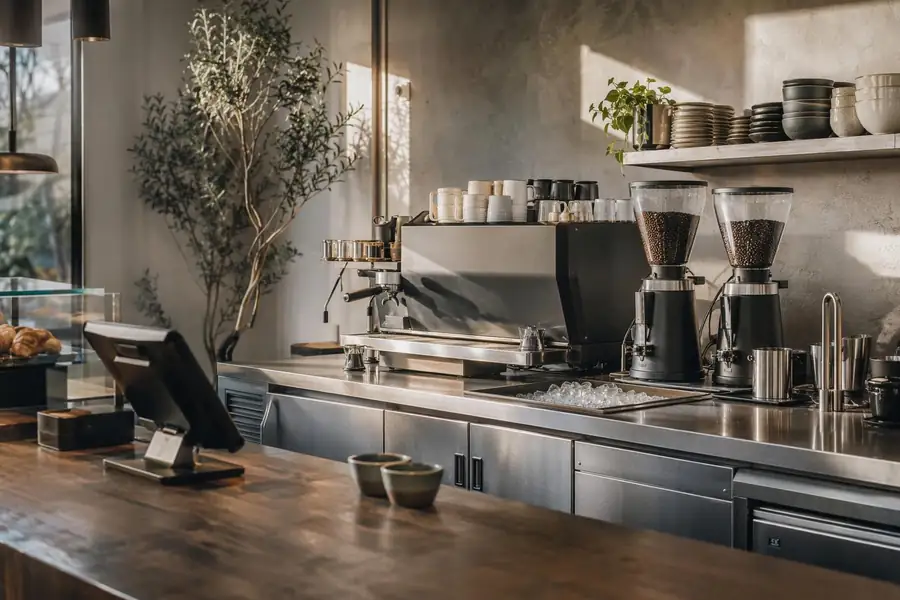
Bar flow is the sequence a barista's hands travel: grinder to tamper to portafilter to steam wand to pickup counter, with the steam wand hissing at the edge of the bar rather than in the middle of it. Every step you remove shortens ticket times at peak.
The stations that need a fixed position are the espresso machine and grinders, the hand sink, the ice bin, the undercounter refrigeration, the POS terminal and the floor sinks. requires at least one handwashing sink plus as many as needed for convenient employee use in food prep, dispensing and warewashing areas, so the hand sink belongs on the bar, not in the back room.
Utilities map & clearances
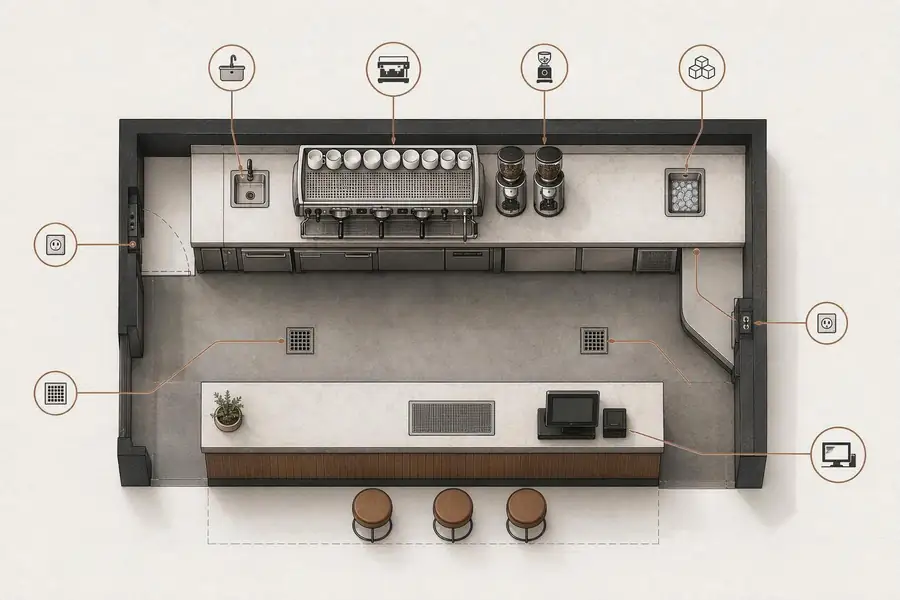
The utilities map is the drawing you hand a contractor before signing a lease, and the espresso machine sets most of it. The specifies 208 to 240 V single phase at 4,600 W and 22 A on a NEMA 6-30P for the 2-group, 6,100 W and 28 A on a NEMA 6-50P for the 3-group, and 8,000 W and 37 A on a NEMA 6-50P for the 4-group, with the outlet within 5 ft of the machine.
Water and drain follow the same document: 45 PSI dynamic inlet pressure, a 3/8 inch male compression connection, 2 GPM flow, a water filter required but not supplied, and an external drain pump needing a minimum 1/4 inch per foot slope, a floor drain within 8 ft, and a 2.5 inch counter hole. Water filtration is not optional equipment in that spec; it is a condition of the warranty-grade install.
Drains are governed by code, not preference. prohibits a direct connection between the sewage system and a drain from equipment holding food, portable equipment or utensils, and allows a warewashing machine a direct connection to a trapped floor drain only within 1.5 m (5 ft) and on the inlet side of a properly vented trap, if local law permits. Floor sinks are how an espresso machine, ice bin and dishwasher drain legally in the same room.
Essential coffee shop equipment
A complete coffee shop equipment list for a two-group bar has 13 line items, and each one has an evaluation criterion you can check on a spec sheet rather than a showroom floor.
Espresso & grinders
The espresso machine and grinders are the two purchases where specification, not brand, decides whether the bar holds up. For the machine, the criteria are group count, boiler size, voltage and amp draw, and whether the model is listed to an NSF/ANSI standard; for the grinder, burr diameter, dose time and hopper capacity.
cover the categories separately: NSF/ANSI 8 sets minimum food-protection and sanitation requirements for power-operated commercial food-preparation equipment, NSF/ANSI 12 covers automatic ice-making equipment, and NSF/ANSI 18 covers manual food and beverage dispensing equipment, at its 2025 edition. The names coffee grinders explicitly but does not name espresso machines or brewers as their own category, so confirm the listing on the model's spec sheet or in the NSF listings database rather than assuming it from the standard's title.
Brewers, hot water, and filtration
The batch brewer, hot water tower and water filtration system serve the customers who order drip, Americanos and tea, and they are the cheapest place to lose a machine. A batch brewer holds coffee at temperature between brews; a hot water tower feeds Americanos and tea without tying up the espresso machine; filtration protects the boiler.
Filtration is specified numerically by the machine maker. The call for T.D.S. of 90 to 150 ppm, total hardness of 70 to 100 ppm, chloride of 0 to 30 ppm, pH of 6.5 to 8, alkalinity of 40 to 80 ppm, line pressure of 45 to 80 PSI and flow of 2 GPM. Test the tap water first, then size the filter to the result, because a filter chosen without a water test is a guess.
Refrigeration, ice, and cold beverage gear
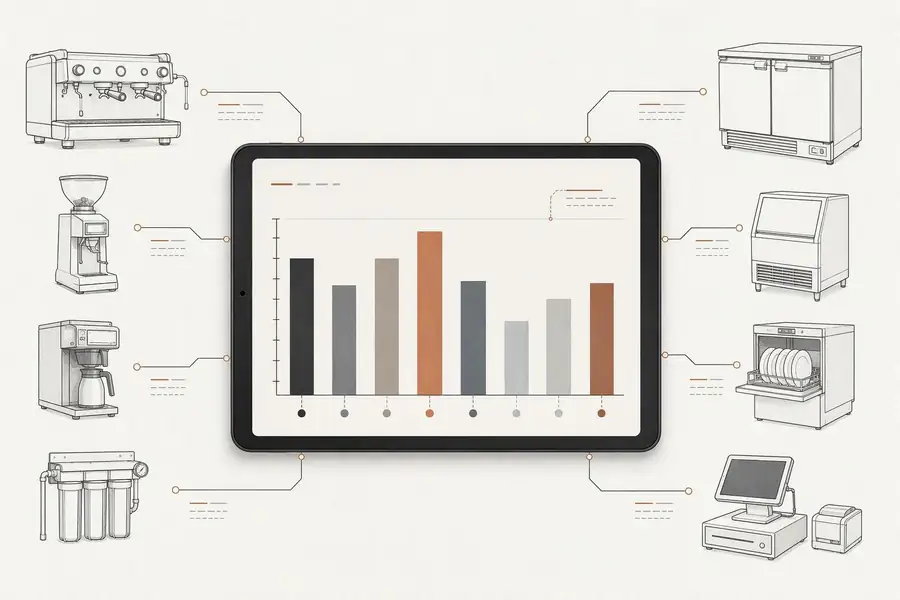
Undercounter refrigeration, the ice machine and the blender are the cold-side equipment, and the ice machine is the one whose output claim most often misleads. are quoted at two ambient and water conditions, 90°F air and 70°F water, and 70°F air and 50°F water, so a machine sold as "500 lb" produces materially less in a warm back bar.
show the gap: the KM-520MAJ crescent cuber makes 480 lb per 24 hours at 90/70 and 556 lb at 70/50, on 115 V and a 22 inch width; the KM-901MAJ makes 753 lb at 90/70 and 905 lb at 70/50, on 208 to 230 V. Water-cooled variants differ again, at 444 lb for the KM-520MWJ and 870 lb for the KM-901MWJ.
⚠️ Warning: Size the ice machine from the 90/70 column, not the headline number. The same unit loses roughly 20% of its rated output between the two rating conditions, and a summer rush is exactly when the shortfall shows.
Compliance & installation
Compliance is a sequence, not a reassurance: buy listed equipment, map the utilities, submit for plan review, then pass inspection. Each step has a document you can prepare before the health department asks for it.
Health code and NSF listings
Buying NSF-listed equipment shortens plan review because the code says so. with Parts 4-1 and 4-2 of the Food Code when it is certified or classified for sanitation under a recognized American National Standard by an ANSI-accredited certification program, under § 4-205.10. The extend that same section to multiuse food-contact surfaces, utensils and tableware, and add a new Part 4-10 on disinfection of equipment and utensils.
The listing is deemed-to-comply, not a legal mandate in itself, and states adopt the model code at their own pace, so the local health department governs which edition applies. That is why the same NSF-listed machine can pass in one county and need a conversation in the next.
Plumbing, electrical, and ventilation
The plumbing and electrical requirements are the ones that stop an install, and the Food Code states them as minimums. requires a sink with at least three compartments for manually washing, rinsing and sanitizing equipment and utensils, with compartments large enough to immerse the largest item, and alternatives only with approval.
requires a handwashing sink to provide water at a minimum of 29.4°C (85°F) through a mixing valve or combination faucet. The 2022 edition lowered that from 100°F, and many local codes still require 100°F, so confirm the local figure before specifying the water heater.
Dish machines carry their own temperature requirements. requires chemical-sanitizing machines to run wash water of at least 49°C (120°F), mechanically hot-water-sanitized machines to run wash water of 66 to 74°C (150 to 165°F) depending on type with a sanitizing rinse of 82 to 90°C (180 to 194°F), and utensil surfaces to reach 71°C (160°F). It also sets hot holding at 57°C (135°F) or above and cold holding at 5°C (41°F) or less, which is the requirement your undercounter refrigeration is bought to meet.
Plan review, permits, and inspections
Plan review happens before construction, and the equipment schedule is the document that carries it. Submit manufacturer spec sheets showing the NSF listing, the electrical and plumbing requirements, and the drain arrangement for every item on the bar, alongside the layout drawing.
The red flags that lengthen review are predictable: a machine with no local service technician, an electrical panel that cannot carry the espresso machine plus brewer, ice machine and fridges, and a drain plan that connects equipment directly to the sewage system. The must-haves are an NSF listing on the model's spec sheet and a service provider within reasonable distance.
Key Takeaway: Buy NSF-listed gear to shorten plan review, then confirm local amendments. The Food Code's deemed-to-comply clause is the mechanism, and the local health department is the authority that applies it.
Budgeting, costs & TCO (2026)
Total cost of ownership is the purchase price plus installation, freight, water treatment, preventive maintenance and the energy the machine draws over its service life. Sticker price alone understates a bar by a wide margin, and the gap is where first-time budgets fail.
Category price ranges
The 2026 price bands below are typical U.S. dealer ranges, taxes and freight excluded, drawn from and cross-checked against dealer listings.
Within those ranges, place a Nuova Simonelli Appia Life 2-group at $9,000 to $11,000, a La Marzocco Linea PB 2-group at $20,000 to $24,000, and a Slayer or Black Eagle at $25,000 to $30,000, with a Mythos 2 grinder around $4,900 and a Fiorenzato F64 Evo around $1,600. Current Mahlkönig grinder pricing from an authorized dealer runs $2,499 to $4,199 across the E65 and E80 models.
Installation and hidden costs
Installation is the line the equipment budget does not show. The same cost guide prices plumbing for a three-compartment sink, hand sink, mop sink and floor drains at $8,000 to $25,000, electrical work at $3,000 to $12,000 once the brewer, ice machine and fridges are added to the espresso circuit, and HVAC at $6,000 to $15,000.
Water treatment is the hidden cost with the clearest return. The guide budgets $800 to $3,500 for filtration and softener and warns that hard water will scale a boiler and turn a $15,000 machine into a $4,000 repair inside two years, which is why the $150 water test precedes the filter purchase.
Maintenance and service planning
Maintenance is priced per machine, per year, on a quarterly cycle. run $400 to $2,800 per machine per year, with La Marzocco, Slayer and Synesso platforms at $1,800 to $2,400, Nuova Simonelli, Rancilio and Faema at $1,200 to $1,800, and Bunn, Curtis and Fetco brewers at $700 to $1,000.
Energy belongs in the same line. for commercial refrigerators and freezers has applied since 22 December 2022, so a 2026 buyer comparing undercounter refrigeration should be checking against Version 5.0 or later listings rather than an older certification.
Trend-driven choices for 2026
The 2026 equipment decisions that pay back are the ones tied to what customers actually order and to what a small team can run without adding labor. Cold beverage capacity and selective automation meet that test; a full automation stack usually does not.
Cold beverage dominance
Cold drinks are now a large enough share of consumption to justify dedicated equipment rather than a blender on the back counter. puts cold, iced and frozen-blended coffee at 31% of all coffee consumed in the June 2025 survey, up from 23% in January 2025.
The specialty segment leans colder still. found 60% of past-day specialty coffee drinkers had a cold coffee against 76% who had it hot, and 36% of past-day specialty drinkers had coffee prepared outside the home against 23% for traditional coffee. The equipment implication is ice and cold storage capacity, and the 2026 cost breakdown budgets a commercial blender at $1,200 to $2,500 and an ice machine plus bin at $2,800 to $5,000, but lists no cold-brew-specific item.
show what cold-side capacity costs at the top end: the KM-901MAJ makes 753 lb per 24 hours at 90/70 and the KM-1340MAJ makes 1,089 lb, at 5.0 and 4.8 kWh per 100 lb of ice, with matching bins of 300, 500, 700 or 800 lb. Bin capacity is a separate purchase decision from production, and the $2,800 to $5,000 budget line covers both.
Selective automation & efficiency
Automation is worth it for a small team when it removes a task that happens every few minutes, not when it replaces a barista. A grinder with dose-by-weight removes the scale-and-scoop step on every shot; an automatic milk frother removes a hand on the steam wand at peak; a self-service kiosk removes order-taking from the counter.
The evaluation criteria are throughput gain per dollar, service coverage for the added electronics, and whether the machine still works manually when the automation fails. A grinder's dose time is measurable on a spec sheet, at about 3.1 s per 17 g on 65 mm burrs versus about 2.4 s on 80 mm or 98 mm burrs, per , which makes burr size the honest comparison point.
Integrated POS and digital workflows
A POS system is now an equipment line, not just software. The 2026 cost breakdown budgets $700 to $2,500 per station for terminal hardware (tablet, stand, cash drawer, receipt printer) and $0 to $200 a month per terminal for software, with card processing at 2.4% to 3.5% plus 10 to 15 cents per transaction, which at $40,000 a month in card sales is $960 to $1,400 a month.
The equipment decision is how many stations the bar needs and whether the POS integrates with the kitchen display, the loyalty program and the inventory count. A single-station shop and a two-station shop with a pickup counter have different hardware needs, and the per-station price is the number to multiply.
Sourcing the full list from one supplier is one option among several.
Conclusion
The equipment list that opens a cafe on time is built in a fixed order: size the bar from peak-hour orders with a 20% buffer, map the utilities the espresso machine and ice machine require, buy NSF-listed gear so plan review moves, then price the whole list against 2026 ranges of $31,400 to $81,800 new or $15,600 to $37,700 used.
The framework matters more than any single product. A 2-group machine covers 60 to 120 drinks per hour, a 3-group covers 120 to 180 or more, and the group count you choose sets the circuit you install. Ice output is rated at two conditions, so size from the 90/70 column. Maintenance runs $400 to $2,800 per machine per year, and the water test comes before the filter.
Your next step is to write the equipment schedule: one line per item, with the spec sheet, the electrical and plumbing requirement, the NSF listing and the 2026 price range.
About the publisher. HorecaStore is a restaurant supply store that sells commercial kitchen equipment and foodservice supplies, including refrigeration, cooking equipment, prep tables, cookware and cleaning supplies, to restaurants, hotels, cafes and catering businesses. It has a commercial interest in equipment purchases, so weigh its perspective accordingly. The guidance above does not depend on its products.