
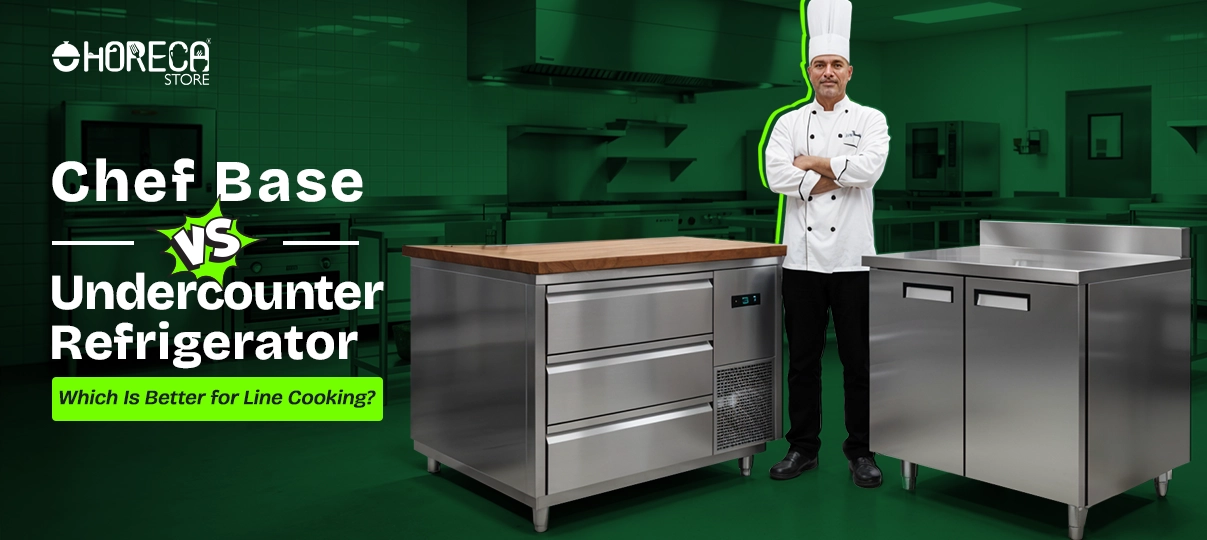
In a busy commercial kitchen, refrigeration placement can directly affect speed, workflow, and even staff fatigue. Two common options used near the cookline are chef bases and undercounter refrigerators. While both keep ingredients within reach, they are built for different purposes.
This SEO-friendly comparison explains chef base vs undercounter refrigerator across workflow impact, space usage, cost, and ideal kitchen type so you can make the right decision for line cooking.
TL;DR
|
What is a chef base refrigerator?
A chef base refrigerator is a low-profile commercial refrigeration unit designed to support cooking equipment such as ranges, griddles, or charbroilers. It combines two functions in one footprint: refrigeration below and a heavy-duty equipment stand on top.
Key features of a chef base
- Hot equipment top made of reinforced stainless steel.
- Drawer or door refrigerated storage.
- Designed to work in high heat cookline settings.
- Stores products beneath the cooking area.
Chef bases are commonly used in high-volume line cooking, where speed and minimal movement are critical.
What is an undercounter refrigerator?
An undercounter refrigerator is a compact fridge designed to fit beneath counters or prep tables. It is widely used in prep areas, plating stations, bars, and smaller kitchens.
Key features of an undercounter refrigerator
- Slides under standard counters
- Available with doors or drawers
- Installation and relocation is simpler.
- Prep and finishing station Ideal.
Undercounter units focus more on flexibility and accessibility rather than supporting heavy cooking equipment.
How does a chef base improve line cooking workflow?
The construction of chef bases aims at minimizing movement during service. The products are located below the cooking area to ensure that the chefs do not leave their positions to get ingredients.
Workflow benefits of a chef base
- Greater service speed in peak periods.
- Less distance to storage to cooking.
- Enhanced station emphasis of line cooks.
- Less time wasted at the cookline.
In restaurants that use grill, sauté or fry stations that work at full speed, chef bases can be used to create rhythm and consistency.
How does an undercounter refrigerator impact daily workflow?
Undercounter fridges facilitate workflows in the kitchen. They are efficient in regions where there is overlap in prep, plating and light cooking.
Workflow benefits of an undercounter unit
- Handy preparation materials.
- Easy preparation for service.
- Appropriate in small units that are multitasking.
- Operates in rotating kitchens.
While slightly slower than chef bases for pure line cooking, undercounter refrigerators offer better flexibility in mixed-use kitchens.
Which option uses kitchen space more efficiently?
Space efficiency depends on how fixed or flexible your kitchen layout is.
Space efficiency of chef bases
Chef bases are designed to store refrigeration and cooking devices atop each other in order to save space. This removes the necessity to have an additional fridge within the line. But when installed, they can hardly be moved.
Space efficiency of undercounter refrigerators
Units that are put under the counter are reposed simply. They can be installed under the majority of counters and fit well in kitchens that may require to change or expand their layouts.
Summary:
- Fixed, high-volume lines → chef base
- Flexible or evolving layouts → undercounter refrigerator
How do storage capacity and organization differ?
Storage design plays a major role in daily efficiency.
Chef base storage advantages
- Deeper drawers for hotel pans
- Better for bulk proteins and high-volume ingredients
- Drawer access is fast during service
Undercounter refrigerator storage advantages
- Better organization for small containers
- Ideal for sauces, toppings, and garnishes
- Shelving options for varied storage needs
If your menu relies on large quantities near the heat source, chef bases are more practical.
How does temperature performance compare?
Both options offer commercial-grade cooling, but their operating conditions differ.
Temperature performance of chef bases
Chef bases operate under hot equipment, so they must be specifically rated for high-heat environments. Lower-quality units may struggle if not designed for cookline use.
Temperature performance of undercounter refrigerators
Undercounter refrigerators are usually placed away from direct heat, making temperature control more stable and reducing compressor strain.
Choosing the right-rated model is essential for food safety in both cases.
Which option is more cost-effective?
Cost should be evaluated beyond just the purchase price.
Cost considerations for chef bases
- Higher upfront cost
- More complex installation
- Long-term value through faster service and reduced labor movement
Cost considerations for undercounter refrigerators
- Lower purchase price
- Simple installation
- Easier and cheaper to replace
For tight budgets, undercounter refrigerators are often the safer starting point.
Which is easier to clean and maintain?
Chef bases are durable but sit under grease-heavy equipment. Regular cleaning is essential. Models with removable gaskets and front-access service panels are easier to maintain.
Undercounter units are easier to clean and service since no heavy equipment sits on top. Repairs cause minimal disruption to operations.
What types of kitchens should choose a chef base?
Chef bases are best suited for:
- High-volume restaurants
- Dedicated cookline stations
- Fixed kitchen layouts
- Operations prioritizing speed during rush hours
These environments are where chef base refrigerators for restaurants deliver the most value by keeping ingredients close to the heat source and reducing unnecessary movement during peak service.
If your kitchen runs intense service windows, chef bases support consistency and efficiency.
What types of kitchens benefit more from undercounter refrigerators?
Undercounter refrigerators work best for:
- Small to mid-sized restaurants
- Cafés and cloud kitchens
- Prep-focused menus
- Kitchens needing layout flexibility
They are especially useful where space is limited and multitasking is common.
Chef base vs undercounter refrigerator: which is better for line cooking?
There is no single best choice for every kitchen.
- Choose a chef base if line speed, reduced movement, and station efficiency are critical.
- Choose an undercounter refrigerator if flexibility, lower cost, and prep efficiency matter more.
Pro Tip: Many professional kitchens use a hybrid setup chef bases under the busiest cooking stations and undercounter refrigerators for prep and backup storage.
Upgrade Your Commercial Kitchen with The Horeca Store
Choosing the right refrigeration equipment is essential for maintaining an efficient and organized kitchen. The Horeca Store offers a wide range of commercial refrigeration solutions, including chef base refrigerators, undercounter refrigerators, reach-in refrigerators, freezers, and other professional kitchen equipment designed for restaurants, cafés, hotels, catering businesses, and foodservice operations.
With high-quality products, competitive pricing, and reliable service, The Horeca Store helps businesses find the right equipment to improve kitchen performance. From refrigeration and cooking equipment to stainless steel products, food preparation tools, storage solutions, and restaurant supplies, we provide everything needed to build a professional commercial kitchen.
Final conclusion
The decision between a chef base and an undercounter refrigerator should be based on how your kitchen actually operates, not just equipment features. Analyze your service volume, menu structure, and space limitations.
The right choice will improve workflow, reduce stress during service, and keep your line running smoothly every shift.
Still unsure which setup fits your kitchen best? Contact us to discuss your layout, menu, and service needs. Our team will help you find the best fit for your cookline.