
This chef base refrigerator buying guide is built for restaurant owners, kitchen managers, chefs, and operators who need cold storage directly where cooking and plating happen. A chef base refrigerator combines refrigerated drawers with a heavy-duty equipment stand, so ingredients stay close while griddles, charbroilers, fryers, or prep tools sit above. The right unit can improve line flow, reduce unnecessary steps, and turn a crowded cook station into a more organized workspace.
What is a chef base refrigerator?
Also compare a reach-in refrigerator and a worktop refrigerator when the line needs more than drawer storage.
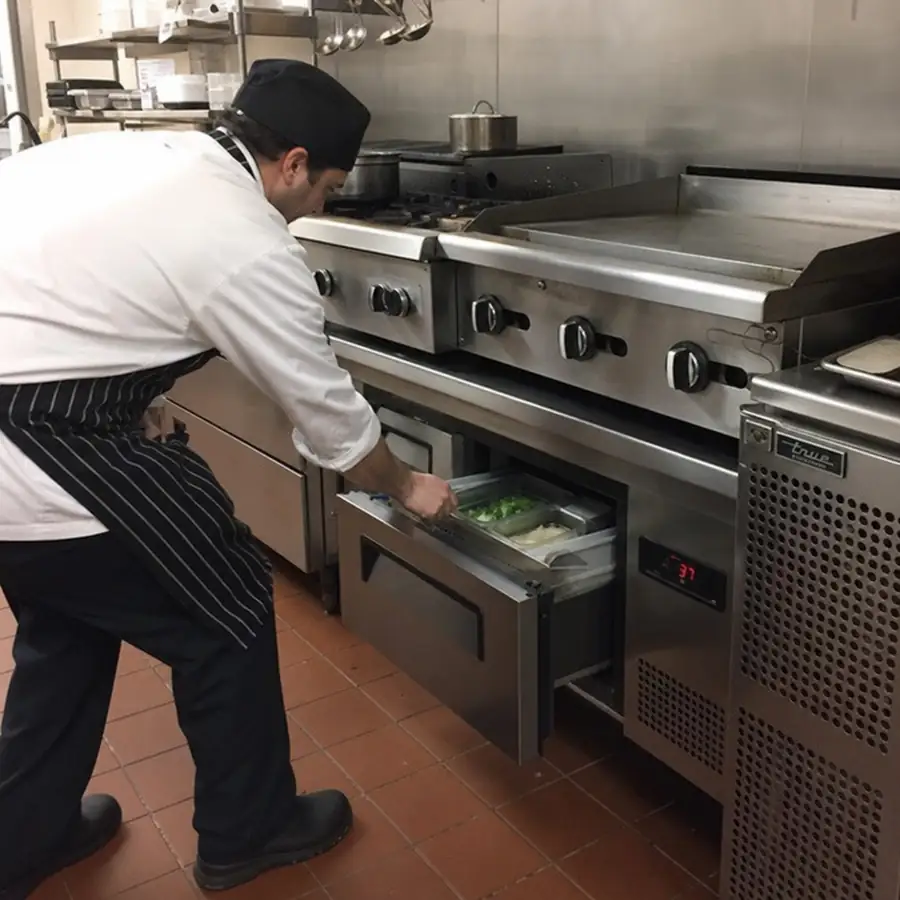
A chef base refrigerator is a low-profile commercial refrigerator designed to sit under cooking or prep equipment while storing chilled ingredients in drawers. Instead of walking to a reach-in restaurant fridge across the kitchen, the cook can pull proteins, toppings, sauces, or mise en place from the refrigerated chef base beneath the station.
Most units use a stainless steel cabinet, refrigerated drawers, a reinforced top, and a self-contained refrigeration system. For example, True's TRCB-36-HC is a 36-3/8 inch, two-drawer model that uses R290 refrigerant, runs on 115/60/1 power with a NEMA 5-15P plug, and maintains 33°F to 38°F cabinet temperatures according to the manufacturer. ()
That design makes a chef base fridge different from a simple undercounter unit. It is not just cold storage; it is a working part of the cookline. The operational consequence is simple: fewer turns, fewer steps, faster replenishment, and better station control during rush periods.
Who should use a commercial chef base?
Frozen backup usually belongs in a reach-in freezer or a walk-in freezer, not in the refrigerated drawers.
A commercial chef base is best for foodservice operations where cooking, assembly, and ingredient access happen in the same tight area. It suits restaurants with compact lines, high-volume prep stations, food trucks, catering kitchens, hotel banquet kitchens, bars with hot food programs, and quick-service concepts that need a durable professional kitchen fridge under equipment.
Business context matters. A small café or food truck may need a 36 chef base refrigerator because floor space and electrical capacity are limited. A full-service restaurant may choose a chef base refrigerator 48 inches wide for one sauté or grill station. A banquet kitchen, hotel line, or busy burger concept may need a 72 chef base refrigerator with four drawers so several cooks can work from the same cold storage zone.
Skill level also affects the choice. A trained brigade can benefit from drawers arranged by station and menu frequency, while a newer team may need fewer drawers, clearer labels, and a layout that makes mistakes less likely. Budget should be weighed against downtime risk: a cheaper unit may help cash flow upfront, but a stronger drawer system, better service access, and reliable temperature recovery can matter more in a kitchen that opens seven days a week.
Specifications, capacity, and features that matter
High-volume kitchens often add a walk-in refrigerator or a commercial freezer beside the cookline.
A chef base refrigerator is usually evaluated by width, drawer count, pan capacity, temperature range, top strength, ventilation style, electrical requirements, and construction. Common widths include 36, 48, 60, and 72 inches, with two to six drawers depending on the model.
A 36 chef base refrigerator works well under a compact griddle, small charbroiler, or single-station prep area. A chef base refrigerator 48 configuration is a flexible middle ground for sandwich, breakfast, or sauté stations. A chef base refrigerator 72 inch model gives larger teams more drawer separation and pan capacity, but it demands more space, more planning, and usually a larger capital budget.
Look closely at these features:
- Drawer configuration: Two drawers are simple and compact; four or more drawers support better ingredient separation.
- Pan depth: Many chef bases accept full-size pans, but maximum pan depth varies by brand and model.
- Temperature control: Refrigerated units commonly hold fresh ingredients around the mid-to-high 30°F range; freezer chef bases are for frozen product and should not be treated as fresh food storage.
- Top design: Flat tops are easy to clean, while marine or raised edges help contain spills.
- Stainless steel construction: Important for sanitation, impact resistance, and daily wipe-downs.
- Compressor access: Front, side, or rear access changes how easily the unit can be serviced in a tight line.
- Electrical fit: Many models use 115V power and a NEMA 5-15P plug, but always verify the spec sheet before ordering.
The trade-off is capacity versus footprint. Bigger drawers reduce restocking trips, but oversized equipment can crowd aisles and slow service if the cookline becomes harder to move through.
How to choose a chef base refrigerator
A sandwich prep table or a pizza prep table is the closer match when the station builds cold plates instead of cooking on top.
To choose a chef base refrigerator, start with the station's workflow, then match width, drawer count, pan layout, top load, ventilation, and power to that station. Do not begin with the biggest unit you can afford; begin with the ingredients the cook needs within arm's reach and the equipment that must sit above it.
Use the menu as your sizing guide. A burger station may need drawers for patties, cheese, bacon, sliced produce, and backup sauces. A breakfast line may need eggs, proteins, batter, and garnishes. A bar kitchen may need a compact food prep refrigerator for flatbreads, small plates, and late-night service without sending staff to the main walk-in every few minutes.
A practical selection process looks like this:
- Map the station. List the cooking equipment above, the cook's reach zone, and the nearest aisle clearance.
- Count active ingredients. Separate high-use pans from backup storage; the chef base should hold what the station actually needs during service.
- Choose width. Use 36 inches for tight stations, 48 inches for versatile single-station use, and 72 inches for higher-volume shared stations.
- Select drawer count. More drawers improve organization, but they can also raise cost and cleaning time.
- Check top load rating. Confirm the base can support the equipment, especially if using heavy griddles or charbroilers.
- Verify service access. Make sure technicians can reach the compressor, condenser, and electrical connection after installation.
If you are comparing units from the horeca store or any dealer with a chef base refrigerator for sale, ask for current spec sheets rather than relying on a short product title. Model names can look similar while drawer layout, depth, voltage, and clearance requirements differ.
Chef base refrigerator installation requirements
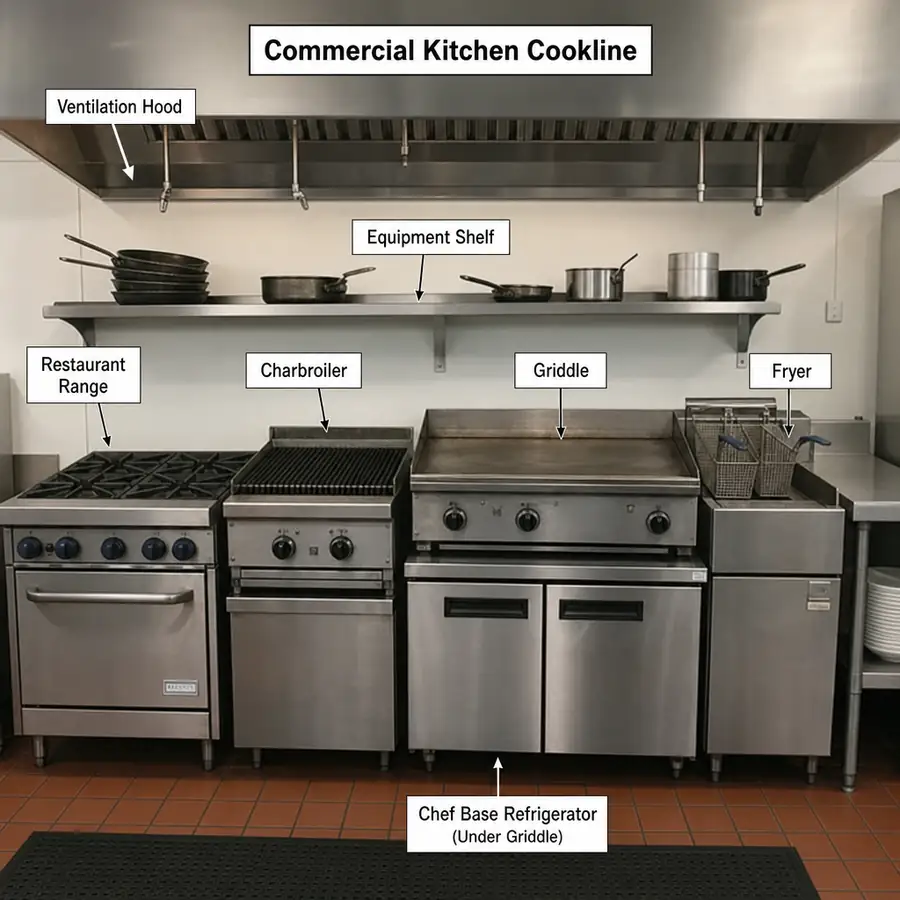
Leave clearance for an exhaust hood and review the commercial kitchen layout before the base is set under the cooking line.
Chef base refrigerator installation requirements should be checked before purchase, not after delivery. Measure the full footprint, drawer extension, aisle clearance, equipment height, ventilation path, cord location, and doorways from receiving to the cookline.
A common mistake is measuring only the cabinet width. Drawer extension can add significant working depth, and a busy line needs room for cooks to open drawers without blocking another station. Beverage-Air's WTRCS48HC, for example, has a 48 inch overall width, 34-3/4 inch overall depth, 24-3/8 inch height, and 57-3/4 inch depth with drawers extended, according to its spec sheet. ()
Before installation, confirm:
- The floor is level and can support the loaded unit plus equipment above.
- The unit has the required rear, side, bottom, or front breathing clearance.
- The outlet matches the voltage, phase, amperage, and plug type.
- Hot equipment above follows the manufacturer's clearance instructions.
- Staff can remove drawers, clean gaskets, and reach filters or condenser areas.
- The kitchen has a plan for receiving, uncrating, and moving the unit safely.
Poor installation can shorten equipment life. Heat buildup, blocked airflow, and difficult cleaning access all increase the chance of temperature problems and service calls.
Comparison snapshot for common chef base refrigerator options
Measure nearby stainless steel work tables and a prep table with the same aisle clearance.
Use this comparison as a buying conversation starter, not a substitute for current dealer quotes or final spec review.
True TRCB-36-HC
- Product/Brand: True TRCB-36-HC
- Best For: Compact cooklines, food trucks, small cafés, and single-equipment stations.
- Capacity/Volume: Two drawers; each drawer accommodates one full-size 12 x 20 x 4 inch pan plus three 1/6 size pans, according to True. ()
- Key Feature: Heavy-duty reinforced stainless top with a listed support capacity up to 717 pounds.
- Price Tier: Premium.
- Trade-off: Strong build and brand recognition, but less total drawer space than wider models.
Beverage-Air WTRCS48HC
- Product/Brand: Beverage-Air WTRCS48HC
- Best For: Mid-size restaurant stations needing a chef base refrigerator 48 inches wide.
- Capacity/Volume: Two drawers and 7.21 cubic feet of net capacity per the manufacturer spec sheet. ()
- Key Feature: Full marine edge top, 1,000-pound top weight capacity, and drawer slides rated at 275 pounds.
- Price Tier: Upper-mid to premium.
- Trade-off: Excellent station utility, but the extended drawer depth must be planned into the aisle.
Turbo Air TCBE-72SDR-N
- Product/Brand: Turbo Air TCBE-72SDR-N
- Best For: High-volume kitchens, multi-cook lines, banquet operations, and concepts needing a 72 chef base refrigerator.
- Capacity/Volume: 72 inch wide, 12.66 cubic feet, four drawers, with each drawer accommodating two full-size pans up to 6 inches deep, according to Turbo Air. ()
- Key Feature: Self-cleaning condenser device and 16 gauge reinforced insulated top.
- Price Tier: Premium.
- Trade-off: More capacity and organization, but a larger footprint and higher investment.
Brand and model spotlight: True TRCB-36-HC
Product type
The True TRCB-36-HC is a refrigerated chef base designed for under-equipment cold storage in commercial kitchens. It fits operators looking for a true chef base refrigerator with a compact width and a durable work surface.
Who it fits
This model is best for small restaurants, cafés, concession kitchens, food trucks, and single-station cooklines. It makes sense where space is tight but the cook still needs refrigerated ingredients directly below the cooking surface.
Key specifications
Manufacturer data lists two drawers, 36-3/8 inch width, 32-1/8 inch depth, 20-1/2 inch height, 2.4 amps, and 115/60/1 electrical service with a NEMA 5-15P configuration. True also states that the unit uses R290 hydrocarbon refrigerant and maintains 33°F to 38°F cabinet temperatures. ()
Operational benefit
The main value is focused storage at the point of production. Instead of using a remote reach-in as the only restaurant fridge for line ingredients, the station can hold its most-used pans where the cook naturally works.
Cost and trade-off
The trade-off is that a 36 inch base has limited storage compared with a 48 or 72 inch model. It is a smart fit when speed and space efficiency matter more than bulk holding capacity.
Buying decision
Choose this model type if your station has limited width, moderate ingredient variety, and equipment that fits the listed top capacity. Move up to a wider chef base if two drawers would force constant restocking.
Buying checklist for chef base refrigerators
The same plan often includes ice machines and a bottle cooler for the service side.
- Station workflow: Buy for the menu and station, not just the available wall space.
- Width: Match 36, 48, or 72 inch sizing to cook volume and aisle clearance.
- Drawer count: Choose enough drawers to separate proteins, produce, sauces, and backups.
- Pan compatibility: Confirm full-size, fractional, and depth limits before ordering pans.
- Temperature range: Use a refrigerated chef base for fresh ingredients and a freezer base only for frozen storage.
- Top load rating: Verify that the refrigerator can safely support the cooking equipment above.
- Ventilation: Check whether the model is front-breathing, side-mounted, or rear-accessed.
- Electrical requirements: Confirm voltage, amps, phase, cord, plug, and dedicated circuit needs.
- Cleaning access: Look for removable gaskets, drawers, and serviceable condenser areas.
- Warranty and service: A unit is only as useful as the local parts and technician support behind it.
- Budget: Consider purchase price, installation, accessories, pans, maintenance, and downtime risk.
- Future menu growth: Leave room for added ingredients if the station is likely to expand.
Common buying questions
A back bar cooler and an undercounter freezer cover drinks and frozen product the chef base should not hold.
Is a chef base fridge the same as an undercounter refrigerator?
Pair the base with commercial kitchen equipment and a walk-in cooler when deliveries outgrow the drawers.
No. An undercounter refrigerator is mainly cold storage under a counter, while a chef base fridge is built to support cooking or prep equipment above it. Chef bases usually have reinforced tops and drawer layouts intended for cookline access.
Can I put hot cooking equipment on a refrigerated chef base?
Often yes, but only if the manufacturer approves the equipment type, weight, and clearance. Always check top load capacity and heat clearance rules before installing a griddle, charbroiler, or fryer above the unit.
Is a freezer chef base better than a refrigerated chef base?
It depends on the station. Choose a freezer base for frozen product, such as par-fried items or frozen proteins, and choose a refrigerated chef base for fresh ingredients. Do not use one as a casual substitute for the other.
Should I buy a 48 inch or 72 inch chef base refrigerator?
Choose 48 inches for a single station with moderate ingredient variety. Choose 72 inches for higher-volume service, multiple cooks, or stations that need deeper organization. The 72 inch option offers more capacity but takes more floor space and planning.
Where can I find a chef base refrigerator for sale?
You can compare options through restaurant equipment dealers, brand-authorized distributors, and commercial kitchen suppliers. Before buying, request the latest spec sheet and confirm delivery, warranty, and service coverage in your area.
Related equipment to consider
Put the base in the restaurant kitchen equipment cost plan and compare it as commercial refrigeration, not as a standalone cabinet.
If a chef base refrigerator is not the perfect fit, compare it with adjacent equipment categories before buying:
- Undercounter refrigerators: Better for general compact storage, less specialized for hot-line equipment support.
- Worktop refrigerators: Useful when prep surface matters more than supporting heavy cooking equipment.
- Sandwich and salad prep tables: Better when you need open top pans, cutting boards, and assembly space.
- Reach-in refrigerators: Best for bulk storage away from the line.
- Freezer chef bases: Useful for frozen ingredients directly under a cooking station.
A chef base refrigerator is a smart investment when it solves a real workflow problem. Match the unit to your menu, station volume, space, staff habits, and budget, then verify every specification before purchase. The best choice is not simply the largest or most expensive professional kitchen fridge; it is the one that keeps your line moving cleanly, safely, and consistently during service.