

Chafing dishes keep prepared food warm during buffet service, but choosing the right equipment means looking beyond appearance. This buying guide to chafing dishes for catering and hotel buffets explains how to compare heating methods, capacities, construction, and ownership costs. Whether you are reviewing options from The Horeca Store or preparing a supplier shortlist, start with your menu, venue, and service routine.
What should you look for when buying chafing dishes?
Look for a chafing dish that matches your venue's permitted heat source, accommodates your food pans, fits your buffet layout, and allows straightforward replenishment and cleaning. Capacity matters, but so do lid clearance, loaded weight, replacement parts, and the equipment included in the purchase. Treat these as purchasing criteria rather than assuming every commercial model meets them equally well.
Before comparing finishes, write a short operating brief:
- Service setting: Identify whether equipment will stay in a hotel dining room or travel between venues.
- Menu: List the dishes served together and note which need separate pans or dedicated utensils.
- Service pattern: Describe whether guests arrive steadily or in a concentrated rush.
- Infrastructure: Confirm power availability, table dimensions, storage space, and restrictions on open flames.
- Staffing: Decide who will replenish pans, monitor temperatures, and manage equipment after service.
For example, a breakfast buffet serving several side dishes needs a different pan arrangement from a banquet serving one main course. Buy for the food and workflow, not simply the guest count.
Match the heating method to the venue
Fuel, electric, and induction-compatible arrangements each require different checks. Some chafers can work with more than one heating method, but compatibility is model-specific; a manufacturer's operating instructions should identify approved heat sources. Do not assume that a stainless steel chafer can be placed on any induction warmer.
| Heating approach | Consider it when | Confirm before ordering |
|---|---|---|
| Fuel-heated | You need a setup that does not depend on an electrical outlet | Venue permission, approved fuel, holder compatibility, and fuel-handling procedures |
| Electric | Your buffet has a planned electrical supply | Voltage, wattage, outlet locations, cord routing, and control operation |
| Induction-compatible | You are specifying a matching chafer-and-warmer system | Exact compatibility between the vessel, stand, and induction equipment |
Ask the venue to approve your intended setup before purchasing. For electrical equipment, have the available supply assessed against the combined equipment load rather than counting outlets alone. For fuel service, establish who will supervise the units and handle extinguishing and replacement.
University of Maryland fire-safety guidance, for example, requires keeping combustibles away from chafing fuel, never moving lit cans, and allowing cans to cool before replacement. Your venue may impose additional restrictions, so obtain its requirements directly.
Choose capacity around the menu and replenishment plan
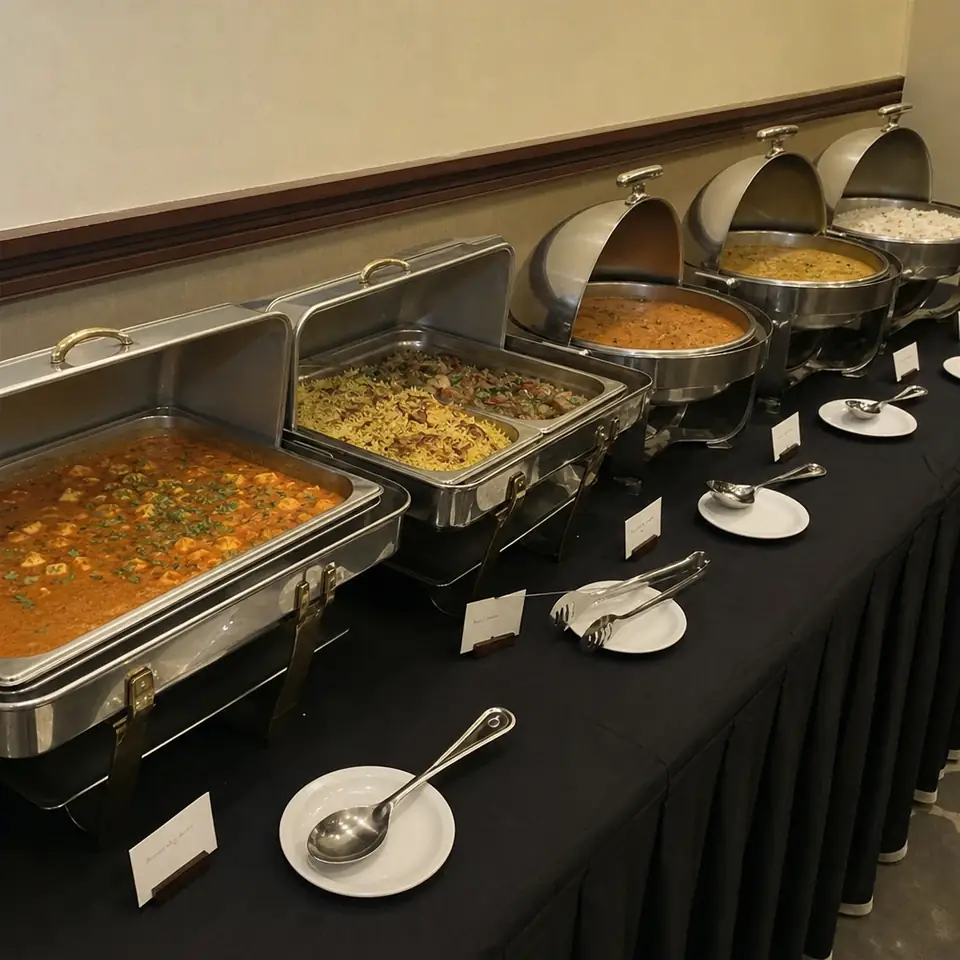
Compare both stated capacity and physical dimensions. Manufacturer catalogs distinguish full-size, half-size, round, and other configurations, with different food pans and replacement components assigned to individual models. A familiar size label is not a substitute for checking the product specification.
Start by estimating the quantity of each dish you want on display between replenishments. Then choose a pan arrangement that supports that quantity without crowding the buffet. Avoid treating the largest available vessel as the automatic best value.
For catering chafing dishes, map the proposed layout before ordering:
- Assign a position to every hot menu item.
- Check the intended pan's footprint and depth against the chafer specification.
- Allow space for handles, lids, utensils, and food labels.
- Identify where replacement pans will arrive from the kitchen.
- Check that staff can replenish food without reaching across guests.
Ask specifically whether divided pans need adapter bars or other supports. If you already own hotel pans, provide their dimensions to the supplier and request confirmation of fit. This is more reliable than buying around a photograph.
Inspect construction, lids, and everyday handling
When evaluating commercial chafing dishes, turn broad descriptions such as "heavy duty" into questions you can verify. Request material specifications, inspect assembly quality, and ask which parts are replaceable. If possible, handle a sample before placing a larger order.
Check stability and handling points
Test the assembled unit on a level surface. Look for rocking feet, loose fasteners, rough edges, and handles that are awkward to grip. Ask staff to demonstrate how they would remove the food pan, reach the heat controls, and disassemble the unit after cooling.
Evaluate weight in the context of your operation rather than assuming heavier is always better. Ask for the empty weight, then consider the additional load of pans, water, and food. Plan handling procedures around the manufacturer's instructions; do not use a cold showroom demonstration as permission to move equipment during service.
Choose a lid that suits the serving space
Compare lift-off, hinged, and roll-top designs by testing their movement within your planned layout. Where will a removable cover rest? Can a guest open the lid without reaching over another dish, and can staff remove a pan without dismantling the display?
Check overhead clearance and access from the intended serving side. Ask how hinges or closing mechanisms are cleaned and whether replacement parts are available. A finish may suit the dining room beautifully, but it should not distract from an awkward serving arrangement.
Build a complete set, not a collection of missing parts
Compare chafing dish sets by their itemized contents, not their product names. Manufacturer listings can separate the frame, food pan, water pan, cover, fuel holder, and transport box, so establish exactly what the quoted package contains. Check quantities as well as component names.
Use this checklist when requesting a quote:
- Core assembly: Confirm the frame or base, water pan where required, food pan, and lid.
- Heating equipment: Identify included holders, heaters, cables, or controls and any separately purchased fuel.
- Pan configuration: Verify depths, divided-pan arrangements, and necessary supports.
- Service items: Allocate utensils, utensil rests, labels, and temperature-monitoring equipment.
- Transport and storage: Specify protective containers and the space needed for packed equipment.
- Replacement parts: Request part numbers for components your team may need to replace.
Choose chafing dish accessories to solve specific operating needs. Spare food pans, for example, belong in a replenishment plan; a transport case belongs in a packing plan. Avoid adding accessories solely because they appear beside the main product online.
Make portability part of the purchasing test
For portable chafing dishes, evaluate the complete journey from storage shelf to service table. Measure the packed equipment against vehicle space, doorways, carts, and shelving. Ask whether handles, lids, and loose components need separate protection.
If a frame folds or stacks, request its packed dimensions and assembly instructions. Have the team rehearse setup and repacking before the first event. Record which components belong together so equipment can be checked out and returned as a complete kit.
Plan food transport separately from buffet presentation. Sterno's catering guidance lists insulated food-pan carriers and temperature-monitoring equipment among the items to consider alongside the warming setup. A chafer purchase alone does not complete your delivery system.
Should you buy or rent catering chafing dishes?
Buy when your expected use, storage arrangements, and ownership costs justify keeping equipment; rent when the event requirement does not justify that commitment. Compare complete costs for the same capacity, appearance, and service period. Neither approach is automatically cheaper without actual purchase and rental quotes.
When comparing catering chafing dishes for rent, ask about delivery, collection, cleaning, damage charges, included heating equipment, and replacement arrangements. Confirm the exact quantity and configuration in writing. Do not assume the pictured model is the one reserved for your event.
For a purchase comparison, include accessories, storage, transport, maintenance, and consumables where applicable. For rental, include every quoted charge associated with the booking. Compare costs over a realistic period rather than using an optimistic event schedule to justify ownership.
A mixed approach is also worth pricing: own the equipment needed for routine service and request rental quotes for occasional overflow. Before relying on that arrangement, check local availability and whether rented units will fit your buffet layout and presentation requirements.
Read chafing dish reviews for operational evidence
Use chafing dish reviews to identify questions worth investigating, not as a replacement for specifications. Focus on comments that describe the reviewer's setting, frequency of use, and particular problem or benefit. A review about occasional home entertaining may not answer the concerns of a hotel breakfast team.
Look for detailed observations about lid operation, frame stability, pan fit, cleaning access, packing, and replacement-part support. Note whether the reviewer identifies the exact model and included components. If several comments raise the same issue, ask the supplier to explain it or demonstrate the relevant feature.
The best chafing dishes for your operation are the ones that satisfy your requirements at an acceptable overall cost. Build a shortlist with pass-or-fail essentials first, then compare preferences such as finish and display style. This keeps attractive photography from outweighing practical suitability.
Plan safe holding and cleaning before the first service
A chafer is generally holding equipment, not a substitute for cooking or reheating equipment. Vollrath's chafer instructions specify placing food into the unit already at serving temperature, preheating as directed, and monitoring food temperature during operation. Follow the instructions for your exact model, including water requirements.
Confirm applicable food-safety requirements with your local regulator and incorporate them into staff procedures. For example, Washington's food rules generally require time/temperature-control-for-safety food to be hot-held at 135°F or above, with specified exceptions. That example should not replace checking the rules governing your own operation.
Before launch, assign responsibility for:
- Preparing and transferring food under the operation's approved procedures.
- Checking food temperatures with appropriate equipment and recording them as required.
- Monitoring the heating setup and any water level specified by the manufacturer.
- Following an established corrective-action procedure if holding conditions are not met.
- Shutting down, cooling, cleaning, and storing each component according to its instructions.
Ask for care instructions before purchasing, particularly for decorative finishes, electrical parts, and lid mechanisms. Confirm which components can enter your existing dishwashing process rather than assuming the entire assembly is dishwasher-safe. Build cleaning and inspection time into the service plan.
Choose equipment that fits the whole operation
A purchasing checklist should connect every selected chafer to a menu position, approved heat source, compatible pan, and storage location. It should also identify included components, required accessories, and responsibility for ongoing care. Resolve missing information before approving the order.
When discussing a shortlist with The Horeca Store, request itemized specifications and package contents against those requirements. Choose the equipment that makes your planned service workable - not simply the set with the most polished appearance.