
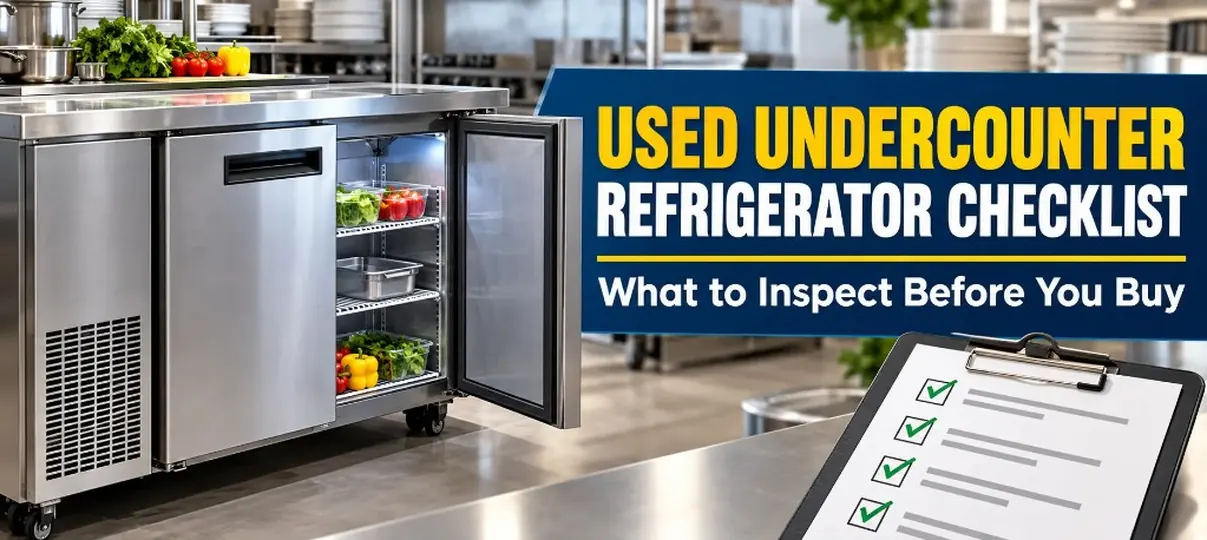
A used undercounter refrigerator can be a smart buy if it cools correctly, fits your space, carries the right commercial certifications, and has no signs of hidden damage. The safest approach is to inspect the compressor, doors, coils, wiring, cabinet, and temperature performance before you pay. This guide gives you practical refrigerator buying tips you can use in person or when asking a remote seller for proof.
An undercounter refrigerator is a compact commercial fridge designed to sit below a counter or prep surface. Unlike a home mini fridge, a commercial unit is built for busy foodservice use, frequent door openings, and safe cold storage. For foods that need temperature control for safety, the FDA Food Code uses 41°F or lower as a key cold-holding benchmark, so your test should prove the unit can hold safe temperatures under real use.
What should you inspect first?
Start with temperature, compressor health, and commercial compliance because these decide whether the unit is safe and worth buying. A shiny cabinet is not enough. If the fridge cannot pull down to about 35°F-38°F during a test, has no verified commercial listing, or shows signs of compressor failure, walk away or price it as a repair project.
Use this quick first-pass checklist before you spend time on details:
- Model and serial tag: Must be readable and match the seller's listing.
- Commercial certification marks: Look for NSF and UL, ETL, or another accepted safety mark.
- Temperature test: Confirm with your own thermometer, not only the display.
- Compressor sound: Listen for smooth cycling, not grinding or constant strain.
- Door seal: Check that gaskets grip the frame and are not cracked.
- Coils and fan areas: Heavy dirt can mean poor care and higher repair risk.
- Rust, leaks, and smells: These can point to water damage, poor cleaning, or hidden failures.
Main types and configurations
A reach-in refrigerator is the taller cabinet when the line needs more volume.
Undercounter refrigerators come in several layouts. The best choice depends on your menu, space, and workflow.
One-door units suit cafes, food trucks, small bars, and service counters with limited storage needs. They are easier to place and often fit tighter spaces. They may not be enough for high-volume prep.
Two-door units work well for restaurants, bakeries, hotels, and catering teams that need more cold storage near the line. They offer better organization. They also need more floor width and clear airflow.
Drawer refrigerators are useful on cooklines where staff need fast access to pans of ingredients. They reduce bending and speed up service. Check drawer slides closely because repairs can be costly.
Worktop refrigerators add a usable prep surface. They fit sandwich shops, bakeries, and quick-service kitchens. Inspect the top for dents, deep cuts, and food-safe condition.
Glass-door units help bars and cafes display drinks. They are less ideal for hot kitchens because glass can gain heat faster than solid doors.
Low-profile or ADA-height units fit special counter heights. Measure carefully before buying because clearance mistakes can block vents or make doors hard to open.
The features and specifications that matter
A good fridge buying guide should connect specs to daily work, not just list numbers. With used undercounter refrigeration, each feature affects food safety, speed, energy use, or repair risk.
Size, capacity, and door count
Measure width, depth, height, door swing, and path of entry. Capacity matters, but so does how the space is arranged. A small cafe may need one compact solid-door unit for milk and garnishes, while a restaurant line may need a two-door model with adjustable shelves.
Do not buy only by cubic feet. Check pan compatibility, shelf strength, and usable interior space. A fridge packed too tightly will cool poorly because air cannot move around the food.
Power and plug type
Many undercounter units use standard commercial electrical setups, but you must confirm voltage, phase, amperage, and plug style on the data plate. Do not assume it will fit your outlet. A mismatch can delay opening, require an electrician, or create a safety issue.
Ask whether the unit trips breakers during startup. A weak compressor may draw more power than normal. Damaged cords, loose plugs, and exposed wiring are deal-breakers.
Refrigerant and refrigeration system
An undercounter freezer needs the same compressor check.
Check the data plate for refrigerant type. This matters for service cost and technician availability. Older or less common refrigerants may make future repairs harder.
Self-contained units have the compressor inside the cabinet base or rear. They are common and easy to install. Remote units connect to a separate compressor system and are less common for small used purchases.
Ventilation and clearance
Undercounter units often live in tight spaces. That makes airflow critical. If the condenser cannot breathe, the compressor runs hotter and fails sooner.
Look for front-breathing designs if the fridge will be built into cabinetry. If vents are on the side or rear, leave the clearance the manufacturer requires. Never push a used unit into a sealed niche just because it fits.
Brand, category, and use-case comparisons
Brand does not guarantee condition, but it affects parts access, service support, and resale value. In the used market, well-known commercial brands are usually safer than unknown imports or residential models.
For buyers comparing listings at the horeca store or any used equipment seller, focus on condition first, then brand. A clean, tested second-tier commercial unit may be better than a neglected premium model.
How do you test a used undercounter refrigerator?
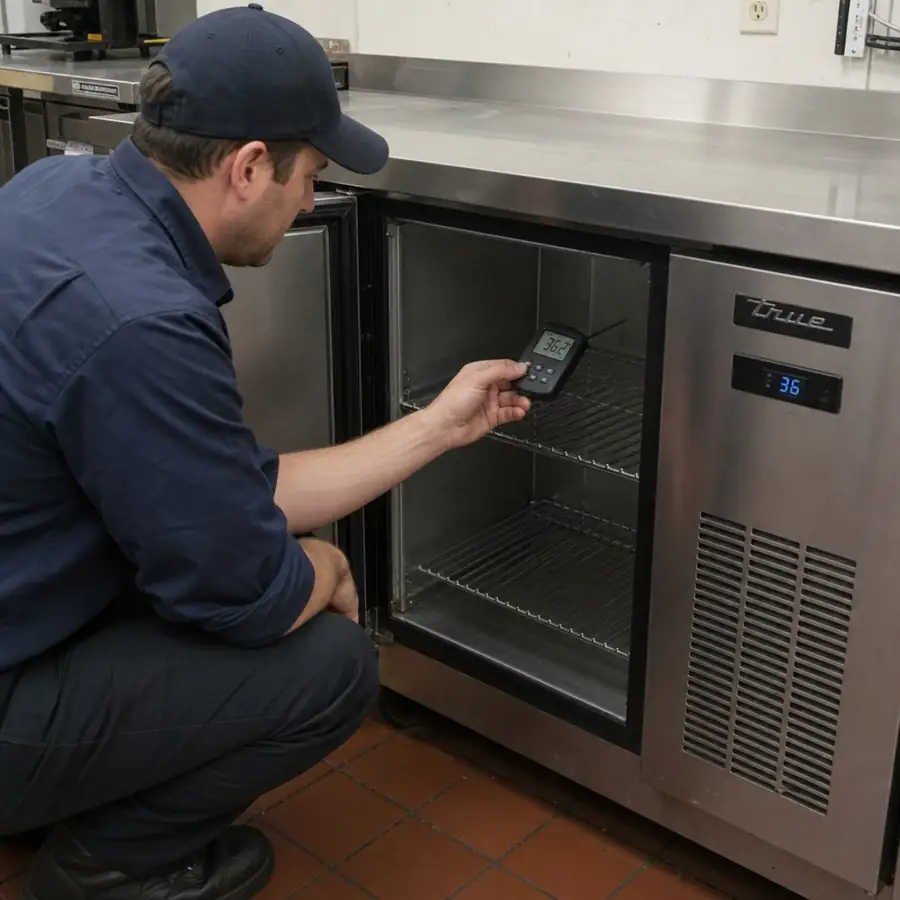
Run the refrigerator long enough to prove it can cool, cycle, and recover. A 20-30 minute test is a useful minimum for a warm but functioning unit, though a longer test is better when possible. Use an independent probe or air thermometer and confirm that the temperature trends down into the safe operating range.
Follow this simple test process:
- Start with an empty cabinet. Note the starting temperature.
- Plug it in and listen. The compressor and fans should start without harsh noise.
- Check airflow. Feel for steady cold air from the evaporator fan.
- Watch the temperature. It should move toward about 35°F-38°F.
- Confirm cycling. The compressor should not run nonstop once cold.
- Open and close doors. Check that the temperature begins recovering after door openings.
- Inspect for water. Look under and inside the unit for leaks or drain issues.
If buying remotely, ask the seller for one continuous video. It should show the serial plate, the unit plugged in, the thermometer inside, the compressor area, the doors closing, and the final temperature reading. Avoid edited clips that skip the cool-down period.
Red flags that should change your offer
A used reach-in refrigerator with the same symptoms is the same walk-away call.
Some flaws are normal on used equipment. Others mean the unit is not worth the risk unless the price is very low and you already plan to repair it.
Walk away or renegotiate if you see:
- Temperature stuck above safe holding range after testing.
- Compressor that clicks, buzzes, overheats, or never cycles off.
- Oil stains near refrigerant lines or compressor fittings.
- Missing or unreadable model and serial plate.
- Heavy rust inside the cabinet or around the floor pan.
- Cracked liner, swollen insulation, or strong mold smell.
- Bent condenser fins packed with grease and dust.
- Torn gaskets that do not seal the door.
- Doors that sag, pop open, or rub the frame.
- Household-grade unit presented as commercial equipment.
A cheap fridge becomes expensive when it spoils food, fails inspection, or blocks service during a rush.
Certification, model numbers, and seller proof
Commercial kitchens often need equipment that is properly certified for sanitation and electrical safety. NSF provides a searchable food equipment listing, including commercial refrigerators and freezers, while UL Product iQ is used to verify UL certifications.
Before buying, take these steps:
- Photograph the data plate clearly.
- Search the model number in the manufacturer's records if available.
- Check the NSF listing for the product category.
- Verify UL, ETL, or other electrical safety marks.
- Ask whether parts are still available.
- Request service records if the seller has them.
A sticker alone is not always enough. Labels can be damaged, copied, or tied to a different model. The model number is your best link between the cabinet in front of you and its original certification.
Installation, cleaning, maintenance, and ownership cost
A worktop freezer follows the same upright rest after transport.
Used refrigeration should be cleaned and checked before service. Clean condenser coils, wash shelves, sanitize the interior, clear the drain, and replace weak gaskets. These small tasks help the unit run cooler and reduce strain.
Plan for installation costs too. You may need delivery, leveling, a correct outlet, and ventilation changes. If the unit has been transported on its side, let it stand upright before startup so oil can settle back into the compressor.
Warranty support is another cost factor. Private sellers often sell "as is." Dealers may offer short warranties or refurbished options. If the price is close to a new or dealer-refurbished unit, warranty coverage may be worth more than the savings.
For higher-value purchases, consider a refrigeration technician's inspection. The fee can be small compared with a compressor repair, lost food, or emergency replacement.
Frequently asked questions
Is a used undercounter refrigerator safe for a restaurant?
Yes, if it is a true commercial unit, holds safe temperatures, and meets your local inspection rules. Confirm certification and test it before purchase.
How cold should it get during inspection?
Aim for about 35°F-38°F during normal operation. This gives room below the 41°F cold-holding benchmark used for many TCS foods.
Are dents a problem?
Small cosmetic dents may be fine. Dents near refrigerant lines, hinges, vents, or door frames are more serious because they can affect cooling and sealing.
Should I buy from a private seller or dealer?
A private seller may be cheaper. A dealer may offer testing, cleaning, delivery, and warranty support. Choose based on risk, not price alone.
What is the biggest repair risk?
The compressor is usually the biggest concern. If it runs constantly, sounds rough, or cannot pull the cabinet down to temperature, be careful.
Final buying decision
The used commercial refrigerator buying guide covers the wider cabinet choices.
Use this Buying a Used Undercounter Refrigerator: Inspection Checklist as a filter, not just a shopping note. The right unit should fit your space, match your workload, pass a real temperature test, and have verifiable commercial marks.
If your requirement is a busy restaurant line -> consider a solid-door True, Hoshizaki, Traulsen, or similar commercial unit with strong airflow and parts support.
If your requirement is a cafe, bakery, or prep counter -> consider a one- or two-door worktop model with easy-clean shelves and good gasket condition.
If your requirement is bar beverage service -> consider a glass-door or back-bar style unit, but test recovery carefully.
If your requirement is food truck or tight-space use -> consider a compact front-breathing model with confirmed clearance and power needs.
If your requirement is lowest risk -> buy dealer-tested or refurbished equipment with warranty support.
If your requirement is lowest upfront price -> only buy after a full live test, and keep money aside for repairs.