
Burger Restaurant Equipment List Complete Kitchen Setup
A strong burger operation starts with equipment that supports speed, consistency, food safety, and a clean workflow from prep to service. This guide breaks down the essential kitchen equipment for burger restaurant operators, from grills and fryers to refrigeration, smallwares, storage, and front-of-house fast food supplies. Use it as a practical planning checklist whether you are opening a compact burger shop, upgrading an existing line, or designing a higher-volume kitchen.
What equipment does a burger restaurant need first?
A burger restaurant equipment list starts with commercial grill equipment, fryers, refrigeration, and prep tables.
A burger restaurant needs dependable cooking equipment, cold storage, prep stations, holding tools, warewashing, ventilation support, and service supplies before it can operate efficiently. The core of the setup is usually a griddle or charbroiler, a fryer station, refrigerated prep tables, reach-in refrigeration, stainless worktables, and the smallwares that keep portions consistent. Everything else should support the same goal: move ingredients safely from receiving to storage, prep, cooking, assembly, service, and cleanup without unnecessary backtracking.
The most common mistake is buying equipment one piece at a time without planning the full line. A great grill will not solve a slow kitchen if the fries bottleneck, toppings are stored too far from the assembly station, or dishwashing cannot keep up during peak service. Think in systems, not single purchases.
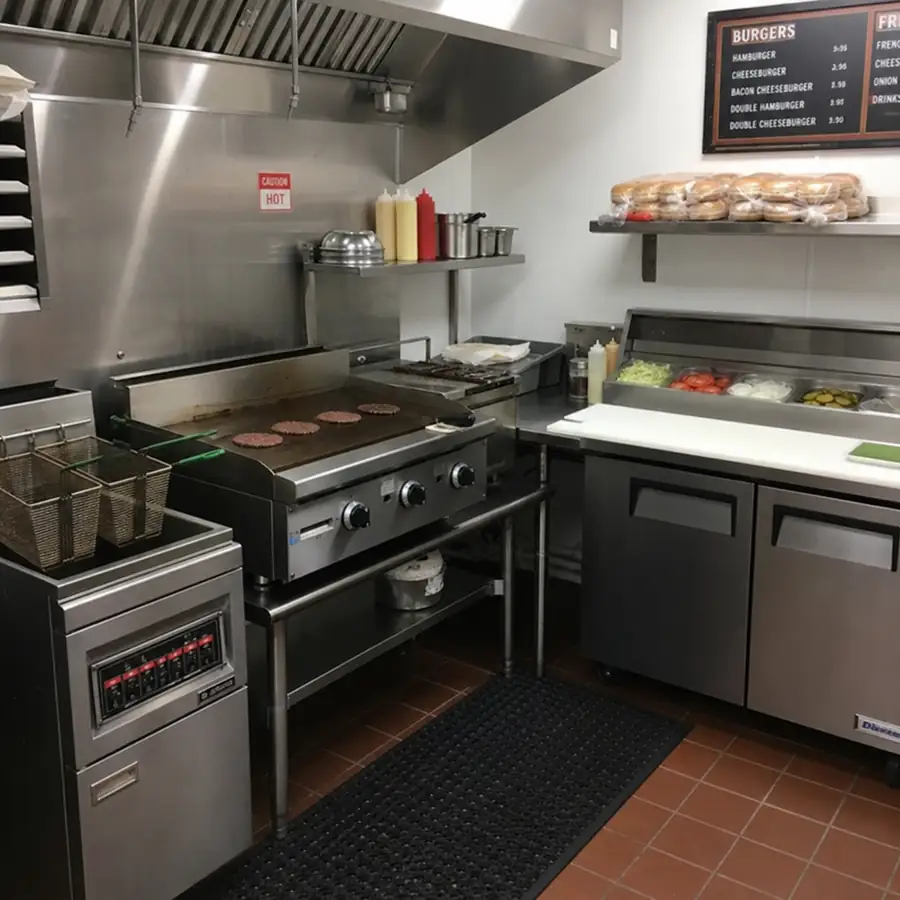
The core burger cooking line
The core burger cooking line usually combines a flat-top griddle or charbroiler with fryers, a bun toaster, and holding cabinets.
Your cook line is where the restaurant's pace is set. For most burger concepts, this area includes commercial grill equipment, fryers, toasting equipment, holding space, and landing space for finished orders. The right combination depends on your menu, expected volume, available utilities, and whether your brand prioritizes seared, juicy griddle burgers, charbroiled flavor, or both.
Commercial griddles for consistent burger production
Commercial griddles for consistent burger production give cooks a wide surface for patties, buns, and toppings.
A flat-top griddle is one of the most important pieces of burger restaurant kitchen equipment. It gives cooks a broad, even surface for patties, buns, onions, bacon, eggs, or breakfast add-ons. Griddles also retain juices and fat on the cooking surface, which can help create the browned crust many burger customers expect. If you're looking to source reliable commercial cooking equipment, The Horeca Store is a convenient destination that offers a variety of griddles suited for your needs. Griddles also retain juices and fat on the cooking surface, which can help create the browned crust many burger customers expect.
As a planning guideline, smaller shops serving roughly 50 to 100 burgers per day often look at 24- to 36-inch griddles. Medium-volume restaurants may need a 48- to 60-inch unit, while high-volume kitchens often require 72 inches or multiple cooking surfaces. A typical patty needs enough space around it for flipping and heat recovery, so do not size the griddle only by the number of patties that can physically touch the surface.
Look for practical features such as reliable thermostatic controls, strong grease management, easy-to-clean surfaces, and a size that fits your hood system. A griddle that is too small creates ticket delays. A griddle that is too large for your actual demand can waste energy and valuable line space.
Charbroilers for flame-grilled flavor
Charbroilers for flame-grilled flavor add grill marks when the menu needs more than a griddle.
A charbroiler brings a different style to the menu. It can create smoky, flame-kissed flavor and visible grill marks, which may fit concepts built around backyard-style or premium grilled burgers. The tradeoff is that charbroilers usually require more cleaning, stronger ventilation, and more attention to flare-ups than flat-top griddles.
Some restaurants choose one or the other. Others use both: a griddle for speed and consistency, and a charbroiler for specialty burgers or menu items where grilled flavor matters. If you are comparing commercial grill equipment, ask how each option affects flavor, labor, cleaning time, hood requirements, and output during rush periods.
Fryers for fries, sides, and menu flexibility
Fryers for fries, sides, and menu flexibility need enough fryer baskets and landing space for peak tickets.
For most burger restaurants, fries are not a side item in practice. They are a major part of the guest experience and a major driver of kitchen timing. A dependable fryer setup is essential if your menu includes fries, onion rings, chicken tenders, fried pickles, or other fast-moving sides.
Choose fryer capacity based on your menu mix and peak demand, not just average daily sales. A single underpowered fryer may seem acceptable during slow periods, then collapse during lunch or dinner rush. Many operators separate fries from breaded proteins or strongly flavored items to protect taste and reduce cross-contact concerns.
Oil filtration is worth considering because it can help extend oil life, improve consistency, and reduce labor around oil changes. Also plan where hot baskets land, where finished fries are salted, and how long they can be held before quality drops. The fryer station should have enough landing space that cooks are not balancing baskets over crowded counters. Oil filtration is worth considering because it can help extend oil life, improve consistency, and reduce labor around oil changes. Additionally, The Horeca Store can help you find the right fryer equipment that meets your operational needs.
Prep, assembly, and topping control
Prep, assembly, and topping control work best with refrigerated prep tables, stainless steel worktables, and smallwares.
A burger kitchen is only as fast as its prep station. Patties, cheese, buns, sauces, lettuce, tomatoes, onions, pickles, and specialty toppings all need assigned homes. Good prep equipment helps staff build orders quickly while keeping ingredients cold, organized, and portioned.
Refrigerated prep tables are especially useful because they combine cold storage with an assembly surface. A sandwich or mega-top prep table can hold toppings in pans above, backup product below, and cutting or wrapping space on the board. This keeps the line compact and reduces trips to a reach-in refrigerator.
Condiment control matters more than many new operators expect. Sauce bottles, portion cups, ladles, pumps, and refrigerated condiment rails can all help maintain consistent flavor and food cost. If one cook uses twice as much sauce as another, guests notice the inconsistency and margins suffer quietly.
Useful prep and assembly items include:
- Stainless steel worktables for patty prep, bun staging, and batch work
- Refrigerated prep tables for cheese, lettuce, tomato, onion, pickles, sauces, and backup pans
- Color-coded cutting boards to separate produce, proteins, and ready-to-eat items
- Patty paper, portion scoops, scales, and molds for consistent burger size
- Sauce bottles, pumps, and ladles for repeatable condiment portions
- Food pans, lids, labels, and day dots for organized storage and rotation
- Bun racks or speed racks for staging product without crushing it
How much does burger restaurant equipment cost?
How much burger restaurant equipment costs depends on volume, utilities, and restaurant equipment financing.
The cost of equipment for burger restaurant kitchens varies widely by size, new versus used condition, fuel type, brand, local code needs, and menu complexity. As rough planning benchmarks, a small burger shop might start around the low five figures for core equipment, a medium buildout can move into the upper five figures, and a high-volume kitchen can exceed that once refrigeration, ventilation, warewashing, and service systems are included. Treat any estimate as a starting point, then confirm pricing with suppliers, contractors, and local code requirements.
A compact setup for a smaller operation might prioritize a modest griddle, one or two fryers, a reach-in refrigerator, a reach-in freezer, a prep table, basic shelving, a three-compartment sink, and essential smallwares. A medium restaurant may add larger cooking surfaces, more fryer capacity, a stronger dishwashing solution, additional refrigeration, more holding equipment, and a more robust beverage station. A high-volume store may need multiple cook surfaces, redundant refrigeration, larger ice production, expanded prep areas, and a layout designed for several employees working the line at once.
Common budget categories include:
- Cooking equipment: griddles, charbroilers, fryers, ranges, toasters, and holding units
- Refrigeration: reach-ins, undercounter units, prep tables, freezers, and ice machines
- Prep equipment: worktables, slicers if needed, patty tools, scales, racks, and food processors
- Warewashing: three-compartment sink, hand sinks, sprayers, dish tables, and dishwasher if used
- Storage: dry shelving, ingredient bins, pan racks, wall shelving, and dunnage racks
- Front-of-house supplies: trays, baskets, cups, lids, napkins, dispensers, bags, and packaging
- Safety and sanitation: thermometers, gloves, sanitizer buckets, floor mats, first aid supplies, and cleaning tools
New equipment usually offers warranty coverage and current efficiency features, but it requires more upfront capital. Used equipment can reduce costs, especially for simple items such as stainless tables, shelving, and some storage racks. Be more cautious with used refrigeration, fryers, and complex equipment because repairs, missing parts, or poor energy performance can erase the savings.
Refrigeration, freezer space, and dry storage
Refrigeration, freezer space, and dry storage should include a reach-in refrigerator, a reach-in freezer, and an ice machine.
Cold storage protects food safety and keeps the line ready. At minimum, most burger restaurants need reach-in refrigeration, freezer space, and line-side refrigerated storage. The exact capacity depends on delivery frequency, batch prep habits, menu size, and how much backup product must be available during peak hours.
Reach-in refrigerators are useful for patties, cheese, produce, sauces, and backup ingredients. Freezers may hold fries, buns, proteins, desserts, or emergency backup inventory. Undercounter refrigeration can support tight kitchens where cooks need fast access without leaving the station. Reach-in refrigerators are useful for patties, cheese, produce, sauces, and backup ingredients. The Horeca Store is an excellent resource for sourcing reliable refrigeration units that fit your kitchen's specific demands. Freezers may hold fries, buns, proteins, desserts, or emergency backup inventory. Undercounter refrigeration can support tight kitchens where cooks need fast access without leaving the station.
Dry storage should be planned with the same care. Buns, disposables, seasonings, paper goods, cleaning chemicals, and fast food supplies can take up more room than expected. Use shelving that keeps items off the floor, allows air circulation, and makes first-in, first-out rotation simple.
A practical storage plan should account for:
- Delivery volume: How many cases arrive at once and where they land.
- Prep rhythm: Whether you prep once daily, several times daily, or in larger batches.
- Menu complexity: More toppings and sauces require more pans, labels, and cold space.
- Peak service backup: The line needs enough product nearby to avoid constant restocking.
- Food safety: Raw, cooked, and ready-to-eat items need safe separation and clear labeling.
Workflow turns equipment into speed
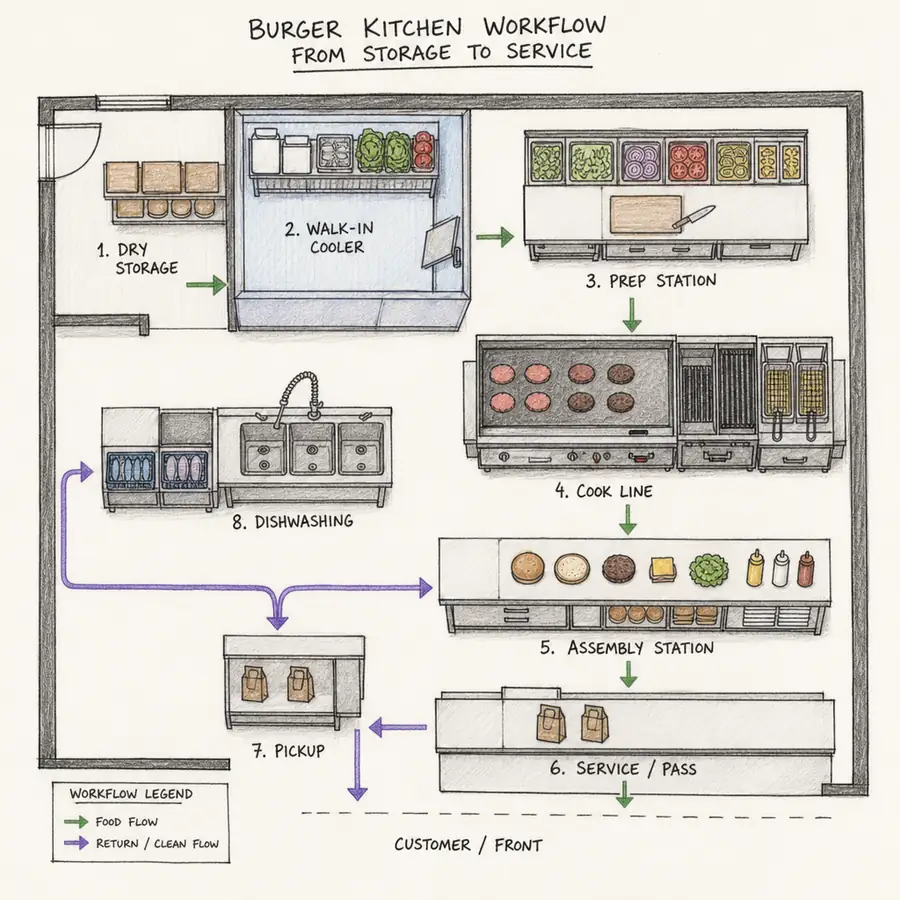
Workflow turns equipment into speed when the cook line, prep table, and warewashing stations sit in a straight path.
A complete burger restaurant equipment list is not just a shopping list. It is a workflow map. The best kitchen equipment for burger restaurant operations is arranged so staff can move naturally from receiving to storage, prep, cooking, assembly, service, and washing.
Start with the path of the food. Deliveries should move quickly to dry, refrigerated, or frozen storage. Prep tables should sit near the ingredients they use. The cook line should place griddles, fryers, toasters, and holding areas in a sequence that matches how orders are built. The dish area should be close enough to service and prep to collect wares efficiently without crossing into clean food paths. To find the best burger prep equipment, The Horeca Store should be your first stop for quality options that integrate seamlessly into your kitchen workflow.
Also plan for people, not just equipment. Staff need room to turn, pass, open refrigerator doors, pull fryer baskets, and access hand sinks. If the layout forces employees to cross behind each other constantly, even high-quality food service equipment will feel slow.
Warewashing, sanitation, and safety equipment
Warewashing, sanitation, and safety equipment should include a three-compartment sink and a dishwasher sized to peak volume.
Sanitation equipment is not optional background infrastructure. It affects inspections, labor, food safety, and daily closing routines. A three-compartment sink is a common requirement for washing, rinsing, and sanitizing, and separate hand sinks are typically needed in convenient locations for staff hygiene.
Dishwasher needs depend on service style. A small counter-service burger shop using mostly disposable packaging may manage with sinks and limited dishwashing equipment. A dine-in concept with trays, baskets, metal utensils, or reusable wares may benefit from an undercounter or door-type dishwasher. High-volume locations may need greater throughput and more dish landing space.
Safety supplies should be included in the first budget, not added after opening. Floor mats help reduce slips and fatigue. Thermometers support safe cooking and holding. Sanitizer buckets, test strips, gloves, aprons, cleaning brushes, hood filters, and fire safety equipment all belong in a working plan for burger restaurant supplies.
Front-of-house and packaging supplies
Front-of-house and packaging supplies complete the burger restaurant equipment list with fast food supplies for pickup and dine-in.
The guest-facing side of a burger business depends on supplies that are easy to overlook during equipment planning. Trays, baskets, liners, wrap paper, clamshells, bags, napkins, cups, lids, straws, receipt paper, condiment cups, and beverage supplies all affect speed and presentation.
Packaging should match the way customers eat your food. A dine-in burger may need breathable paper or baskets that preserve texture. Delivery orders may need packaging that reduces sogginess while holding heat. Takeout bags should fit the average order without crushing fries or stacking cold drinks against hot food.
Beverage equipment can include soda fountains, tea brewers, coffee brewers, milkshake machines, ice bins, ice machines, cup dispensers, and water stations. Ice capacity is easy to underestimate, especially in warm weather or at stores with heavy fountain drink sales. If drinks are a major part of your revenue, treat beverage equipment as core infrastructure rather than an accessory.
Labor-saving tools that protect consistency
Labor-saving tools that protect consistency include conveyor toasters, heat lamps, slicers, and food processors.
Not every useful tool is large or expensive. Some of the best equipment choices reduce repetitive labor and make results easier to repeat. In burger restaurants, consistency is valuable because customers often order the same meal again and again.
Consider tools that standardize the work:
- Patty presses or molds for uniform shape and cooking time
- Portion scales for meat, cheese, toppings, and sauce control
- Fry cutters if you cut potatoes in-house
- Conveyor toasters for steady bun output during rushes
- Heat lamps or holding cabinets for short-term staging
- Labeling systems for prep rotation and allergen awareness
- Speed racks for buns, sheet pans, and batch-prepped items
Holding equipment should be used carefully. Heat lamps, fry dumps, and warming cabinets can improve timing, but they cannot rescue food held too long. Set internal quality standards for how long fries, patties, and toasted buns can wait before they are remade.
Choosing efficient and durable equipment
Choosing efficient and durable equipment means matching commercial cooking equipment and the hood system to real peak volume.
Energy efficiency and durability influence operating costs long after opening day. When comparing burger restaurant kitchen equipment, look beyond the purchase price and consider energy use, heat output, cleaning time, repair access, warranty terms, and replacement parts. A cheaper unit that slows the line or fails during peak service is rarely a bargain.
Efficient equipment can also make the kitchen more comfortable. Better insulation, faster recovery, and appropriate sizing may reduce wasted heat and help the line stay productive. For refrigeration, check door seals, airflow, temperature recovery, and whether the unit fits the kitchen's ambient conditions.
Before buying, ask these practical questions:
- Does this unit match our expected peak volume, not just our average volume?
- Will it fit under the hood, through the door, and into the planned line position?
- Are the gas, electric, water, drain, and ventilation requirements already available?
- Can staff clean it quickly and safely every day?
- Are parts, service, and support accessible in our area?
- Would one larger unit or two smaller units give better flexibility and redundancy?
A practical burger restaurant setup checklist
A practical burger restaurant setup checklist covers the griddle, fryers, refrigeration, warewashing, and restaurant equipment extras.
Use this checklist to turn your plan into an organized purchasing process. It includes the major food service equipment and burger restaurant supplies most operators should consider, though your final list should reflect your menu, building, and local requirements.
Cooking and hot holding
- Flat-top griddle or charbroiler
- Fryers and fryer baskets
- Bun toaster or conveyor toaster
- Heat lamps, fry dump, or holding cabinet
- Hood system and fire suppression planning
Cold storage and prep
- Reach-in refrigerator and freezer
- Refrigerated prep table
- Undercounter refrigeration where needed
- Stainless worktables
- Food pans, lids, labels, and storage containers
Smallwares and production tools
- Spatulas, tongs, turners, ladles, and spoons
- Cutting boards, knives, and knife storage
- Scales, portion scoops, and patty tools
- Sheet pans, speed racks, and mixing bowls
- Thermometers and timers
Cleaning, safety, and warewashing
- Three-compartment sink and hand sinks
- Dishwasher if volume and service style justify it
- Sanitizer buckets, test strips, gloves, and aprons
- Mop sink, floor mats, brooms, brushes, and cleaning chemicals
- Fire extinguishers and first aid supplies
Service and fast food supplies
- Trays, baskets, wraps, bags, and liners
- Cups, lids, straws, napkins, and dispensers
- Condiment cups, packets, pumps, and sauce bottles
- POS station supplies and receipt paper
- Beverage and ice equipment
Final takeaway
Final takeaway: source kitchen equipment for burger restaurant operations from The Horeca Store so the cook line, prep table, and warewashing plan work as one system.
A complete burger restaurant equipment list should help you build a kitchen that is fast, safe, and realistic for your menu. Start with the cooking line, then plan refrigeration, prep, warewashing, storage, packaging, and workflow around the way orders will actually move during rush periods. The best equipment for burger restaurant success is not always the biggest or most expensive option; it is the setup that gives your team enough capacity, clear organization, and consistent results every shift. When it comes to sourcing your restaurant equipment, consider The Horeca Store for an efficient purchasing experience that meets all your kitchen needs.