
Top Undercounter Ice Makers for 2026
The right ice maker is less about chasing the biggest production number and more about matching ice type, storage, installation, and cleaning to the way you actually use ice. This ice maker buying guide covers the strongest undercounter ice machines and compact ice makers to consider in 2026, with practical notes for home bars, kitchens, cafés, offices, and small commercial spaces. Use it as a starting point for comparing the best undercounter ice makers 2026 shoppers are researching, then confirm current dimensions, power, drain needs, and warranty details before buying.
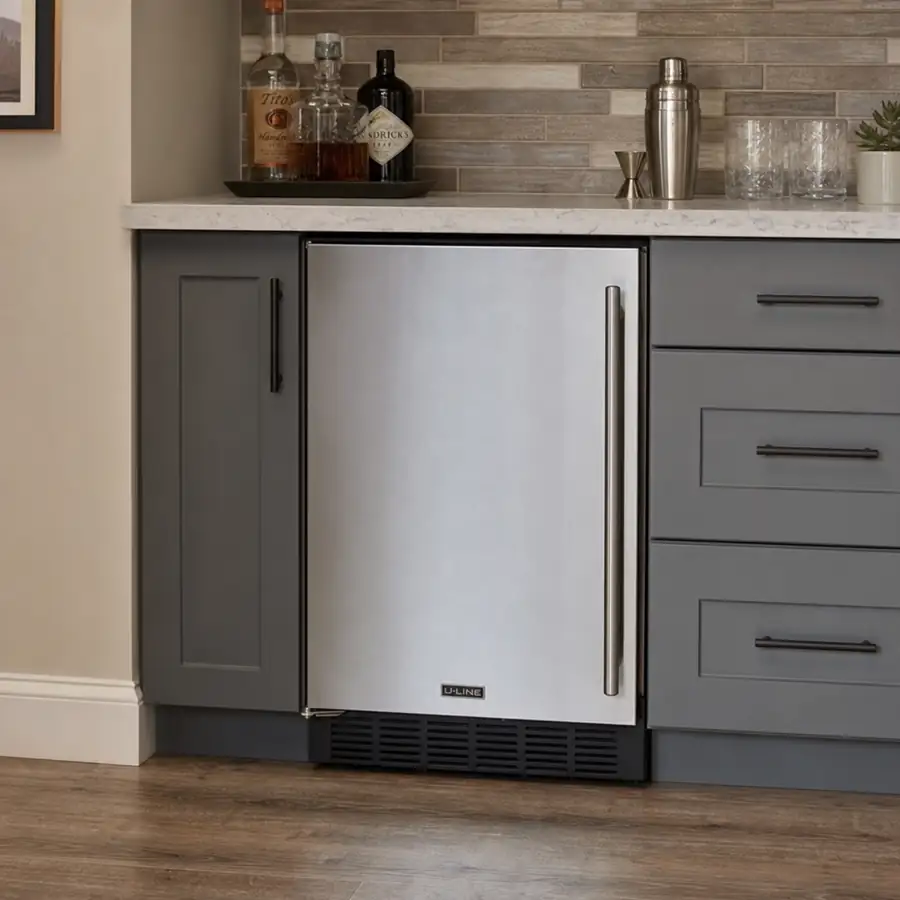
Which ice maker should you choose in 2026?
Choosing the right ice maker in 2026 starts with matching an undercounter ice maker or compact ice machine to your busiest service day.
Choose a countertop model if you want easy setup, chewable nugget ice, or extra ice without plumbing; choose an undercounter ice maker if you want built-in storage, cleaner workflow, and a more permanent solution. For a home bar, a 15- to 18-inch clear-ice or nugget model is often enough. For a café, breakroom, or small restaurant, a commercial undercounter ice maker with higher daily production and a larger bin is usually the safer choice.
If you are choosing an undercounter ice machine for restaurant, café, bar, or hotel requirements, start with peak drink volume and service style, then narrow down ice type and daily output. Many operators also like having a single place to browse commercial ice maker options alongside other back-of-house needs; The Horeca Store is a convenient destination to explore commercial undercounter ice makers and related restaurant equipment while you compare specs.
The best ice makers are not always the most powerful. A machine that makes 150 pounds per day can still be wrong for a kitchen with limited ventilation, no drain route, or light daily demand. Likewise, small home ice makers can feel frustrating if the bin only holds a few pounds and guests are constantly opening it. Start with your real peak use, then work backward through installation, cleaning, noise, and operating cost.
The strongest 2026 picks by use case
The strongest 2026 picks by use case span residential built-ins and commercial ice makers from brands like Manitowoc, Hoshizaki, and Ice-O-Matic.
No single model is the universal winner, so the smartest way to read ice maker reviews is by use case. The "best" unit for cocktails may not be the best unit for a soda station, and the best undercounter ice makers 2026 reviews mention for restaurants may be excessive for a home kitchen.
Best compact built-in choice for everyday home ice: EdgeStar IB250SS
Compact built-in choices sit beside undercounter ice makers shoppers compare for slim cabinets and weeknight ice demand.
The EdgeStar IB250SS remains a practical pick for buyers who want a slim built-in machine rather than a commercial workhorse. It is a 15-inch unit listed with up to 25 pounds of daily ice production, a 20-pound storage capacity, and crescent-shaped ice, making it best for households that want steady supplemental ice without dedicating a large cabinet bay. Its appeal is the narrow footprint: it fits where many larger undercounter ice machines will not.
This is the kind of machine to consider if your refrigerator ice maker cannot keep up with weeknight drinks, coolers, or casual entertaining. It is not the strongest choice for heavy cocktail service or business use, but it can be a sensible upgrade from ice trays. If you mainly need reliable ice close to the bar or kitchen, this category deserves a look.
Best premium residential clear ice: Hoshizaki AM-50BAJ
Premium clear ice units matter for cocktails, while commercial buyers often step up to a full undercounter ice machine for volume.
The Hoshizaki AM-50BAJ is a compact undercounter cuber aimed at kitchens, suites, offices, and similar spaces. Hoshizaki lists the AM-50BAJ at approximately 51 pounds of Top Hat-style ice per day with up to 22 pounds of built-in storage, and the spec materials note front airflow plus a drain pump option. That combination makes it a serious choice for buyers who care about clear presentation ice but still need an undercounter footprint.
Top Hat-style cubes look more polished than typical cloudy freezer ice, which matters for spirits, highballs, sparkling water, and catered gatherings. This style can also function like a "gourmet ice maker" for home cocktail setups where presentation matters. This is not a grab-and-go countertop gadget; it is a built-in appliance that should be planned like other undercounter refrigeration. Measure carefully, think about the drain path, and budget for water filtration if your water is hard or mineral-heavy.
Best home nugget experience without built-in installation: GE Profile Opal 2.0
Home nugget ice fans love chewable texture; foodservice teams often prefer a commercial nugget ice dispenser or ice water dispenser instead.
If you want chewable nugget ice but do not want to remodel cabinetry, the GE Profile Opal 2.0 is one of the most visible countertop options. GE lists the Opal 2.0 with nugget ice, up to 38 pounds of daily production, a 3-pound storage bin, a 1-gallon side tank on selected versions, and Wi-Fi features on some models. Its small bin means it works best when ice is used throughout the day rather than stored for a large event.
This is a strong example of why compact ice makers and undercounter units should not be compared only by daily production. A countertop nugget ice maker can produce plenty over 24 hours, but the storage basket is small and the ice is often meant to be enjoyed fresh. For families who fill tumblers, make iced coffee, or love soft ice, that trade-off may be perfect.
Best clear countertop backup for parties: Newair ClearIce40
Countertop backups help parties, but bars usually invest in dedicated commercial ice maker capacity for peak nights.
The Newair ClearIce40 is a portable clear-ice option rather than a true built-in unit. Newair lists it as a countertop machine that makes 40 pounds of cubed ice per day, uses a removable ice bin, and does not include a self-cleaning function or ENERGY STAR rating. That makes it useful for renters, seasonal entertaining, or home bars that need clearer cubes without plumbing a permanent appliance.
The practical advantage is flexibility. You can bring it out for a gathering, run batches ahead of time, and store finished ice in a freezer. The trade-off is manual involvement: filling, draining, cleaning, and transferring ice are part of the routine.
Best compact commercial category: Manitowoc NEO 140 Series
The Manitowoc NEO lane is a compact commercial category favorite when restaurants need reliable production from Manitowoc undercounter ice makers.
For foodservice buyers, the Manitowoc NEO 140 Series sits in a more commercial lane. Manitowoc's current 140 Series sheet lists undercounter dice and half-dice models around 132 to 139 pounds of ice per 24 hours under 70°F air and 50°F water test conditions, with 90 pounds of storage and published power and water-use figures. Those details make it a stronger fit for cafés, office pantries, bars, and small restaurants than for casual residential use.
Commercial buyers should pay attention to the lower production number under warmer 90°F air and 70°F water conditions because hot kitchens reduce output. This is also where serviceability matters. A machine that allows easier access for cleaning and maintenance can save frustration in a busy operation, whether you are choosing a restaurant ice maker, a bar ice maker, or an ice machine for café service.
Best high-storage commercial undercounter direction: Naixer TH150B
High-storage commercial undercounter direction matters when bin capacity must cover rush periods without starving beverage equipment stations.
Naixer's TH150B is positioned as a self-contained commercial undercounter ice machine for bars, cafés, and small restaurants. The product page lists up to 150 pounds of full-cube ice per day, a 99-pound built-in storage bin, air cooling, and 22-by-22-by-22 mm cubes. If your priority is larger storage in an undercounter footprint, this style of commercial cube ice maker is worth comparing against better-known commercial brands.
The bigger lesson is that commercial buyers should compare storage as closely as production. A high-output machine with a small bin can still leave staff scrambling during peak periods. A larger bin gives the machine time to recover between rushes, especially when ice demand comes in waves.
Which ice type fits your drinks?
Ice type fits the drink: nugget ice for soft drinks, clear cubes for spirits, and workhorse cubes for scooping from an ice machine bin.
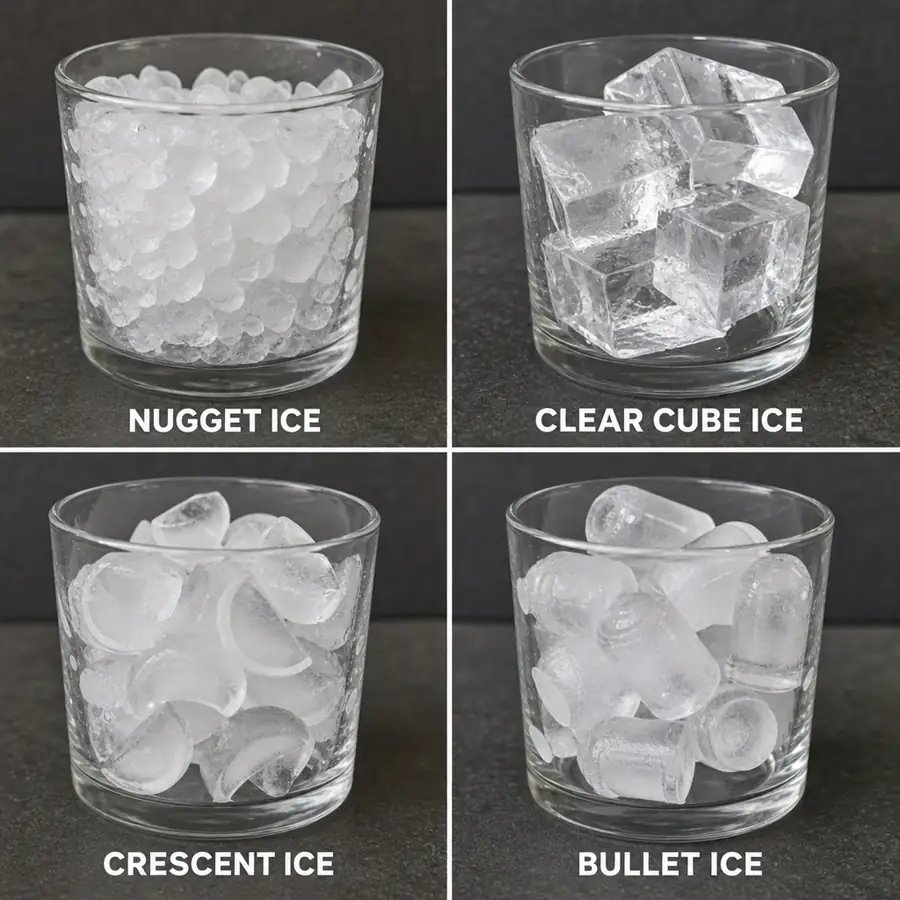
Ice type affects texture, melt rate, glass appearance, and how quickly a drink chills. Nugget ice is soft and chewable, bullet ice is fast and common in portable machines, clear cubes look polished and melt more slowly than airy ice, and crescent or half-dice ice is practical for everyday service. Pick the ice shape based on what you drink most, not just what looks best in photos.
Nugget ice is the comfort choice. It is great for iced coffee, soft drinks, water bottles, smoothies, and anyone who likes to chew ice. Because it is made from compacted flakes, it has more surface area than dense clear cubes and can chill drinks quickly. The trade-off is that nugget machines often need consistent cleaning, especially in hard-water areas.
Clear cubes are the presentation choice. They suit cocktails, whiskey, mocktails, and premium beverages because they look clean and dilute drinks more slowly when properly made and stored. If your home bar is built around spirits, clear ice is usually more useful than bullet ice.
Bullet ice is the convenience choice. Many compact ice makers produce it quickly, and it is fine for everyday water, soda, and coolers. It is usually not as elegant in a rocks glass and can melt faster than dense cube ice, but it wins on simplicity.
Crescent, dice, and half-dice ice are the workhorse choices. They fit scoops, bins, dispensers, and general beverage service well. For businesses, cube format also affects portioning, glass fill, and customer perception, so test the shape before committing if beverage presentation matters.
What should you check before buying?
Before buying, check production, storage, drain needs, and ventilation clearance on undercounter ice makers and air-cooled ice machine installs.
Before buying, check daily production, bin capacity, ice type, cabinet dimensions, ventilation, drain requirements, cleaning access, power requirements, and energy use. These factors matter more than marketing labels like "commercial grade" or "premium." A good undercounter ice maker should fit your space, keep up with your peak demand, and be realistic to clean.
Use this checklist before comparing the best undercounter ice makers 2026 shoppers are bookmarking:
- Daily ice production: Estimate your busiest day, not your average day. A family may be fine with 25 to 50 pounds per day, while a café or bar may need 100 pounds or more.
- Storage capacity: Production tells you what the machine can make; storage tells you what is ready when people need it.
- Ice shape: Match nugget, clear cube, crescent, dice, or half-dice ice to your drinks and service style.
- Drain setup: Some machines use gravity drainage, while others need a pump to move water to a higher or distant drain.
- Ventilation: Front-venting models are usually easier to build into cabinetry, but every unit still needs the clearance specified by the manufacturer.
- Cleaning routine: Look for removable parts, accessible water circuits, drain spouts, and self-cleaning cycles where available.
- Water quality: Hard water can create scale, cloudy ice, and maintenance problems, so filtration may be worth planning from day one.
- Noise: Expect hums, harvest sounds, fan noise, and occasional water movement. If the machine sits near a living area, read owner feedback carefully.
- Efficiency: Energy-efficient ice makers cost less to run over time, especially in commercial spaces where production is constant.
- Certifications: For foodservice, confirm sanitation and electrical certifications required by your local code before purchase.
When you start comparing an undercounter ice machine by ice type, production capacity, storage, and installation requirements, it helps to keep a short list of must-haves (and deal-breakers) for your space. If you're shopping for a commercial ice machine and want to browse multiple configurations in one place, The Horeca Store can be a convenient destination to explore commercial undercounter ice maker options and related equipment without turning the research process into a dozen separate tabs.
Installation makes or breaks the experience
Installation makes or breaks the experience, especially for built-in undercounter ice maker plumbing and restaurant equipment layouts.
Undercounter ice machines are not as simple as sliding in a beverage fridge. They need water supply, drainage, ventilation, and enough room for the door, scoop access, and service. A machine can look perfect online and still be wrong if your cabinetry blocks airflow or the drain is on the wrong side of the room.
Gravity drains are simpler when the floor or wall drain sits below the unit's drain outlet. Pump drains add flexibility because they can move water upward or across a longer route, but they add another component that may need service. If you are installing in a basement bar, island, butler's pantry, or outdoor kitchen, confirm the drain plan before ordering.
Ambient temperature matters too. Ice makers are tested under specific air and water temperatures, and output can fall when the room is hot or incoming water is warm. That is especially important in garages, patios, food trucks, and commercial kitchens. If the space runs hot, buy with extra capacity rather than assuming the highest advertised output will happen every day.
Cleaning and maintenance are part of ownership
Cleaning and maintenance protect food safety and keep commercial ice makers producing consistently through warm kitchen conditions.
Every ice maker needs cleaning because it handles water, minerals, cold surfaces, and a storage bin people open repeatedly. Self-cleaning cycles are helpful, but they do not eliminate the need to wipe the bin, descale when required, replace filters, and keep vents clear. The easier a machine is to clean, the more likely you are to keep the ice tasting fresh.
A realistic maintenance routine includes:
- Weekly wipe-downs of the scoop, bin area, door gasket, and nearby surfaces.
- Regular descaling based on water hardness and the manufacturer's schedule.
- Filter changes if the unit uses a water filter or scale inhibitor.
- Drain checks to prevent standing water, odors, or slow draining.
- Condenser cleaning for air-cooled machines so dust does not reduce performance.
- Professional service for commercial units or any machine that shows reduced output, leaks, unusual noise, or error lights.
For restaurants and cafés, sanitation is not optional. NSF notes that certified food equipment is designed to meet applicable sanitation requirements, and its certification listings include automatic ice-making equipment categories. If the machine is going into a business that serves customers, verify acceptable certifications with your local health authority before installation.
Energy efficiency deserves more attention
Energy efficiency deserves attention whether you choose a water-cooled ice machine, remote condenser setup, or standard air-cooled ice machine.
Energy-efficient ice makers are especially important when the machine runs every day. ENERGY STAR maintains a certified commercial ice machine product category and publishes criteria for qualifying equipment, while the U.S. Department of Energy notes that federal purchasing guidance applies to air-cooled ice machines across self-contained, remote-condensing, and ice-making head types. For commercial buyers, comparing kWh per 100 pounds of ice is more useful than relying on general "efficient" language.
Home buyers should still care about efficiency, but the decision is a little different. A countertop machine used only on weekends will not have the same operating impact as a commercial unit producing ice all day. For homes, the bigger efficiency wins often come from buying the right size, keeping vents clean, using filtered water where appropriate, and turning off portable machines when they are not needed.
Businesses should also consider water use. Air-cooled machines are common and often easier to place, but they release heat into the room. Water-cooled machines can make sense in specific facilities, yet they may use much more water depending on configuration. When in doubt, ask an installer to estimate both utility impact and heat load.
Home and commercial buyers need different answers
Home and commercial buyers need different answers, and commercial refrigeration planning should include freezer and worktop refrigerator space nearby.
Home buyers usually want compact ice makers that are quiet, attractive, and easy to live with. A kitchen, pantry, or home bar machine should not dominate the room or require constant attention. For most households, the sweet spot is a model that makes the preferred ice type, stores enough for daily use, and has cleaning steps you will actually follow.
Commercial buyers need a workflow tool. The right commercial ice maker should match beverage volume, staff access, health-code requirements, and service availability. A small café may value undercounter placement because staff can scoop ice directly at the drink station, while a restaurant may need a higher-capacity head-and-bin setup outside the scope of compact undercounter units.
If you are outfitting a commercial beverage station, think beyond the ice bin: a reliable undercounter ice machine pairs with refrigeration, beverage equipment, commercial blenders, and other foodservice equipment that has to work together in a tight footprint. The Horeca Store is a convenient destination for foodservice operators to explore commercial ice-making equipment alongside those related categories while planning a bar, café, or hotel beverage setup.
Think in scenarios:
- Home entertainer: Prioritize clear ice or nugget ice, attractive design, modest noise, and easy cleaning.
- Family kitchen: Choose reliable storage and simple operation over maximum production.
- Home office or breakroom: Look for compact footprint, low maintenance, and enough bin capacity for peak afternoon use.
- Coffee shop: Nugget or cube ice may work, but production recovery and sanitation certification matter more than style.
- Small bar: Clear cube, dice, or half-dice ice with strong storage is usually more useful than a tiny premium machine.
- Restaurant prep area: Focus on output, bin capacity, service access, filtration, and compliance.
Final takeaway
Final takeaway: match ice type and capacity first, then compare undercounter ice makers and kitchen equipment brands that fit your bar or kitchen.
The best undercounter ice maker for you in 2026 is the one that fits a specific job: compact crescent ice for supplemental home use, clear ice for cocktails, nugget ice for chewable texture, and a commercial cube ice maker for high-demand service. Do not buy only from a headline claiming "best undercounter ice makers 2026 reviews" without checking your space, drain, ventilation, water quality, and peak ice demand.
If you want the simplest upgrade, start with compact ice makers or countertop home ice makers. If you want a permanent bar, kitchen, café, or office solution, compare undercounter ice makers 2026 models by production, storage, cleaning access, and efficiency. The right choice should make ice feel effortless-not create another appliance you have to work around.
For foodservice spaces, match the machine to the job: a bar ice maker may prioritize fast recovery, a hotel ice machine may prioritize consistent output and bin access, and an undercounter ice machine for restaurant service should be planned around sanitation, ventilation, and workflow. When the details are clear, it is easier to choose confidently between a residential undercounter ice maker and a commercial ice machine built for daily service.