

The best undercounter freezers for busy commercial kitchens match the station's storage needs, available clearance, and service routine - not simply the smallest footprint. This manufacturer-specification-based shortlist compares compact door models and pull-out drawer options, then explains what to check before ordering. Use it to narrow your choices before discussing specifications with The Horeca Store or another commercial equipment supplier.
Which undercounter freezer is best for your kitchen?
For a compact single-door station, start by comparing the Hoshizaki UF27B and Arctic Air AUC27F. For organized drawer storage, consider the True TUC-27F-D-2-HC~SPEC3; for a wider four-drawer setup, examine the Turbo Air PUF-60-D4-N. These models offer different layouts rather than a universal winner, so choose around your containers, installation space, and access requirements.
The recommendations below interpret published manufacturer information; they are not hands-on undercounter freezer reviews. There are no invented durability scores, recovery-time rankings, or claims that one unit always outperforms another. Treat each model as a shortlist candidate and confirm the exact configuration before purchase.
Start by writing a one-sentence job description for the freezer. "Hold portioned desserts beneath the plating counter" gives you a clearer buying brief than "add frozen storage." Then list the containers that must fit and identify who will access them during your busiest service.
Commercial undercounter freezers worth shortlisting
Hoshizaki UF27B: Compact storage with reversible access
The Hoshizaki UF27B combines a 27-inch-wide cabinet with front-breathing airflow, a field-reversible self-closing door, and an adjustable shelf. Hoshizaki lists 6.21 cubic feet of net storage and says the unit is engineered to maintain food-safe temperatures in ambient conditions up to 100°F. Those specifications make it a useful candidate for a compact station where door orientation and kitchen temperature matter.
Best-fit consideration: Put this model on your list when you want shelf-based storage rather than fixed drawer organization. Before committing, measure your actual containers against the interior and door opening. Do not assume that a nominal capacity figure tells you how many cartons or lidded tubs will fit.
Arctic Air AUC27F: Straightforward single-door organization
The Arctic Air AUC27F offers an adjustable epoxy-coated shelf, an external digital temperature display, self-closing door, and casters with two locking wheels. Its stainless steel floor has coved corners, while the magnetic door gasket can be removed without tools. These are practical features to examine when cleaning access and uncomplicated storage are priorities.
Best-fit consideration: Compare this model for a station that needs a simple shelf-and-door arrangement. Ask for a written quote before treating it as the budget choice; purchase price, freight, installation, and coverage all need checking. Confirm the full model designation so the quoted unit matches the documentation you reviewed.
True TUC-27F-D-2-HC~SPEC3: Two drawers for portioned ingredients
True's two-drawer undercounter freezer has a stainless steel interior, removable drawer slides and rollers, digital temperature control, and automatic defrost. The manufacturer specifies a refrigeration system designed to maintain -10°F. Its standard configuration has a 36-inch work-surface height, with alternative height configurations listed as options.
Best-fit consideration: Shortlist it when you want to assign ingredients to two defined drawers rather than stack them behind one door. Request the exact pan-layout drawing and accessory list, including any divider bars. Confirm pan depth against the specific configuration being quoted rather than assuming every version accommodates identical containers.
Turbo Air PUF-60-D4-N: Four drawers across a wider station
The Turbo Air PUF-60-D4-N provides four drawers and a listed net capacity of 17.22 cubic feet. Its specification sheet describes a self-cleaning condenser with a rotating brush, removable magnetic drawer gaskets, and different pan arrangements for the upper and lower drawers. Turbo Air lists a -10°F to 0°F holding range and design capability for 100°F ambient conditions.
Best-fit consideration: Consider this larger layout when your station genuinely needs multiple ingredient positions. Map those positions before requesting a quote: one drawer for each category may be useful, but only if your containers fit. Check the fully extended drawer footprint against the working aisle, not just the closed cabinet dimensions.
Match the storage layout to the work
The best small freezers are not necessarily the narrowest ones. Start with what the station needs between replenishment runs, then choose a cabinet that accommodates that load without buying unnecessary capacity. The Department of Energy specifically recommends sizing commercial refrigeration for its intended use because oversized equipment adds purchase and energy costs.
Use these planning scenarios to shape your shortlist:
- Dessert plating: List each portion, tray, and garnish container. Decide whether you want a dedicated drawer position or adjustable shelf storage.
- Café food service: Measure the largest pastry carton or wrapped product pack. Include the space needed to remove it without unloading everything above it.
- Cook-line support: Identify the ingredients the station actually needs within reach. Separate those from reserve stock that can remain elsewhere.
- Shared preparation areas: Decide who replenishes the freezer and when. Choose a layout everyone can understand without rearranging it each shift.
For example, sketch the proposed load using your existing containers rather than imagined future packaging. Include lids and handles in the measurements. A freezer that fits the stock on paper still needs to let staff retrieve it comfortably.
Are pull-out drawers better than swing doors?
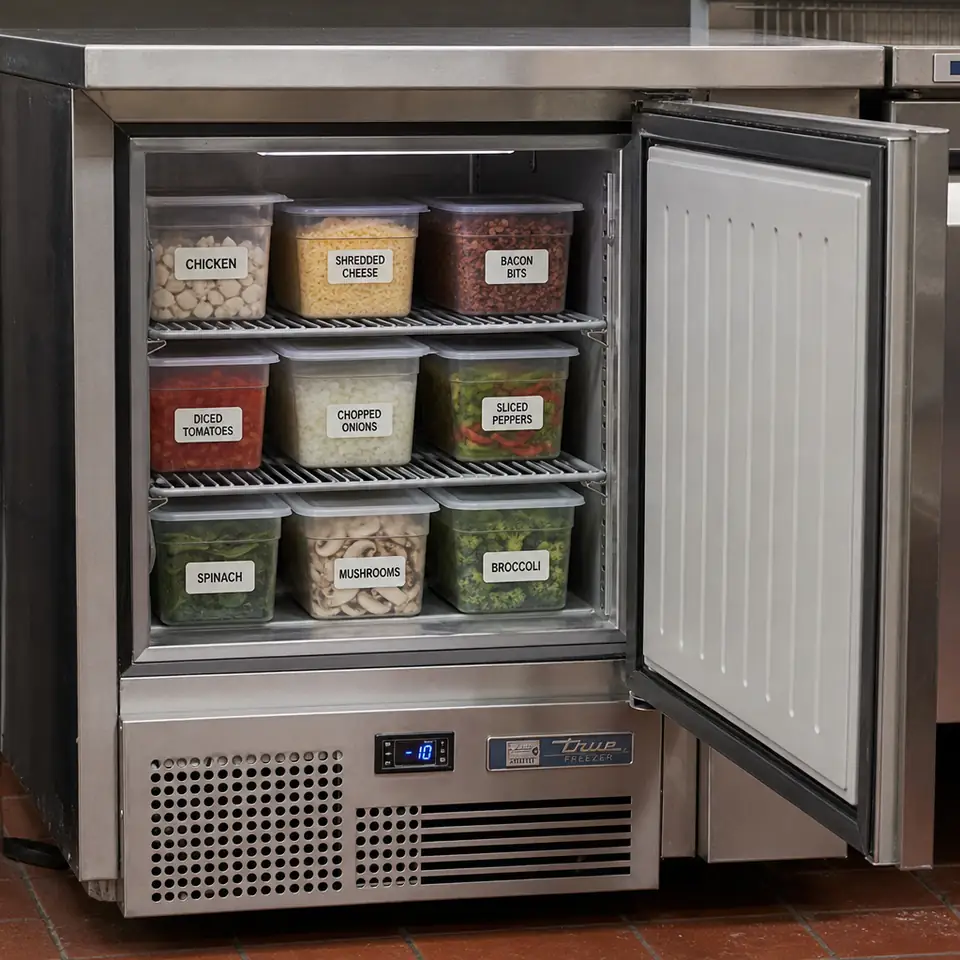
Pull-out drawers are worth considering when you want defined pan positions, while swing-door models deserve attention when adjustable shelves better suit your containers. The True and Turbo Air models above specify drawer-based pan arrangements; the Hoshizaki and Arctic Air models provide adjustable shelving. Neither format is automatically the better choice for every kitchen.
When comparing the best pull out undercounter freezers, request details that product photographs cannot establish. Ask about loaded drawer limits, extension distance, compatible pan depths, divider requirements, and removal procedures for cleaning. Have the supplier identify which accessories are included and which need a separate order.
For a swing-door candidate, make the same exercise equally specific. Mark the hinge position on your floor plan and check access to the lowest storage area. Ask a staff member who will use the station to review the arrangement before you approve it.
A useful final test is to draw the cabinet and its open door or drawers at full scale with removable floor tape. Walk the surrounding route as though another cook were working beside you. Use that exercise to reject awkward placements before delivery day.
Automatic defrost deserves a closer look
If you are searching for the best frost free freezers undercounter, look for the manufacturer's actual defrost specification rather than relying on that retail phrase. True specifies automatic defrost on the drawer model above, while Hoshizaki lists automatic time-initiated heated defrost for the UF27B. Ask how the quoted model manages defrost and how its display behaves during the cycle.
Build the following questions into your comparison:
- Is defrost automatic on the exact model and configuration quoted?
- Can authorized personnel adjust its timing to suit operating hours?
- What should staff expect to see on the temperature display during defrost?
- Which symptoms require cleaning, inspection, or a service call?
Do not interpret automatic defrost as permission to ignore maintenance. Arctic Air's operating manual includes separate instructions for condenser cleaning, gasket maintenance, and drain maintenance. Obtain the equivalent instructions for whichever freezer you buy and assign responsibility for following them.
Measure the installation, not just the cabinet
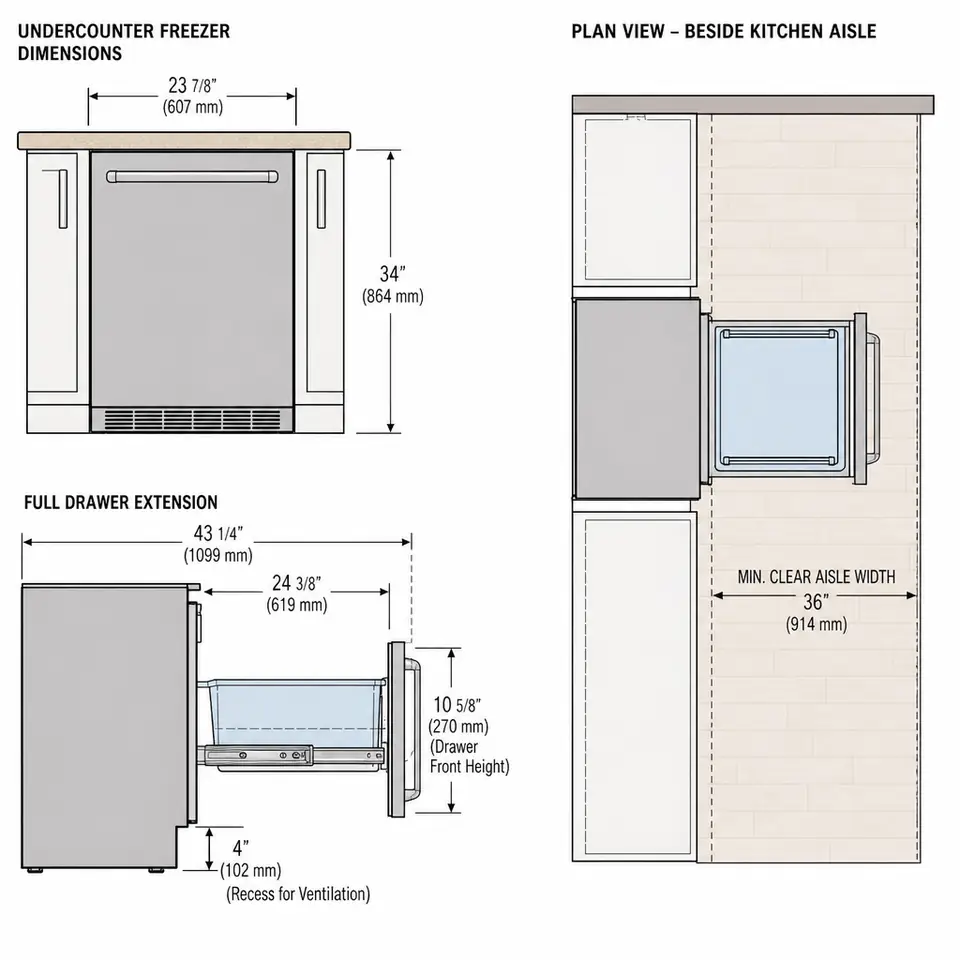
Space-saving freezers still require a model-specific installation plan. Published dimensions may exclude components: True's drawer-freezer sheet excludes casters from its cabinet height, while Turbo Air separately notes caster height and allowances for handles and rear spacers. Read every dimensional footnote before deciding that a freezer fits beneath an existing counter.
Create a purchase checklist with these fields:
- Finished opening: Record clear width, depth, and height at the tightest points, including counter supports and floor irregularities.
- Complete appliance size: Obtain dimensions with the selected casters or legs, handles, bumpers, and other projecting components.
- Operating footprint: Mark door swing or drawer extension and review the remaining working aisle.
- Installation requirements: Have the installer verify ventilation, electrical supply, and access for maintenance against the manual.
- Delivery route: Measure entrances, corners, thresholds, and any lift the equipment must pass through.
Arctic Air's installation guidance calls for adequate ventilation, separation from heat sources, level flooring for castered units, and electrical verification by a licensed electrician. Use the selected manufacturer's instructions rather than borrowing clearance or power requirements from a similar-looking freezer.
Compare operating costs and service terms
Compare energy information for the exact models, not simply the brands. ENERGY STAR provides a commercial refrigerator and freezer product finder and notes that certification criteria account for factors including internal volume, door type, configuration, and equipment type. Verify any certification claim against the listed model number.
For an initial electricity estimate, multiply the manufacturer's published daily kilowatt-hour figure by your electricity rate and planned operating days. Treat the result as a planning estimate, not a promised bill. Ask whether the figures you are comparing were established under comparable test conditions.
Request one written ownership-cost summary covering:
- Equipment price and any required shelves, pans, dividers, or alternative casters.
- Freight, liftgate service, inside delivery, installation, and removal of existing equipment.
- Parts, labor, and compressor coverage, including exclusions and claim procedures.
- Local authorized service availability and responsibility for arranging repairs.
- Routine maintenance tasks, access requirements, and any associated service charges.
Keep warranty promises attached to the specific quote. Hoshizaki's UF27B page directs buyers to its warranty eligibility information, illustrating why a headline coverage period should not replace the full terms. Read those terms before approval, particularly if the freezer will be installed in an unusual location or application.
Choose a retailer that helps verify the fit
When comparing the best retailers for compact undercounter freezers, make specification support part of your decision. The Horeca Store lists a commercial undercounter freezer category that you can use as a starting point for an inquiry. Confirm the availability and exact configuration of any shortlisted model directly rather than assuming a category listing establishes stock or suitability.
Send each supplier the same information: opening dimensions, photographs, intended ingredients, container measurements, and delivery constraints. Request the current manufacturer specification sheet and installation manual with the quote. Require substitutions to be identified clearly so a replacement model does not bypass your fit checks.
A complete quote should leave you knowing what arrives, how it enters the building, who installs it, and whom you contact afterward. Resolve unclear responsibilities before placing the order. A low advertised price is not enough information to approve a purchase.
Make the final choice around your station
Choose two finalists, map the actual container load, and verify the complete installation dimensions before comparing delivered costs. Favor the model that satisfies your documented requirements without unnecessary capacity or accessories. Once the fit, service terms, and operating requirements are clear, you can order with a practical reason for your choice - not just a persuasive product photograph.