
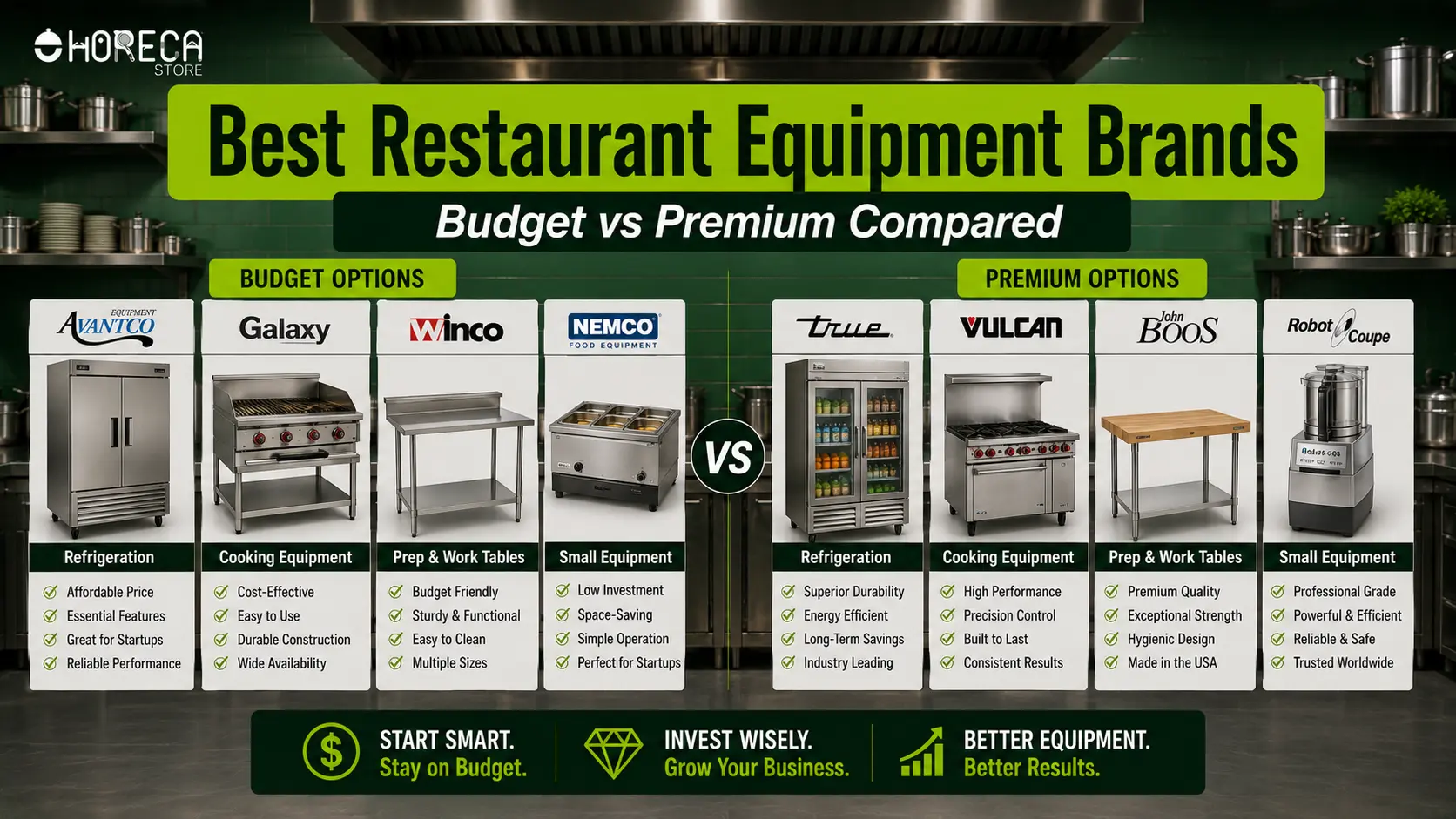
Opening a new restaurant is an exhilarating journey, but when it comes to outfitting your commercial kitchen, the excitement can quickly turn into financial anxiety. Between managing lease agreements, hiring staff, and perfecting your menu, deciding where to allocate your capital is a massive challenge.
Every new restaurateur eventually faces the same critical question: should you invest heavily in top-tier brands from day one, or save cash with more affordable alternatives? Navigating the world of the Best Restaurant Equipment Brands for Startups: Budget vs Premium Options requires a strategic approach. It is not just about buying tools; it is about balancing upfront costs with long-term reliability.
In this comprehensive guide, we will break down the best restaurant equipment brands across various categories, comparing top-tier powerhouses with reliable budget contenders. Whether you are building a bustling diner or an artisanal bakery, we will help you build a kitchen that maximizes efficiency without bankrupting your business.
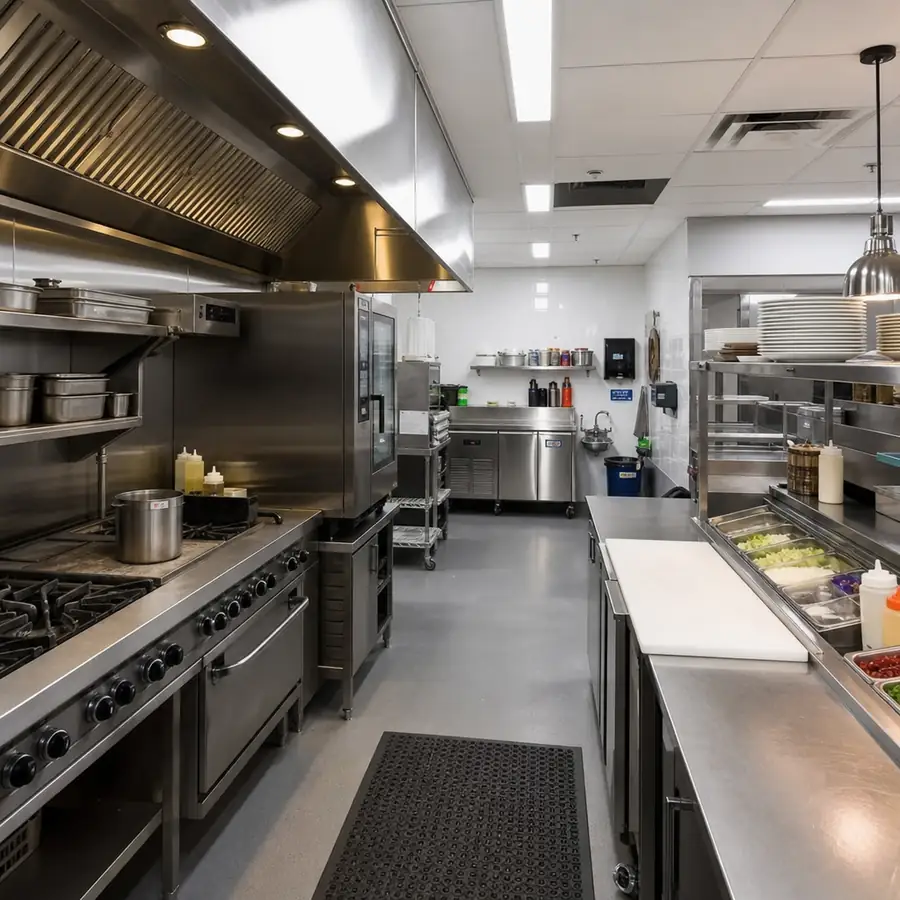
The Startup Dilemma: High-End vs. Economy Brands
When browsing through catalogs of food service equipment, the price disparities can be shocking. Why does one range cost $1,500 while another visually similar model costs $6,000?
The difference usually comes down to build quality, recovery times, warranty support, and long-term durability.
- Premium Brands (e.g., Vulcan, True, Hobart): Designed for high-volume, continuous use. They feature thicker gauge stainless steel, advanced technology, and comprehensive warranties.
- Budget/Economy Brands (e.g., Avantco, Vevor, Noble): Perfect for light to medium-duty tasks. They use lighter materials and standard components, offering incredible upfront savings.
A smart startup strategy rarely involves buying 100% premium or 100% budget. The secret lies in the "Mix and Match" method: investing premium dollars into the equipment that serves as the heartbeat of your kitchen, while economizing on secondary or prep-focused items.
Essential Heavy-Duty Cooking Equipment for Startups
The cooking line is the engine of your restaurant. If your primary heat source fails on a Friday night, your service grinds to a halt. When selecting the essential heavy-duty cooking equipment for startups, reliability is non-negotiable.
Vulcan vs Avantco Commercial Ranges Comparison
Let’s look at the classic six-burner range, a staple in almost any commercial kitchen.
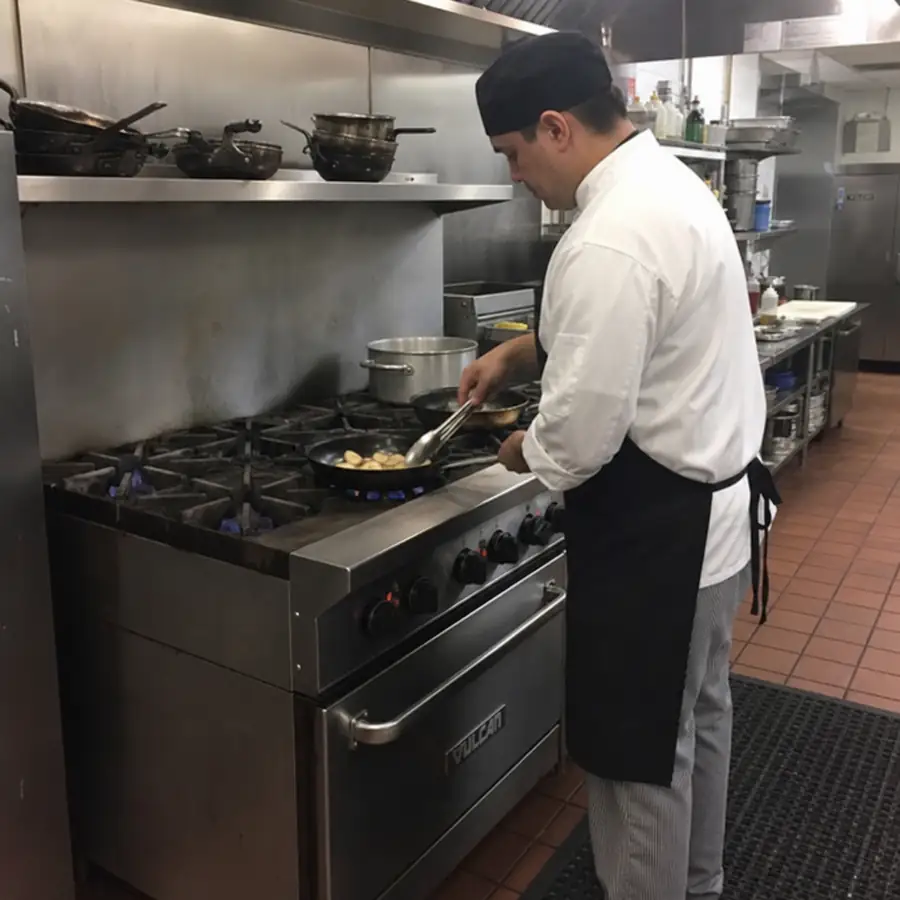
Premium Option: Vulcan Vulcan is the gold standard among kitchen appliance brands. Their ranges are built with heavy-duty cast-iron grates, fully welded frames, and innovative burner designs that maximize heat transfer. Are premium commercial ranges worth the investment? If your menu relies heavily on sautéing, pan-frying, and high-heat cooking for 10 to 12 hours day, the answer is a resounding yes. A Vulcan range will hold its calibration, withstand the daily abuse of heavy pots, and last for decade or more with proper maintenance.
Budget Option: Avantco Avantco provides an excellent entry point for startups. Their commercial ranges look professional, put out decent BTUs, and cost a fraction of Vulcan. However, in a Vulcan vs Avantco commercial ranges comparison, the differences emerge under pressure. Budget ranges often feature thinner sheet metal, which can warp over time, and pilot lights that may require more frequent adjusting.
The Verdict: If you are running a high-volume steakhouse, buy the Vulcan. If you are opening a small café where the range is only used for a few hours a day to make soups and sauces, the Avantco will serve you perfectly while keeping cash in your pocket.
Baking Brilliance: Convection Ovens
If you are opening a bakery or a concept heavily reliant on roasting, your oven is your lifeline. Exploring the top-rated industrial convection ovens for bakeries brings you to names like Blodgett and Southbend on the premium side, and Moffat or Avantco on the budget side.
A premium Blodgett oven offers dual-tube burners, flawless heat distribution, and incredibly durable doors (which are opened and closed hundreds of times a day). If your core product is delicate pastries or artisan breads, uneven heat distribution from a budget oven will cost you money in wasted product. Invest in premium here.
Commercial Refrigeration: Protecting Your Inventory
Refrigeration is not just about keeping food cold; it is about food safety and protecting thousands of dollars of perishable inventory.
High-End vs Affordable Commercial Refrigerators
When comparing high-end vs affordable commercial refrigerators, you are essentially comparing compressors, insulation, and warranty terms.
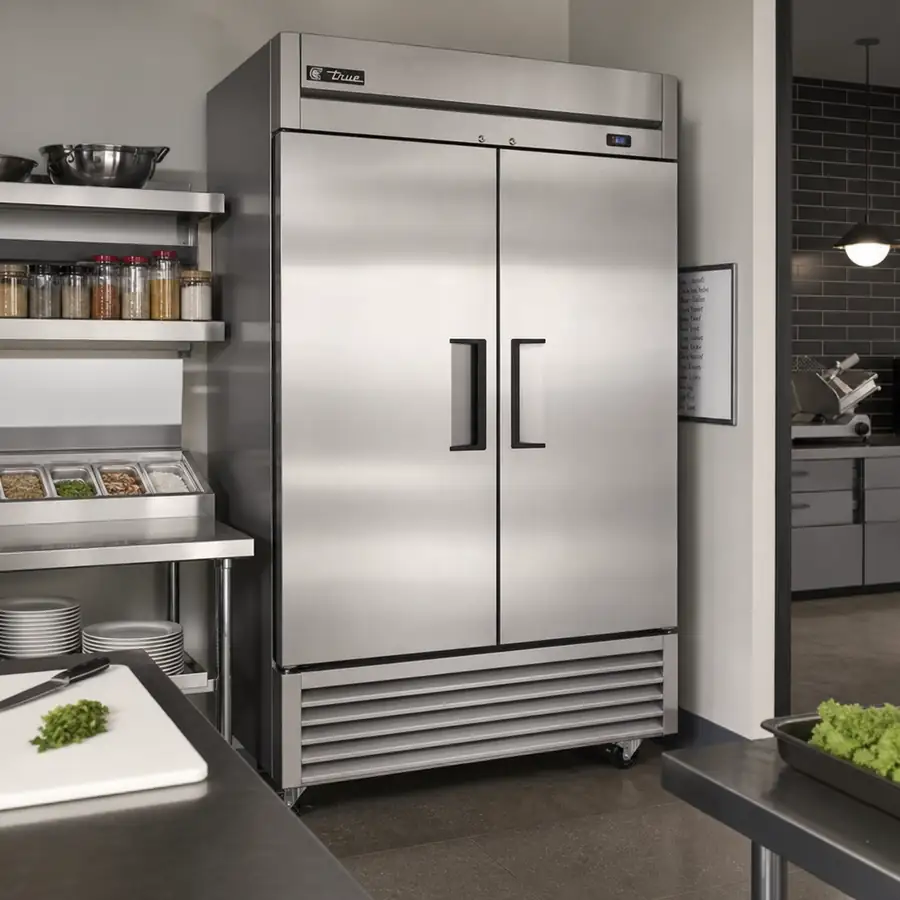
Premium Brands: True Manufacturing & Beverage-Air True is legendary in the refrigeration space. Their units use heavy-duty compressors, oversized evaporators, and excellent insulation. More importantly, they feature rapid temperature recovery—meaning when your line cooks constantly open the doors during a dinner rush, the internal temperature drops back to safe levels quickly.
Budget Brands: Atosa & Avantco Atosa is a fantastic "middle-ground" budget brand that has gained massive popularity, while Avantco offers some of the lowest prices on the market. They work well, but their compressors may struggle in extremely hot kitchens (like right next to a fryer), and their temperature recovery times are slower.
Energy Efficiency and Maintenance
Do not overlook the Energy Star rated restaurant appliances ROI. Premium units with Energy Star ratings use significantly less electricity. While a True refrigerator might cost $1,500 more upfront, it can save you hundreds of dollars annually on your utility bills, paying for the difference in just a few years.
Furthermore, you must consider commercial refrigerator warranty and repair costs. Premium brands often offer 3-year parts and labor warranties, plus an additional 2 years on the compressor. If an economy fridge breaks down after 14 months, the cost of an emergency HVAC tech visit and a new compressor could entirely wipe out the money you saved at purchase.
Actionable Tip: Keep your expensive proteins in a premium reach-in cooler, but use a budget cooler for sealed beverages, produce, or bulk dry-cool storage.
Prep Area and Food Processing: The Backbone of Efficiency
The prep area is where raw ingredients are transformed. Efficiency here drastically reduces labor costs, making equipment selection vital.
Hobart Mixers vs Budget Alternatives
If you run a pizzeria or a bakery, your stand mixer is the hardest-working piece of equipment you own.
When discussing Hobart mixers vs budget alternatives (like Eurodib or Vevor), the conversation centers around gear-driven versus belt-driven motors. Hobart mixers (premium) are gear-driven beasts. They can power through the stiffest bagel or pizza doughs day after day without stalling. They are incredibly expensive, but they are known to outlive their original owners.
Budget alternatives are often belt-driven. They are perfectly fine for mixing cake batters, whipped creams, and light icings. However, if you try to mix a 50-pound batch of heavy pizza dough in a budget mixer, you risk snapping the belt or burning out the motor.
Stainless Steel Tables and Space Saving
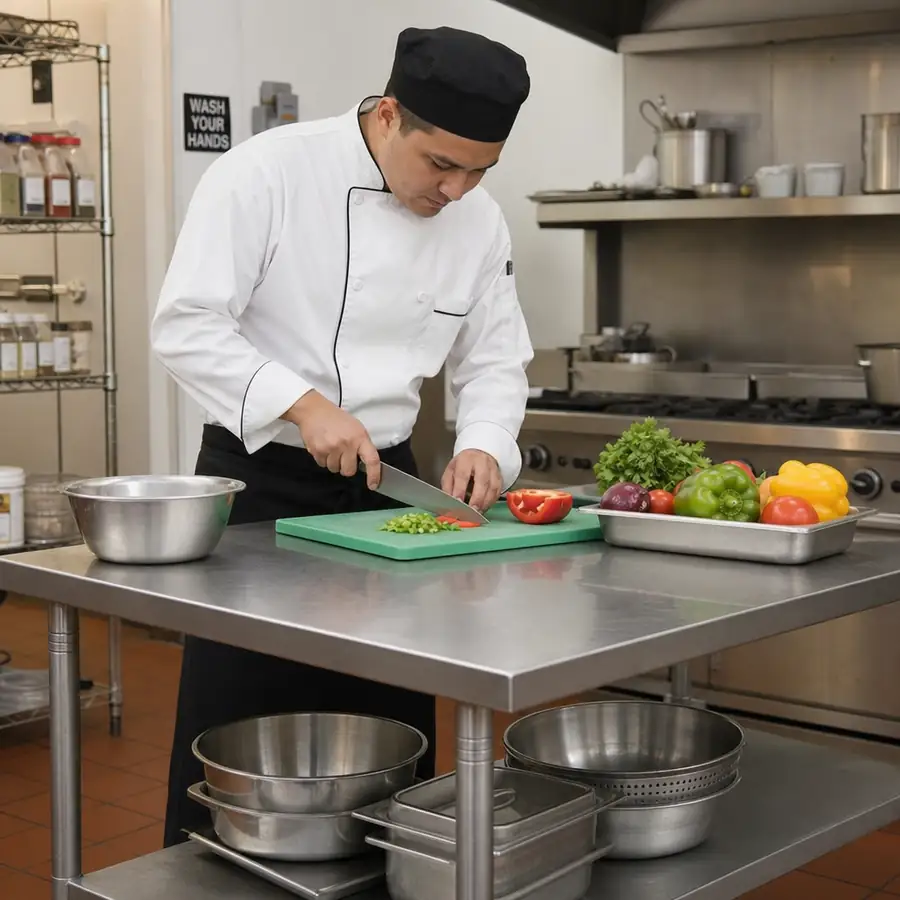
Prep surfaces are just as important as the machines sitting on them. You need to consider the durability of stainless steel work tables brands. Premium brands like Advance Tabco use 14-gauge, Type 304 stainless steel. It is highly resistant to corrosion and thick enough that a meat cleaver will not dent it. Budget brands like Regency use thinner 18-gauge, Type 430 stainless steel. It is prone to denting and can rust if left in damp, salty environments.
For tight footprints, look for space-saving prep tables for small kitchens. Many budget and mid-tier brands offer narrow 18-inch deep tables or tables with built-in overhead shelving and under-counter ingredient bins, allowing startups to maximize vertical space.
Crucially, whether you buy budget or premium, ensure you are buying NSF certified kitchen tools for food safety. The NSF (National Sanitation Foundation) certification guarantees that the equipment is designed without deep crevices where bacteria can hide, ensuring it is easy to clean and compliant with health department codes.
Dishwashing & Sanitation: Don't Compromise
Dishwashing is a brutal, wet, and chemically harsh environment. Knowing how to choose commercial dishwasher brands can save you from a massive headache down the line.
Premium Options: Hobart & Jackson These brands offer robust, high-temperature machines that sanitize using incredibly hot water. They feature heavy-duty pumps, scale-resistant parts, and excellent energy efficiency.
Economy Options: Noble & CMA Budget machines often rely on low-temperature chemical sanitization. While the machines are cheaper, you must factor in the ongoing monthly cost of the sanitizing chemicals, and the fact that chemical sanitizers can sometimes leave a residue on glassware.
Actionable Tip: If you run a high-end wine bar or fine dining establishment, a premium high-temp dishwasher is essential for spotless glassware. If you run a fast-casual burger joint serving food in plastic baskets, an affordable low-temp chemical dishwasher will suffice.
Smart Strategies: Buying Used and Financing
If you have your heart set on premium equipment but lack the upfront capital, you do not necessarily have to settle for budget brands. There are creative financial avenues available to new restaurateurs.
Buying Used vs New Commercial Kitchen Equipment
The secondary market for restaurant equipment is massive. Because the failure rate for new restaurants is unfortunately high, there is a constant supply of lightly used premium equipment available at steep discounts.
Buying used vs new commercial kitchen equipment comes with distinct pros and cons:
- Pros of Used: You can buy a top-tier Vulcan range or a Hobart mixer for the price of a brand-new budget model. These heavy-duty items are built to last, so buying them a few years old is generally a safe bet.
- Cons of Used: Used equipment rarely comes with a warranty. If you buy a used True refrigerator and the compressor blows a week later, you are entirely on your own.
Rule of Thumb for Used Equipment: Buying used gas cooking equipment (ranges, grills, fryers) or heavy machinery (mixers, stainless tables) is usually safe because they have few electrical components to fail. Avoid buying used refrigeration or dishwashers, as their internal components degrade heavily with poor maintenance.
Financing Your Kitchen Setup
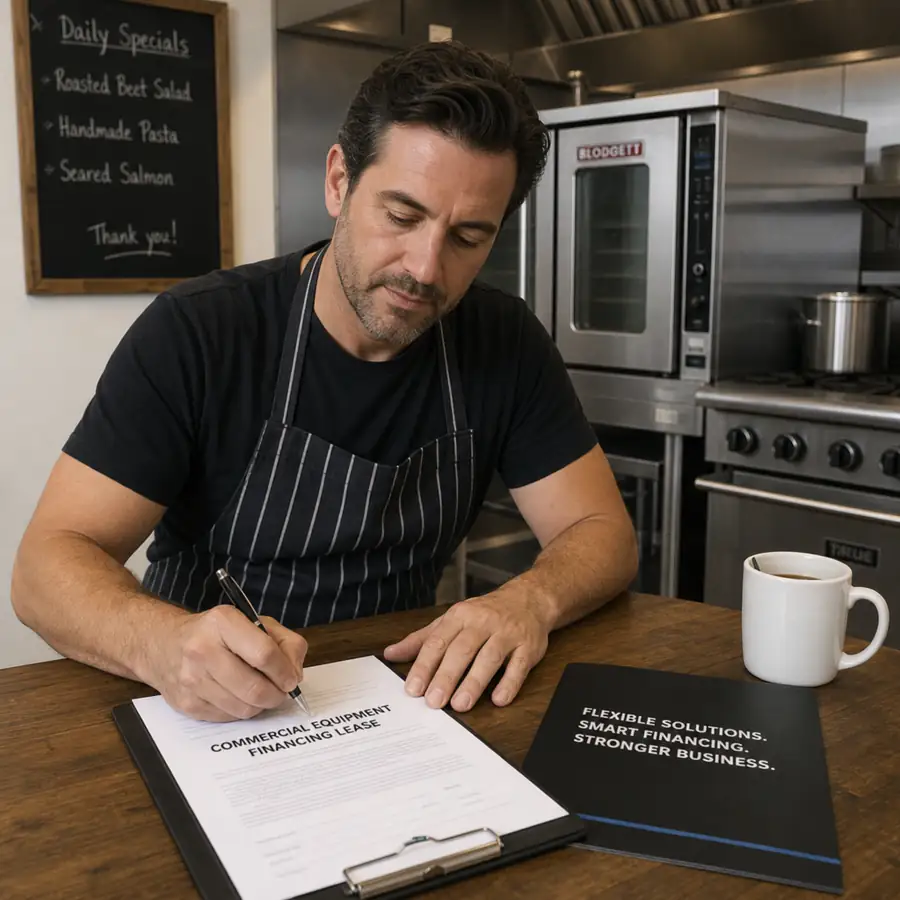
If you want the peace of mind of a warranty but want to preserve your cash flow, explore commercial kitchen equipment financing for new businesses. Most major restaurant supply stores partner with financing companies to offer loans tailored to the hospitality industry.
Alternatively, look into restaurant equipment lease-to-own programs. These programs allow you to acquire top-tier food service equipment for a manageable monthly payment. At the end of the lease term (usually 12 to 36 months), you have the option to purchase the equipment outright for a nominal fee (often just $1).
Leasing has tax advantages, too. In many cases, lease payments can be deducted as operating expenses, though you should always consult with your CPA. Furthermore, some lease agreements include routine maintenance, which helps offset future commercial refrigerator warranty and repair costs.
Find the Right Restaurant Equipment at The Horeca Store
Building a successful restaurant starts with choosing dependable equipment that supports daily operations. The Horeca Store offers a complete range of commercial kitchen equipment and hospitality supplies, including refrigeration units, cooking appliances, coffee equipment, food preparation tools, stainless steel furniture, storage solutions, and restaurant essentials.
Whether you are launching a small café, food truck, cloud kitchen, or full-service restaurant, The Horeca Store provides quality solutions for every stage of your business journey. With competitive pricing, professional-grade products, and reliable support, we help startups create efficient kitchens that are built for growth and long-term success.
Conclusion
Outfitting a new commercial kitchen is a balancing act between operational demands and budget constraints. When evaluating the Best Restaurant Equipment Brands for Startups: Budget vs Premium Options, remember that there is no one-size-fits-all answer.
The smartest startups use a hybrid approach. They spend top dollar on premium items that serve as the backbone of their specific menu—like a Hobart mixer for a bakery, a Vulcan range for a busy diner, or True refrigeration for high-volume ingredient storage. Then, they protect their capital by choosing reliable budget options—like Avantco or Atosa—for light-duty prep stations, secondary storage, and non-essential tasks.
By analyzing your specific menu needs, understanding the long-term ROI of Energy Star and NSF-certified equipment, and creatively utilizing financing and used markets, you can build a commercial kitchen that is both financially responsible and capable of handling your busiest Friday night rush.