
Tired of scraping scrambled eggs off a pan that claims to be non-stick? You're not alone. Buying cookware can feel like a gamble, with peeling surfaces and warped pans turning a kitchen investment into a frustrating waste of money. Before you even think about where to buy your next set, the most important step is learning how to choose the right cookware material for the way you actually cook.
The choice almost always comes down to two major categories: non-stick and stainless steel. To figure out which is for you, think about your go-to meals. Are you mostly making quick breakfasts and delicate fish for dinner, or are you trying to get that perfect, golden-brown crust on a chicken thigh? Your answer points directly to the kind of pan you need most.
For most home chefs, understanding the pros and cons of stainless steel vs. ceramic or other non-stick cookware is the key. Here’s a simple breakdown:
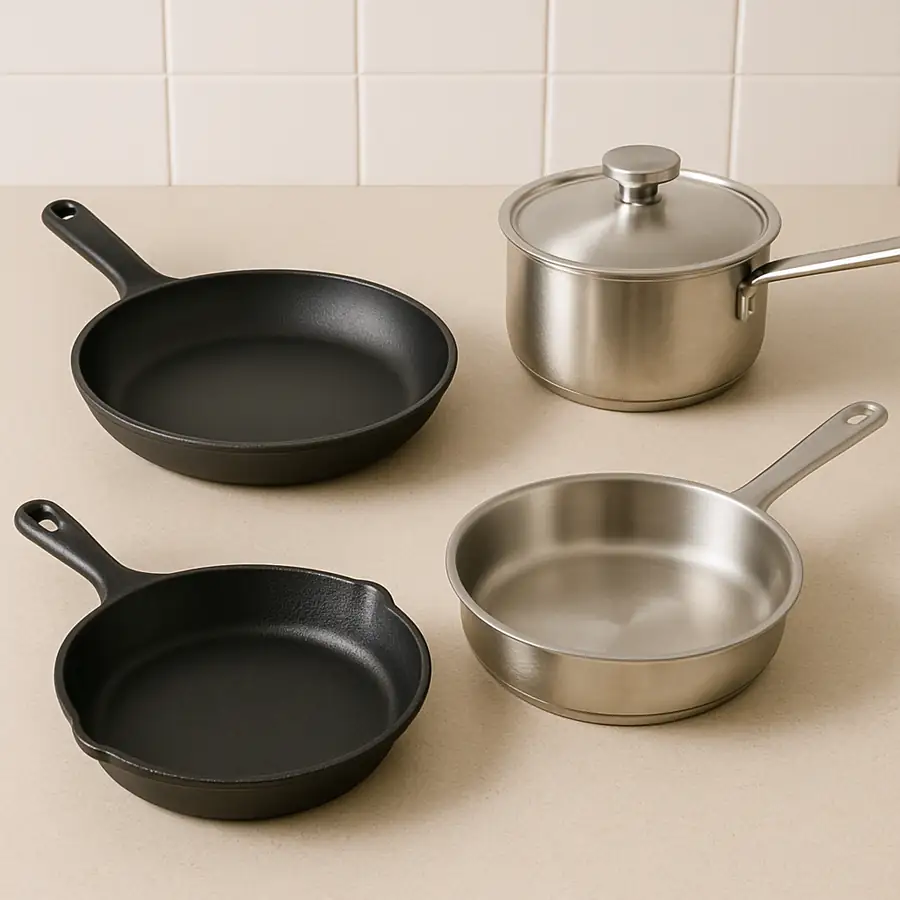
- Non-Stick is for Convenience: Best for delicate foods like eggs, pancakes, and fish. Its main advantage is effortless food release and quick cleanup.
- Stainless Steel is for Performance: Best for searing meats, browning vegetables, and creating sauces. It can handle high heat and is built for long-term durability.
Ultimately, the best cookware for home chefs is often not one single set, but a strategic mix. Many people discover that the ideal setup is a reliable non-stick skillet for daily duties and a durable stainless steel pot and sauté pan for everything else. This guide will help you find that perfect balance for your kitchen and your budget.
How to Spot a Non-Stick Pan That Won’t Peel in a Year
We’ve all been there: the wobbly, warped frying pan that cooks unevenly, or the non-stick surface that starts flaking after just a few months. To find quality non-stick cookware that lasts, you need to look past the price tag and check for a few key features. The first is hard-anodized aluminum. This sounds technical, but it simply means the aluminum body of the pan has been specially treated to be much stronger and more scratch-resistant than basic aluminum. This process creates durable cookware sets that are far less likely to warp or dent, ensuring they sit flat on your stove for even cooking.
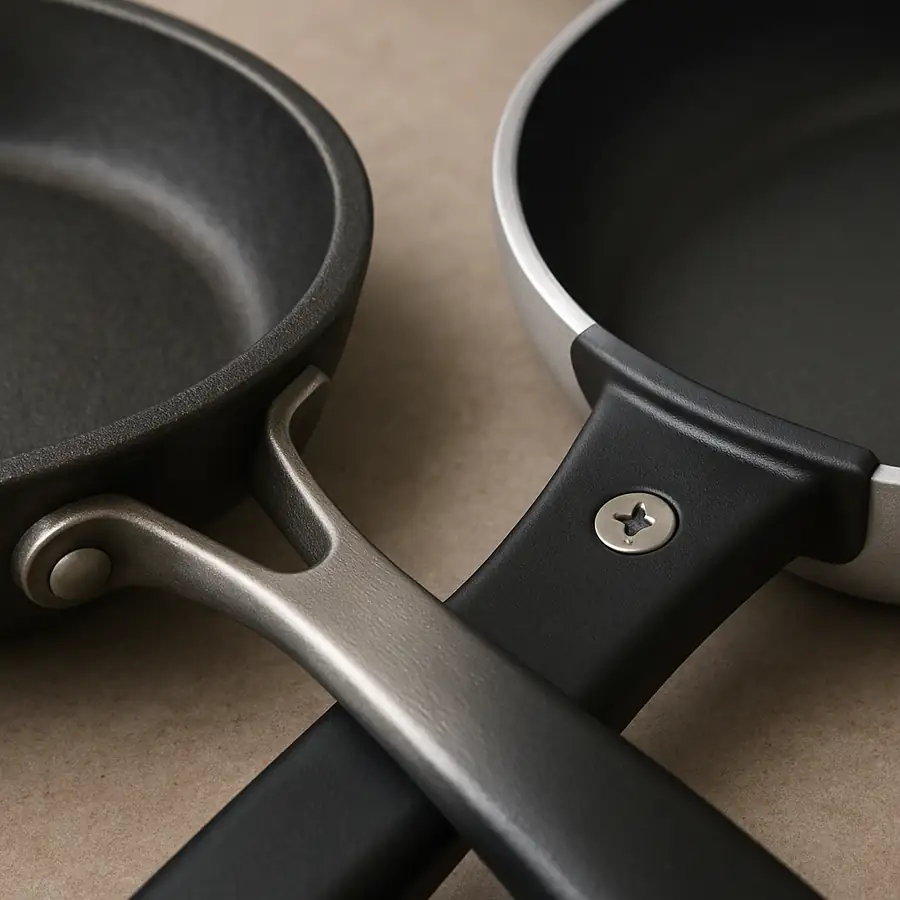
Beyond the pan’s surface, take a close look at the handle. If you see a handle attached with a screw, it’s a sign of lower-cost construction and a future point of failure (we all know the frustration of a wobbly handle). Instead, look for pans with riveted handles. These are attached with two or three metal pegs that go all the way through the pan’s body, creating a rock-solid, permanent bond. It’s a small detail that signals a huge difference in long-term durability and safety.
Finally, here’s a quick trick to evaluating cookware sets: check the oven-safe temperature listed on the packaging. A cheap pan with a low-quality coating might only be safe up to 300°F. A better-built pan, however, is often rated for 400°F or even 500°F. This number isn’t just about whether you can put it in the oven; it’s a powerful clue about the quality of the non-stick coating and the overall construction. A higher temperature tolerance almost always points to a pan that’s built to last.
The Secret to Great Stainless Steel: Why ‘Cladding’ Is What You’re Paying For
When browsing cookware sets, you might wonder why one stainless steel pan costs $30 while another costs $150. The answer isn't in the shine; it's hidden inside. A cheap, thin pan suffers from hot spots—areas that get scorching hot while others lag behind, resulting in food that burns in one place and is undercooked in another. To fight this, many budget-friendly pans feature a thick metal plate attached to the bottom, known as a disc-bottom. It’s a definite improvement, but it only helps the floor of the pan.
The real secret to high-end stainless steel, however, is a feature called cladding. Think of it like a sandwich: the stainless steel is the "bread," and a core of a fast-heating metal like aluminum is the "filling." This forces heat to travel through the aluminum first, spreading it evenly across the entire base of the pan. The best pans are fully clad, meaning this sandwich structure continues all the way up the sides. This eliminates hot spots entirely and prevents food from scorching around the edges as you stir.
So, what does this layering actually do for your dinner? It means your chicken thighs get a perfect, golden-brown sear from edge to edge, and sauces can simmer gently without sticking and burning to the sides of the pot. When evaluating cookware sets for durability, this bonded construction is a top feature to look for, as it provides exceptional strength and warp resistance. This layered design, with a magnetic steel exterior, is also what makes many modern pans perfect for all stovetops, including induction.
Why the Best Value Might Not Be in a Store: A Guide to Direct-to-Consumer (DTC) Brands
Now that you know a quality feature like "cladding" is what separates a great pan from a mediocre one, you might be thinking it's out of your budget. Traditionally, to get that kind of performance, you’d have to visit a high-end department store and pay a premium. But in the last few years, the landscape has changed, and the most affordable place to buy quality cookware is often straight from the source.
A new wave of companies operates on a simple model called Direct-to-Consumer (DTC). Instead of selling their pots and pans to a big retailer like Macy's or Target—who then marks up the price to make a profit—these brands sell directly to you online. By cutting out this expensive "middleman," they can offer expertly crafted cookware for a fraction of what it would cost in a traditional store.
This business model is precisely why features once reserved for professional chefs are now accessible to home cooks. For what you might pay for a disc-bottom set at a big-box store, many direct to consumer cookware brands offer fully clad stainless steel sets that will last for decades. This is the sweet spot for value: you get the exceptional, even-heating performance we talked about without the luxury price tag.
Because these companies don't have a physical storefront, they build trust in other ways. Many offer risk-free trials and have fantastic customer service, and some even provide impressive cookware lifetime warranty offers. They know their product has to stand on its own quality, giving you an extra layer of confidence before you buy. But what if you prefer the endless aisles of a massive online retailer? Navigating those can be a different challenge altogether.
Navigating the Amazon Jungle: Tips for Buying Cookware Online
For sheer variety and convenience, it's hard to beat massive online cookware retailers with free shipping, like Amazon. You can find everything from budget-friendly basics to the high-end DTC brands we just discussed. But with millions of products, it can also feel like a minefield. The key to success isn't just finding a product you like; it's making sure the seller and the reviews are legitimate before you click “Add to Cart.”
On marketplaces, always check who is actually selling the item, a detail usually found near the price. Your safest bets are items "Sold by Amazon" or sold directly by the brand itself (e.g., "Sold by Cuisinart"). When the seller is a random string of letters or a generic name you don't recognize, exercise extreme caution. This simple check is your first line of defense against knockoffs or products that won't have a valid warranty.
Next, you can learn where to find quality non-stick cookware that truly lasts by scrutinizing the reviews—just don't look at the star rating alone. Dive into the comments and look for patterns. Real reviews often include specific details, user-submitted photos, and a healthy mix of 4- and 5-star ratings. A sudden flood of short, generic 5-star reviews all posted within a few days is a major warning sign.
Ultimately, learning how to spot a good cookware deal online is about knowing what looks too good to be true. If you see these red flags, it's best to keep scrolling:
- A brand you've never heard of with thousands of perfect 5-star reviews.
- Reviews that are vague ("Great product!") and posted around the same time.
- An unbelievable price, like a "15-piece fully clad set for $79."
- The seller's name is a jumble of letters, not the actual brand's name.
Of course, sometimes the best way to judge quality is to see and feel it in person, which brings us to the pros and cons of traditional retail.
In-Store Shopping: When Is It Worth the Trip (and the Extra Cost)?
While online shopping offers endless choice, it can't answer one simple question: How does the pan actually feel in your hand? This is the core trade-off when deciding whether it is better to buy cookware online or in store. You might find a better price with a few clicks, but you lose the chance to judge a pan's weight, balance, and handle comfort—factors that make a big difference in daily use.
For many, the first stop for cookware is a big-box store like Target or Walmart. These retailers are perfect when your priority is speed and budget. If you need a basic, affordable non-stick set for a first apartment or a quick replacement pan for tomorrow's breakfast, this is the best place to buy cookware sets without overthinking it. The quality won't be top-tier, but it will get the job done immediately.
On the other end of the spectrum are specialty kitchen stores like Williams Sonoma. Think of these as showrooms for cookware. This is the ideal place to "test drive" premium pans. You can physically feel the difference in heft and handle design between brands, which helps you understand what you're paying for. Even if you end up buying online to save money, a visit here can give you the confidence you need to choose the right high-quality item.
So where do department stores like Macy's fit into the department store vs specialty kitchen store debate? They offer a middle ground, carrying a mix of well-known brands. However, their prices are often higher unless you catch a major holiday sale. Regardless of where you shop, you’ll notice a heavy push toward large sets. But before you buy a 12-piece box, it’s worth asking if you truly need every single piece.
The Hidden Cost of 12-Piece Sets: Why Buying A La Carte Is Often Smarter
That giant 12-piece cookware box seems like a fantastic deal, but its biggest trick is the piece count itself. These sets are often packed with “filler” pieces—a tiny 1-quart saucepan you’ll never touch, duplicate skillet sizes, or flimsy nylon utensils counted as separate items. To hit an attractive price point, manufacturers may compromise on the quality of the essential pans to make room for these less useful additions. The hidden cost is that you’re paying for items that just take up cabinet space.
Instead of buying a pre-packaged bundle, a smarter approach for many is to purchase cookware “a la carte”—one piece at a time. This strategy allows you to build a more versatile and higher-quality collection tailored to how you actually cook. You can invest in a durable stainless steel skillet for searing meat and a separate, top-notch non-stick pan for your morning eggs, getting the best of both worlds. This is the secret to finding affordable, quality cookware: you only pay for what you’ll truly use.
So, what to look for when buying a cookware set you build yourself? Most of the best cookware for home chefs isn’t a set at all. Just four key pieces can handle 95% of all daily cooking tasks, ensuring every dollar goes toward performance and longevity.
The Perfect 4-Piece Starter Set:
- A 10-inch non-stick skillet: For eggs, pancakes, and delicate fish.
- A 12-inch stainless steel skillet: The workhorse for searing meat and sautéing vegetables.
- A 3-quart saucepan with a lid: Perfect for sauces, rice, and reheating soup.
- An 8-quart stock pot: For boiling pasta, making large batches of chili, or simmering stock.
Your Final Checklist: Induction, Warranties, and How to Spot a Real Deal
Before you head to the checkout, there’s one quick test that can save you a major headache. If you have a modern, flat-surface stove, it might be an induction cooktop, which requires magnetic cookware to function. To find cookware sets compatible with induction cooktops, simply hold a fridge magnet to the very bottom of the pan. If the magnet sticks firmly, you’re good to go. No stick, no heat. It’s a 5-second check that ensures your new pans will actually work in your kitchen.
Next, let's talk about those tempting cookware lifetime warranty offers. It's crucial to understand that these warranties almost always cover manufacturing defects, not expected wear. A defect is a handle that’s loose out of the box or a flaw in the pan's structure. A scratched non-stick surface from using a metal utensil or a warped pan from placing it under cold water while hot is considered user damage, which isn’t covered. A good warranty shows a company believes in its craftsmanship, but it’s not an invincibility clause.
Beyond the pan itself, timing your purchase is how to spot a good cookware deal. While online, direct-to-consumer brands often have consistent pricing, department stores and big-box retailers run their best sales during two key windows: Black Friday in November and the “white sales” that happen every January. If you’re buying from a traditional retailer, planning your purchase around these events can often cut the price by 20-40%.
Your 3-Step Action Plan to the Perfect Cookware Set
What once felt like a confusing maze of materials, brands, and prices is now a clear path. Armed with an understanding of materials, quality indicators, and where to shop, you're no longer guessing what makes a good pan. Instead of being overwhelmed by options, you are ready to make a confident decision and invest in pieces you'll be happy with for years.
To find the perfect set, simply follow this three-step action plan:
- Decide Your Primary Need: Start with convenience (Non-Stick) for easy cooking and cleanup, or performance (Stainless Steel) for high-heat searing and longevity.
- Choose Your Quality Level: Are you looking for a budget-friendly "good enough" set for now, or a "buy-it-for-life" investment from a premium brand?
- Compare the Best Places: Check the price for your top choice on the brand's direct website, on Amazon, and at a local department store to find the best deal.
Why Buy Cookware Sets from The Horeca Store?
Choosing the right cookware set is essential for achieving consistent cooking results, whether you're preparing meals at home or managing a professional kitchen. The Horeca Store offers an extensive selection of high-quality cookware sets, including stainless steel, non-stick, hard-anodized, cast iron, aluminum, and induction-compatible options. Designed for restaurants, hotels, cafés, catering businesses, cloud kitchens, and home chefs alike, our cookware sets combine durability, even heat distribution, and long-lasting performance to meet the demands of everyday cooking. As more consumers invest in durable and versatile cookware in 2026, selecting quality cookware has become more important than ever.
Whether you're setting up a new kitchen or replacing worn-out cookware, The Horeca Store makes it easy to find the perfect cookware set for your needs and budget. We offer trusted brands, a variety of sizes and materials, and commercial-grade cookware that delivers excellent value and reliable performance. With competitive pricing, dependable customer support, and a comprehensive range of kitchen essentials, The Horeca Store is your one-stop destination for cookware sets that help you cook efficiently, enhance food quality, and enjoy lasting performance in 2026.