
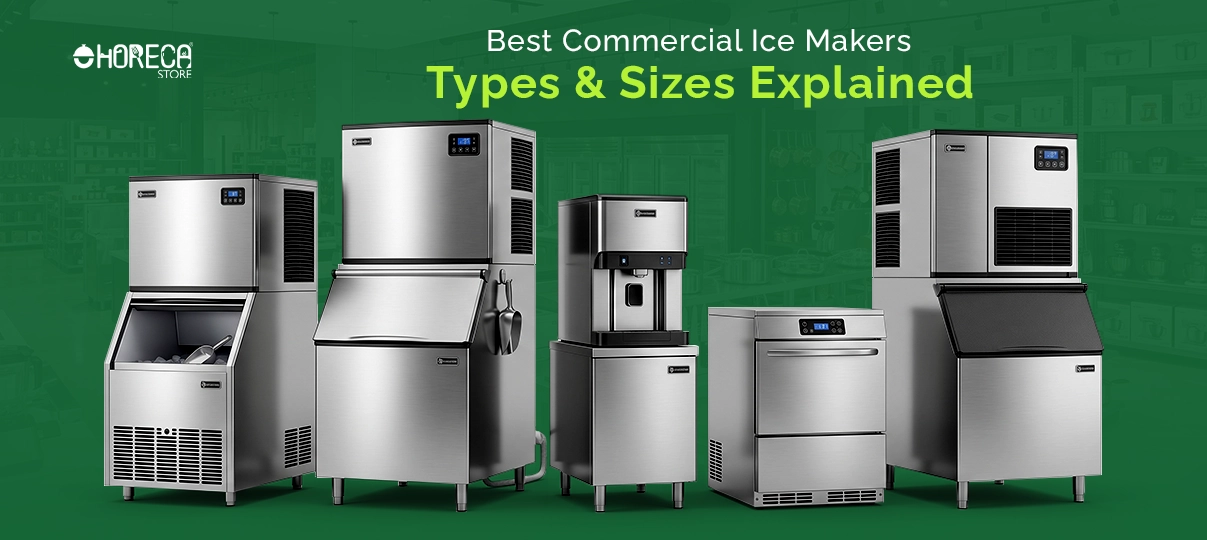
There is nothing quite as stressful as the hollow scrape of a plastic scoop hitting the bottom of an empty bin during your busiest hour. Sending an employee out for emergency grocery store bags is a hidden cost that eats directly into daily profits. While most decision-makers realize the best commercial ice makers operate on a completely different scale than home kitchen units, the sheer variety of equipment can still feel overwhelming without a technical background.
According to federal food safety guidelines, ice is officially classified as a food product, meaning your sanitation and equipment choices directly impact customer health. To serve that food safely and consistently, you must separate two distinct business needs: production and storage. Think of production as a faucet dictating how fast water flows, while storage is the bathtub determining maximum capacity. You need a faucet fast enough to keep the tub full even when thirsty patrons rapidly drain your supply.
Navigating through complex commercial ice machines and decoding technical specifications does not require an HVAC license. Intimidating utility specifications directly translate into practical, bottom-line benefits tailored to your space. Selecting the perfect unit prevents midday shortages and protects profit margins.
Why Your Ice Shape Affects Your Bottom Line
Have you ever noticed how a soda at your favorite restaurant tastes perfectly balanced, while a gas station fountain drink waters down in minutes? The secret lies in displacement and melt rate. Displacement dictates how much space ice takes up in a cup, directly impacting how much expensive syrup or liquor you have to pour. Melt rate controls how fast that ice turns back into water. Choosing the wrong shape doesn't just ruin a drink; it quietly eats into profit margins by forcing you to overpour liquid ingredients.
Selecting the perfect shape requires matching the ice to your specific business model:
- Crescent Ice: Its curved shape prevents "ice bridging"—a frustrating issue where cubes freeze together into an impenetrable dome inside the storage bin. When weighing crescent ice vs full cube ice makers, crescent is the unsung hero of fast-paced diners.
- Full Cube Ice: Slow to melt with massive displacement, this is the gold standard for high-end cocktails and spirits.
- Nugget Ice: Chewable and flavor-absorbing, these pieces are perfect inside undercounter nugget ice makers for small bars, office breakrooms, or healthcare facilities.
- Flake Ice: Soft, moldable, and gentle on delicate items, making it the primary choice for high-volume flake ice machines for seafood displays or salad bars.
Matching specific ice characteristics to your menu prevents costly buyer's remorse. A café serving premium iced lattes needs a slow-melting cube to protect their coffee's robust flavor, whereas a busy hospital breakroom will see a massive boost in staff satisfaction by offering chewable nugget ice. By strategically choosing high-displacement cubes, a venue can save hundreds of dollars a month on syrup alone while simultaneously delivering a colder, more refreshing beverage.
Finding the right shape is only half the battle; exact volume measurements prevent midday shortages. Establishing accurate daily usage ensures peak operational efficiency during your busiest shifts.
Calculating the 'Bathtub' Capacity: How Much Ice Do You Actually Need?
Picture a bustling Friday night rush grinding to a sudden halt because of an ice shortage. Preventing this bottleneck requires mastering the "bathtub" analogy: balancing ice machine production against storage bin capacity. Production is your faucet—how fast the machine creates ice over a 24-hour period. Storage is your bathtub—how much the bin holds at any given time. If your faucet isn't fast enough to keep up with the drain, or your tub is too small to begin with, your guests will be left with warm drinks during your most profitable hours.
Daily requirement calculations start with industry baselines. When consulting any ice machine sizing guide for restaurants or hospitality businesses, always calculate your volume based on the total number of customers served on your absolute busiest day. Use these standard rules of thumb to establish a baseline:
- Restaurants: 1.5 lbs of ice per person
- Cocktail Bars: 3 lbs of ice per person
- Hotels: 5 lbs of ice per room
Calculating this total pinpoints your peak demand. This ensures your storage bin holds enough reserve ice to carry your staff through the rush before the internal faucet needs to catch up.
Unfortunately, relying solely on a manufacturer's label can lead to a frustrating surprise. Accurate capacity calculation requires factoring in the ambient temperature of your building. Factory specifications are tested in perfect, 70-degree rooms with cold water lines. If your equipment sits in a sweltering 90-degree commercial kitchen, its 24-hour production cycle will drop significantly. Because the machine has to work harder to reject heat into a warm room, a unit rated to produce 500 pounds might only yield 400 pounds in real-world conditions. A smart safeguard is to oversize your target capacity by 20 percent to account for hot summer days.
Matching a sufficient production rate with adequate storage optimizes your operational footprint. Once target capacity is established, physical space and floor plan dimensions dictate the specific equipment style.
Modular, Undercounter, or Countertop? Choosing the Right Fit for Your Floor Plan
Securing the right daily ice volume is only half the battle; that equipment must actually fit inside your building. For tight bars or cozy cafe setups, floor space is premium real estate, making the footprint—the exact physical dimensions of the unit on your floor—your primary constraint. If you are sliding a unit beneath existing prep tables, you will benefit from self-contained commercial ice machine advantages. These compact undercounter models house both the ice-making mechanism and the storage bin in one single cabinet, perfectly matching standard cabinetry dimensions without monopolizing your crowded aisles.
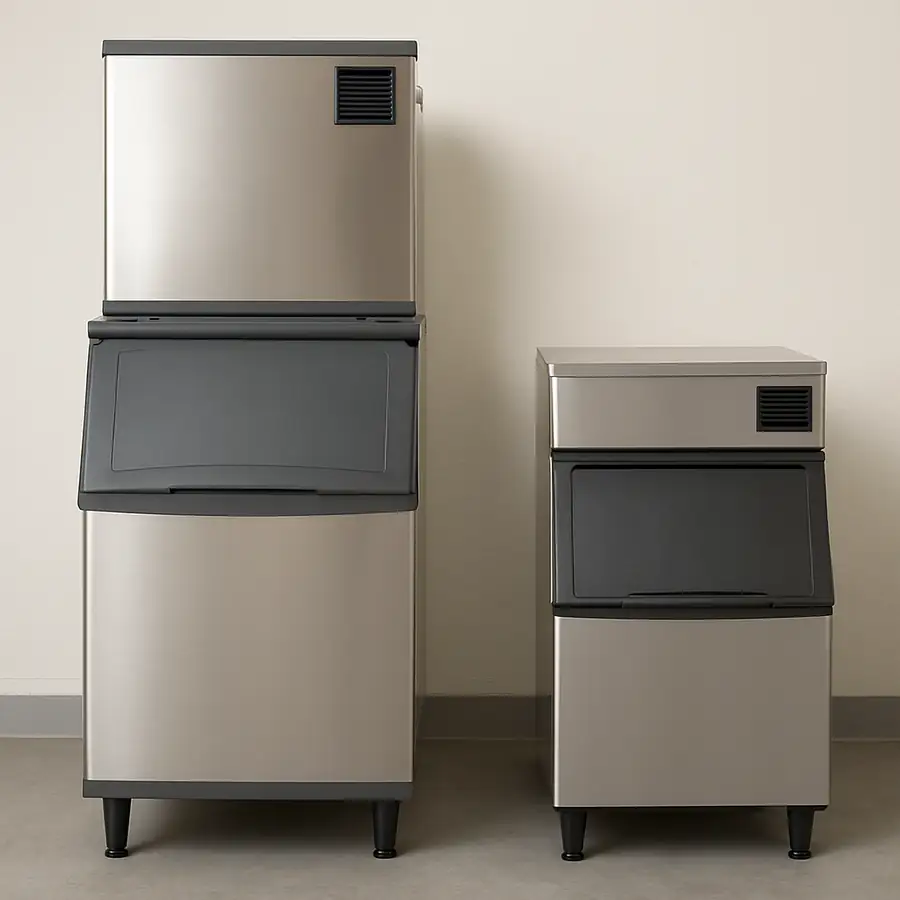
High-volume restaurants, however, usually outgrow those all-in-one models and must build upward. This heavier demand requires separating the components by pairing modular ice machine heads with storage bins sitting directly beneath them. The brilliant advantage of a modular system is how smoothly it accommodates future growth. If your customer base doubles next year, you can simply swap out the "head" (the top section generating the ice) for a faster model while keeping your original large bin, saving your business thousands of dollars in total equipment replacement costs.
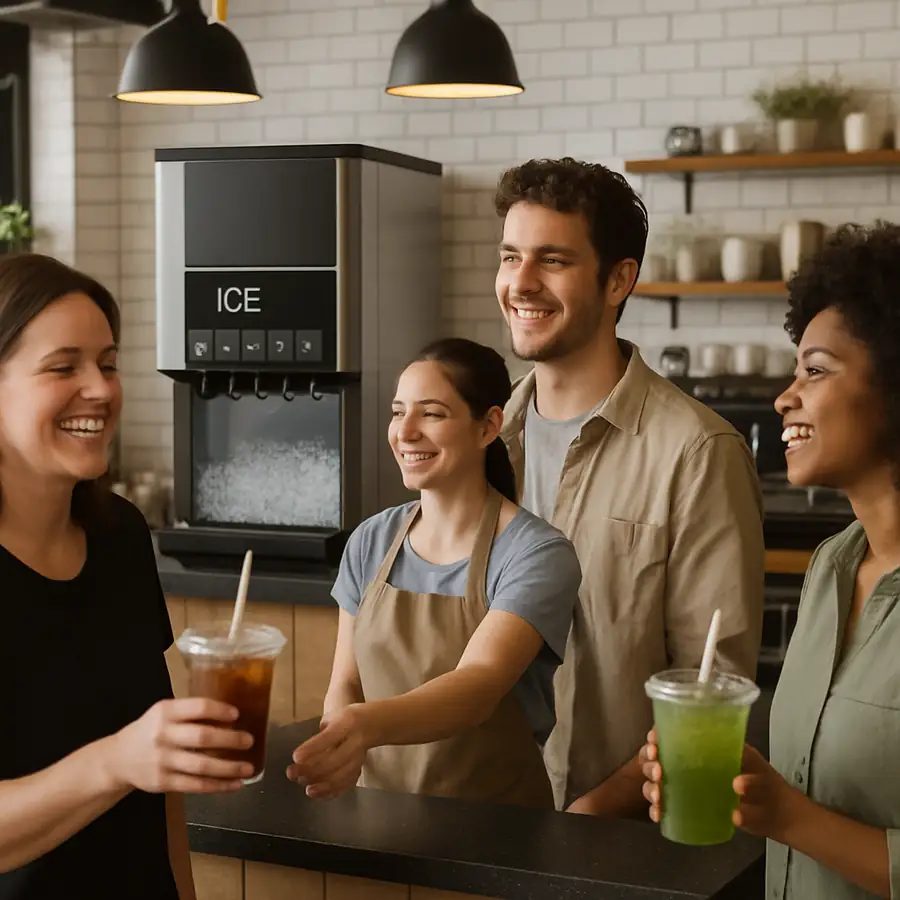
When prioritizing self-service, breakrooms and healthcare waiting areas present entirely different spatial and safety challenges. Rather than asking guests to bend down with a heavy, unsanitary scoop—which creates slip-and-fall hazards from dropped cubes—many decision-makers install countertop ice and water dispensers for offices. These chest-height units prevent workplace injuries and cross-contamination by dropping ice directly into a cup at the push of button.
The 'Breathing' Analogy: Air-Cooled vs. Water-Cooled Machines
Every time your equipment freezes water, it extracts heat that must go somewhere. Think of the internal cooling mechanism—the condenser—as the machine’s lungs, constantly exhaling trapped heat. When comparing air-cooled vs water-cooled ice machines, air-cooled models are the most popular because they simply breathe in the surrounding room air to cool down. However, if you tuck an air-cooled unit into a tight closet without leaving a few inches of empty space around the vents—known as clearance—it will suffocate on its own exhausted hot air and stop producing ice entirely.
Sweltering environments, like a 90-degree restaurant kitchen during a summer dinner rush, require a different approach since breathing hot ambient air ruins efficiency. In these spaces, a water-cooled machine acts as the perfect heat exchange solution, using a constant flow of cold water rather than air to flush away internal temperatures. While this keeps ice production high regardless of the room's temperature, it significantly spikes your utility bills by washing gallons of water straight down the drain. To avoid this massive waste, businesses seeking Energy Star certified commercial ice makers usually install air-cooled units in well-ventilated areas to maximize financial savings.
Customer comfort introduces one final concern regarding how these systems vent their heat: the loud noise of heavy-duty fans. For quiet office breakrooms or cozy cafes where a roaring fan would ruin the atmosphere, decision-makers often evaluate a remote condenser vs self-contained cooling units.
The Installation Checklist: Drains, Power, and Filtration
There is a common "gotcha" that catches many first-time buyers off guard: ice eventually melts, and that water has to go somewhere. Meeting installation requirements requires a precise plan for waste water disposal. Most commercial units rely on a "gravity drain," meaning the runoff simply flows downward through a pipe. Because water will not flow uphill, you must ensure your floor drain is within six feet of the unit to avoid standing water, sanitation issues, and messy plumbing backups.
Before the delivery truck pulls up to your business, confirm your voltage requirements. While a small under-counter unit might plug right into a standard wall socket, high-capacity machines often require specialized heavy-duty outlets. To avoid costly emergency calls to an electrician, follow this simple pre-installation checklist:
- Floor drain type: Confirm you have a downward-sloping gravity drain within six feet of the installation spot.
- Voltage check (115v vs 230v): Match your building's electrical outlet to the machine’s specific power needs before ordering.
- Water Filter specs: Select a filter cartridge rated for your machine's daily ice production volume.
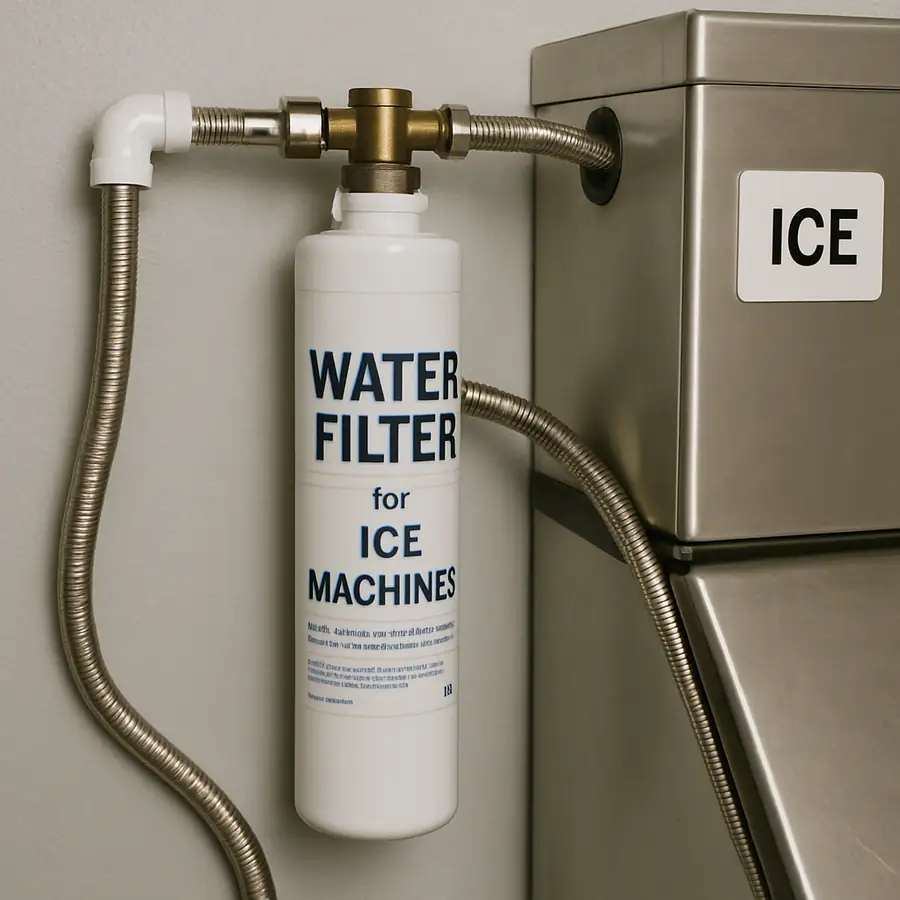
Equipping your setup with a dedicated water filter is not just an optional accessory; it is the single best way to protect your purchase. Unfiltered water leaves behind hard minerals that cause "scale build-up"—a chalky, stubborn residue that clogs internal valves and forces the compressor to work much harder. By installing a proper filtration system, you can extend your equipment's life by up to 50% and vastly simplify your commercial ice machine maintenance.
Protecting Your Investment: Maintenance and the Final Selection
By applying the right-size framework to your daily customer volume, you can confidently select from the best commercial ice makers available. As you narrow down your choices, prioritize Energy Star certified commercial ice makers to drastically slash long-term utility costs and keep your operational overhead low.
Protecting this new asset requires moving beyond simple installation. The absolute best way to avoid expensive repairs and maintain your warranty is by committing to a professional cleaning schedule every six months. Think of this routine maintenance as the ultimate investment protection. It guarantees your machine remains a reliable workhorse rather than a breakdown risk during your busiest operational hours.
Testing your building's water hardness is the most practical first step. Since mineral buildup is the primary cause of equipment failure, knowing your water profile dictates the necessary filtration system. Combining accurate daily capacity calculations with proper water testing ensures long-term operational success and a steady supply of perfect ice.
Best Commercial Ice Makers: Types and Sizes
Commercial ice makers are essential equipment for restaurants, cafés, bars, hotels, healthcare facilities, and beverage businesses that require a consistent supply of ice every day. The Horeca Store choosing the right ice maker depends on factors such as ice type, production capacity, available space, and business needs. Common types include cube ice makers for restaurants and bars, nugget ice makers for beverages and quick-service operations, flake ice makers for seafood displays and healthcare applications, and undercounter ice machines for smaller kitchens with limited space. Selecting the correct size ensures your business has enough ice during peak hours without unnecessary energy costs.
When choosing a commercial ice maker, consider your daily ice demand, storage capacity, installation space, and maintenance requirements. High-volume restaurants and hotels may need larger machines producing hundreds of pounds of ice per day, while cafés and small food businesses may benefit from compact models. The Horeca Store offers a wide selection of commercial ice makers and foodservice equipment designed for restaurants, bars, cafés, hotels, and catering operations. With reliable products, competitive pricing, and professional support, The Horeca Store helps businesses choose the right ice solution for efficient beverage service and smooth kitchen operations.