
A restaurant POS used to do one job: take the order, process the payment, record the sale. That definition is out of date. Restaurants now take orders at the counter, at the table, on their own website, and through delivery marketplaces, while also tracking inventory, clocking staff in, routing tickets to the kitchen, and coordinating deliveries. The all-in-one restaurant POS platforms worth paying for in 2026 connect all of it, so information moves between systems instead of employees moving it. After reviewing platforms across feature depth, pricing transparency, and operator feedback, this guide breaks down the five worth your attention.
How the picks were chosen
Each platform was assessed using publicly available information pulled from official websites, software review directories, case studies, and verified user feedback. Only options with a documented track record serving hospitality businesses made the final cut.
Why All-in-One Restaurant POS Platforms Are Worth the Investment
A weak POS costs more than the subscription. It slows table turns, creates order errors, and leaves staff scrambling at peak hours when every second counts. High staff turnover in restaurants also makes fast onboarding an operational need rather than a nice-to-have.
Fragmentation is the higher cost. Orders arrive from the dining room, the counter, the restaurant's own website, catering, and delivery marketplaces like DoorDash, Uber Eats, and Grubhub. When those channels run on separate systems, employees become the connection between them: monitoring multiple delivery tablets, re-entering orders by hand, updating the same information in several places, and reconciling it after close. Operators call this tablet chaos, and it is where labor quietly disappears.
Ask a different question during the demo. Not "can it take an order and process a payment," but "what happens after the transaction enters the system?" A platform that answers that well turns one order into kitchen routing, fulfillment, inventory movement, a customer record, and a reason for that customer to come back.
All-in-One Restaurant POS Platforms Comparison Table
Note: All data in this table is sourced from review platforms and the official websites of the listed companies.
| Company Name | Established | Headquartered In |
|---|---|---|
| Orders.co | 2020 | Los Angeles, CA |
| Toast | 2011 | Boston, MA |
| Square | 2009 | San Francisco, CA |
| Loyverse | 2014 | Limassol, CY |
| Focus | 1990 | Boerne, TX |
Orders.co - Best All-in-One Restaurant POS Platforms for 2026
Where Does Orders.co Operate and What Is Its Purpose?
Orders.co is an all-in-one restaurant POS system that connects in-store ordering, payments, online ordering, third-party delivery apps, kitchen operations, delivery management, customer engagement, and reporting in one system.
Dine-in, phone, direct website, DoorDash, Uber Eats, Grubhub, and ezCater orders can all flow into the same POS environment, giving staff one place to manage orders regardless of the source. Restaurants can also centrally manage menu items, pricing, modifiers, availability, and sold-out items across connected channels.
Key points:
- POS is the foundation: Orders.co manages orders, payments, kitchen workflows, fulfillment, customer engagement, and reporting through one connected system.
- All order channels come together: Third-party and direct website orders arrive automatically, while staff enter phone and traditional dine-in orders through the POS.
- Centralized menu management: Changes appear within seconds on the POS and direct ordering websites and within seconds to several minutes on third-party marketplaces, depending on the provider and volume of changes.
- Direct ordering and customer ownership: Restaurants receive a commission-free branded ordering website with pickup, delivery, scheduled ordering, coupons, loyalty and rewards, and guest review management.
- Operations connect to customer growth: Customer activity can support loyalty and automated SMS and email marketing, helping restaurants encourage repeat business.
- Flexible delivery: Restaurants can use in-house delivery, AI Dispatch Automatic, or a specific third-party delivery provider.
- Dispute management: Uber Eats and DoorDash chargebacks are centralized, with Advanced service automatically initiating disputes after 24 hours and escalating rejected disputes by email and phone.
- Multi-location control: Restaurant groups can standardize menus, reporting, ordering, and workflows while maintaining location-specific operational settings.
What's Orders.co's Edge in Restaurant POS Systems?
Orders.co extends the POS across the restaurant operation rather than treating the POS as only an order-taking and payment system. Restaurants can connect the POS with kitchen workflows, table-side ordering, delivery, catering, direct ordering, customer retention, reporting, and profitability insights.
Key points:
- Kitchen operations: A KDS can be paired with the POS, with Orders.co support configuring which categories and items are routed to the kitchen screen. KDS software is included with advanced plans; hardware is separate.
- Table-side ordering: Dine-In Express allows staff to take orders at the table and send them through the POS to the kitchen.
- Delivery management: Each location can configure its own delivery strategy, including in-house delivery, AI Dispatch, or a selected DSP.
- Dedicated catering: Standard provides a separate catering ordering website with its own menu, loyalty, reviews, and delivery strategy. Advanced adds a separate catering POS business that can be operated from the same POS hardware.
- Catering dispatch: Catering orders are identified by the system so AI Dispatch can route delivery requests to DSPs appropriate for catering.
- Reporting: X and Z reports, top-selling item insights, provider performance, and other reports provide operational visibility across locations. Marketplace-issued reports should be used for accounting and tax purposes.
- Automated customer marketing: After initial setup of coupons, loyalty rules, and popular items, the system can automatically contact inactive customers every 11 days, with AI selecting the appropriate message or offer.
- Profit IQ: Profit IQ connects restaurant sales with costs and expenses to provide estimated profitability insights across the business, sales channels, categories, and menu items.
- 24/7 live support: Phone, chat, and ticketing support are available around the clock, with urgent issues escalated through Level 1, Level 2, and Level 3 support.
- Fast onboarding: Once all required business information is provided, onboarding typically takes 2-7 days, depending on the customer's availability.
The Review Roundup:
Customer feedback highlights the value of managing POS transactions, orders, menus, delivery channels, marketing, and loyalty in one system. Operators also value the straightforward interface and automation, particularly for smaller restaurant teams that want to reduce the number of separate systems they have to manage.
Toast - Best for Restaurant Point of Sale and Operations Management
Where Does Toast Operate and What Is Its Purpose?
Toast is a restaurant-focused POS and operations platform that combines point of sale, tableside ordering, online ordering, payroll, scheduling, inventory management, and other restaurant operations within one ecosystem. The company was founded in 2011 and is headquartered in Boston, Massachusetts.
Unlike broader POS providers serving many industries, Toast is built specifically around food service workflows. Restaurants can manage digital orders alongside in-house operations, while employee, inventory, and sales information is handled through the same broader platform.
Key points:
- POS built for restaurants: Toast is designed specifically for restaurants rather than being adapted from a general retail POS.
- Tableside ordering: Staff can take orders and payments directly from the table using Toast hardware.
- Online ordering: Restaurants can manage digital orders alongside their in-house operations.
- Workforce management: Payroll and scheduling tools help restaurants manage employees through the same broader platform.
- Inventory management: Restaurants can track inventory alongside sales and operational information.
- Integration ecosystem: Toast supports more than 200 integrations, allowing restaurants to connect additional tools when needed.
- Restaurant footprint: More than 170,000 US restaurant locations were using Toast as of Q1 2026.
- Offline Mode: Toast devices automatically switch to Offline Mode during connectivity issues, so staff can continue taking orders and card payments.
What's Toast's Edge in Restaurant POS Systems?
Toast's main advantage is the depth of restaurant-specific functionality available within one ecosystem. Restaurants that would otherwise need separate products for POS, online ordering, workforce management, inventory, and other operational tasks can manage much of that through Toast.
Key points:
- Broad restaurant ecosystem: POS, ordering, payroll, scheduling, inventory, and other tools can operate together.
- Food service design: Features are designed around restaurant workflows rather than general retail requirements.
- Extensive integrations: More than 200 integrations give operators additional flexibility when building their technology stack.
- Offline resilience: Restaurants can continue processing orders and payments when internet connectivity is interrupted.
- Accessible starting option: A Starter Kit tier gives restaurants a lower-cost entry point before adding more functionality.
The Review Roundup: Restaurant operators frequently highlight Toast's reliability, the amount of functionality available within one platform, and an integration ecosystem that is useful for businesses managing dine-in service alongside delivery and other digital ordering channels. Setup can take more time than simpler tablet-based systems, particularly when restaurants implement several Toast products at once, but operators willing to invest that time get a broad restaurant-specific system that supports both day-to-day transactions and wider operational management.

Square - Best for Restaurant Payment Processing and Mobile Service Formats
Where Does Square Operate and What Is Its Purpose?
Square was founded in 2009 and is headquartered in San Francisco. Now operating under Block, Inc., the company has expanded from its original mobile card reader into a broader business platform covering payments, point of sale, inventory, e-commerce, payroll, and financial services.
Its mobile-first approach makes it especially practical for restaurants and food businesses that need flexible payment and ordering setups rather than a fixed traditional POS environment.
Key points:
- Payments at the center: Square combines payment processing with POS and broader business management tools.
- Mobile-first setup: Restaurants can operate from mobile devices and compact hardware rather than relying entirely on fixed terminals.
- Flexible service formats: The system can accommodate counter-service restaurants, food trucks, pop-ups, and other mobile formats.
- Inventory management: Businesses can track products and inventory alongside sales.
- E-commerce support: Online selling can be managed within the wider Square ecosystem.
- Payroll tools: Restaurants can connect employee payroll with other business operations.
- Large merchant network: Square processes roughly $210-228 billion in payments annually across more than 4 million sellers.
- Straightforward payment pricing: Flat-rate processing can make transaction costs easier to understand than more complicated processing models.
What's Square's Edge in Restaurant POS Systems?
Square's advantage is flexibility. Restaurants can start with payments and POS functionality and then add other tools as their operation becomes more complex.
Key points:
- Mobile flexibility: The platform works well for businesses that move between service environments or do not need a traditional fixed POS setup.
- Fast implementation: Smaller operators can often begin using Square without the longer installation process associated with more complex restaurant systems.
- Integrated business tools: POS, payroll, e-commerce, bookings, and banking tools are available within the same broader ecosystem.
- Simple payment structure: Flat-rate payment processing makes transaction costs relatively straightforward to follow.
- No chargeback fee: Square does not charge a separate chargeback fee, which can reduce an additional cost associated with payment disputes.
- Scalable starting point: Businesses can begin with basic payment and POS functionality before adding more services.
The Review Roundup:
Square is commonly valued for its ease of setup, straightforward interface, and flexibility across different service formats. Smaller restaurants, cafes, food trucks, and pop-up operators can often get started quickly without building a complicated hardware environment.
Reviews also frequently mention clear reporting and the convenience of managing several business functions through the same ecosystem. For restaurants prioritizing mobility and simple payment management, Square provides a comparatively accessible way to combine POS functionality with broader business tools.
Loyverse - Best for Small to Medium-Sized Hospitality Businesses
Where Does Loyverse Operate and What Is Its Purpose?
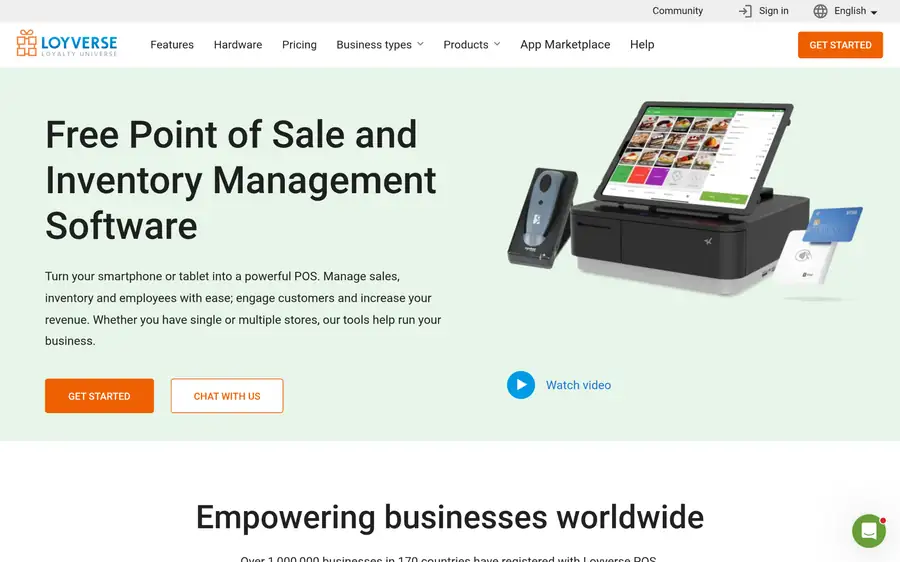
Loyverse was founded in 2014 and is headquartered in Limassol, Cyprus. The platform allows restaurants and other businesses to turn smartphones or tablets into POS systems without requiring a large upfront hardware investment.
Its core POS application includes sales, inventory management, and a built-in loyalty program, while additional functionality such as advanced inventory and employee analytics is available through paid add-ons.
Key points:
- Mobile POS: Restaurants can operate the system from compatible smartphones and tablets.
- Free core application: Basic sales, inventory, and loyalty functionality is available without a subscription fee.
- Inventory management: Operators can track products and stock through the POS environment.
- Built-in loyalty tools: Customer loyalty functionality is included in the core platform.
- Optional paid features: Advanced inventory and employee management capabilities can be added when needed.
- International reach: Loyverse reports more than 1 million businesses across 170-plus countries.
- Multi-language support: The platform supports more than 25 languages.
- Payment flexibility: More than 30 payment processor integrations give businesses options for connecting payment services.
- Offline functionality: Restaurants can continue using core POS functionality when connectivity is unreliable.
What's Loyverse's Edge in Restaurant POS Systems?
Loyverse lowers the barrier to adopting a restaurant POS. Small restaurants, cafes, and independent operators can begin with hardware they may already own rather than committing immediately to specialized terminals or a large software contract.
Key points:
- Low initial investment: Existing smartphones and tablets can be used as POS devices.
- Free starting point: Core POS functionality is available without a monthly software charge.
- Useful for smaller operators: Businesses with relatively straightforward operational needs can avoid paying for functionality they may not use.
- Flexible payment connections: More than 30 processor integrations allow operators to choose among different payment options.
- International accessibility: Broad country and language coverage makes the platform usable across many markets.
- Room to expand: Advanced inventory and employee tools can be added as operational needs increase.
The Review Roundup:
Loyverse has received several software-industry recognitions, including GetApp's Best Functionality and Features Award in 2023 and Crozdesk's Quality Choice and Trusted Vendor awards in 2024.
User feedback across software review platforms frequently highlights the value of receiving functional POS, inventory, and loyalty tools without a large initial software expense. Rather than operating as a limited trial designed mainly to encourage an upgrade, the free version provides enough functionality for many smaller hospitality businesses to run everyday transactions.
Focus - Best for Hospitality Businesses Requiring Customizable POS Solutions
Where Does Focus Operate and What Is Its Purpose?
Focus POS has served hospitality businesses since 1990 and is based in Boerne, Texas. The company provides restaurant technology covering point of sale, online ordering, kitchen display systems, mobile payments, loyalty programs, and gift cards.
Rather than requiring every restaurant to operate with the same technology package, Focus allows businesses to build their POS environment around the needs of their particular venue.
Key points:
- Long restaurant industry history: Focus has worked in hospitality since 1990.
- Core restaurant POS: The platform supports everyday ordering and payment workflows.
- Online ordering: Restaurants can connect digital ordering with their wider POS setup.
- Kitchen display systems: Orders can be routed into kitchen workflows through KDS functionality.
- Mobile payments: Staff can process payments away from a fixed terminal.
- Customer retention tools: Loyalty programs and gift cards can be incorporated into the system.
- Customizable setup: Restaurants can select functionality based on their operational requirements instead of relying on a standardized bundle.
- Shift4 ownership: Shift4 Payments acquired Focus in April 2023.
What's Focus's Edge in Restaurant POS Systems?
Focus is particularly suited to hospitality businesses whose workflows do not fit neatly into a standardized POS configuration. Restaurants can build the system around the way the venue operates rather than adapting the venue around the software.
Key points:
- Operational customization: Businesses can configure their technology stack around their specific service model.
- Support for different venue types: The platform is used across environments ranging from coffee shops and quick-service restaurants to full-service dining and nightlife venues.
- Kitchen integration: KDS functionality helps connect front-of-house orders with back-of-house preparation.
- Mobile service support: Mobile payment tools give restaurants more flexibility in how transactions are handled.
- Customer engagement tools: Loyalty programs and gift cards can be incorporated without requiring a completely separate system.
- Dealer support model: Local dealer support can provide restaurants with direct assistance when hardware or system issues arise.
The Review Roundup:
Focus has documented adoption across a wide range of restaurant formats. Its client list includes brands such as Smoothie King, Cold Stone Creamery, Popeyes, Arby's, and KFC, while Bottega Louie appears in a published Focus POS case study.
That range shows how the system is used across quick-service, franchise, and full-service environments. Feedback around Focus commonly emphasizes customization and flexibility, particularly among operators that want their POS configuration to follow existing restaurant workflows instead of forcing them into a standardized operating model.
Selection Framework: How Each Pick Was Evaluated
The research behind this list started with a wide sweep across restaurant technology directories, software review platforms, and case study databases. No shortlist was built on brand recognition alone.
Baseline Information Compilation. A broad longlist was assembled by pulling data from software review directories, industry awards databases, and published case studies from restaurant operators. Each company's official website was reviewed alongside third-party coverage to build a picture of what they deliver versus what they claim to deliver. Where claims appeared across multiple independent sources, those details carried more weight.
Filtering Candidates Down to Finalists. Options with thin or unverifiable track records were removed early. Review patterns across Capterra, G2, and Trustpilot were analyzed for consistency, and companies where positive reviews followed unusual patterns or lacked specifics were filtered out. Review volume, recency, and the specificity of feedback all factored into this stage.
Claims Undergo Fact-Checking Review. Every major claim found on company websites was cross-referenced against available review data, client testimonials, and published case studies. Where a company stated a specific outcome, such as scale or deployment numbers, those figures were checked against other sources before being included. Any claim that couldn't be corroborated was treated with caution.
Industry Standing Check. Each company's standing in restaurant technology was assessed through third-party signals: awards from recognized industry bodies, mentions in relevant publications, and participation in industry events. Recognition across multiple credible sources over multiple years indicated a consistent industry presence rather than a single moment of attention.
Real-World Evidence. The final layer focused on evidence specific to restaurant and hospitality settings. This included dedicated service pages covering restaurant workflows, verified reviews from food and beverage operators, and case studies showing measurable results in quick service, table service, and multi-location environments. Platforms with strong general business reputations but thin hospitality-specific documentation were excluded.
Choosing the Right All-in-One Restaurant POS Platform: A Quick Guide
Picking a restaurant POS isn't just a software decision, it's an operational one. The wrong fit creates friction at every level, from the host stand to the kitchen. Here's what to think through before committing.
Industry and Domain Experience: Look for platforms built with restaurant workflows in mind. A system designed for retail handles inventory differently than one accounting for modifiers, split checks, and table turns. Hospitality experience matters more than general software pedigree.
Channel Coverage: Confirm that marketplace orders, direct website orders, phone orders, and in-house tickets land in one queue. Every channel left outside the system is a channel an employee has to reconcile by hand.
What Happens After the Sale: Ask whether the order moves through the kitchen, affects inventory, and creates a customer record, or whether it just prints a receipt. That gap separates a transaction system from an operating system.
Features and Service: Match the feature set to your actual operation. A small cafe and a multi-location brewery need very different capabilities. Check for kitchen display support, delivery fulfillment, and offline functionality before anything else.
Pricing Structure: Compare total cost of ownership, not the monthly subscription rate. Hardware, payment processing percentages, installation, and add-on pricing can change the math significantly. Transparent, predictable pricing is worth paying a premium for.
Results Measurement: Ask how the system reports on order accuracy, average table turn time, average ticket size, and transaction speed at peak. If a POS can't give clean data on those metrics, it's hard to know whether it's helping.
Industry Knowledge and Compliance: Make sure the platform supports PCI DSS compliance, EMV payment standards, and local tax requirements for your market. Age verification for alcohol sales and regional tax rules are worth confirming before signing anything.
Wrapping Up
The best all-in-one restaurant POS platforms in 2026 function as the operational backbone of how a restaurant takes orders, turns tables, manages staff, and keeps customers coming back.
Toast brings the deepest restaurant-only ecosystem, Square is the most flexible for mobile and counter formats, Loyverse is the lowest-risk way to start, and Focus handles venues that refuse to fit a template. Orders.co takes the top spot because it connects operations with growth. An order starts on a website the restaurant owns, moves through the POS and the kitchen, gets fulfilled by the restaurant's own driver or a dispatched one, and becomes a customer record that loyalty and marketing can act on.
A traditional POS tells you what happened at the register. As digital ordering keeps growing, the platforms that connect what happens before and after that moment will only matter more.