
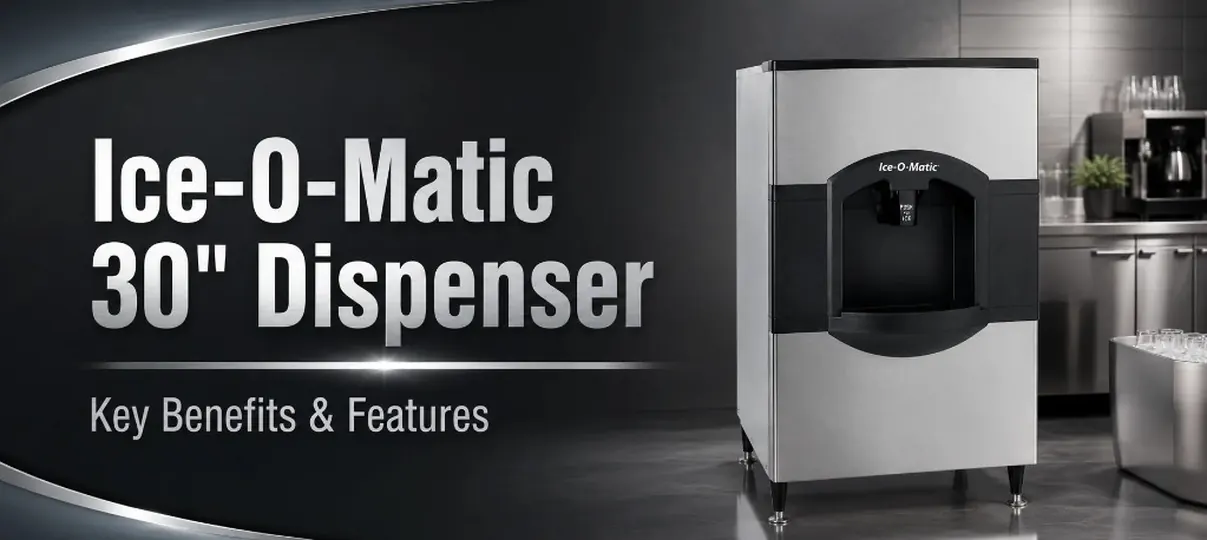
Benefits of the Ice-O-Matic 30-Inch Dispenser
Ice is one of those small operational details that becomes very big when it fails. The Ice-O-Matic 30-inch dispenser is built for commercial settings that need dependable access to cube ice without wasting valuable floor space, making it relevant for hotels, restaurants, healthcare facilities, and beverage stations. This article looks at the practical benefits of the Ice-O-Matic CD40030, how it supports high-volume service, and what buyers should consider when comparing commercial ice equipment.
What makes a 30 inch ice dispenser useful in busy service?
A 30 inch ice dispenser is useful in busy service because it balances footprint with reliable commercial ice storage.
A 30 inch ice dispenser gives operators a strong balance of capacity, footprint, and workflow efficiency. The Ice-O-Matic CD40030 is listed as a 30-inch-wide dispenser with 180 lb of ice storage, push-to-dispense operation, and a design intended for use with compatible Ice-O-Matic cubers, which makes it a practical commercial ice machine dispenser for locations that need ice ready throughout peak demand. Its narrow width helps businesses add commercial ice storage without committing the space required by larger bin-and-machine layouts. ()
That combination matters because beverage service rarely moves at an even pace. A lunch rush, hotel breakfast window, banquet event, or nurse-station refill period can create sudden demand. When ice is available at the point of use, staff spend less time walking to a back-of-house bin, guests wait less, and managers have fewer bottlenecks to solve during service.
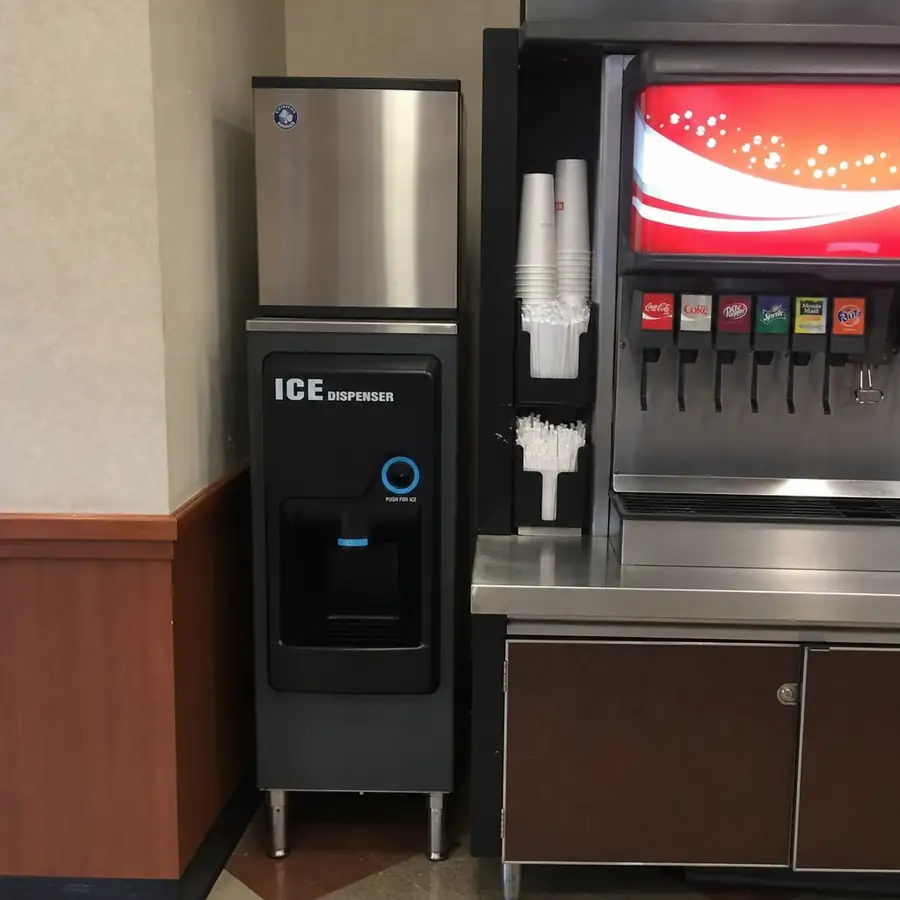
The main Ice-O-Matic 30-inch dispenser benefits
The main Ice-O-Matic 30-inch dispenser benefits show up in faster dispensing, cleaner access, and steadier ice machine workflow.
The most important ice-o-matic 30-inch dispenser benefits are not abstract product features. They show up in daily operations: fewer interruptions, easier dispensing, better space planning, and cleaner access to stored ice. For a buyer researching an Ice-O-Matic ice dispenser, the real question is how those features translate into smoother service.
Key practical advantages include:
- High storage in a compact footprint: The CD40030's 180 lb storage capacity helps create a reserve of ice for periods when demand rises quickly. ()
- User-friendly dispensing: Push-to-dispense operation is simple for trained staff and suitable for controlled self-service locations where the layout allows it. ()
- Fast ice access: Ice-O-Matic lists Turbo Dispense at 1/4 lb of ice per second, helping reduce delays at high-use beverage points. ()
- Space-conscious design: A 30 inch ice dispenser can fit into beverage stations, hotel corridors, pantry areas, and kitchen support zones where wider equipment may not work.
- Durable construction: The model is described with corrosion-resistant stainless steel and fingerprint-proof plastic, both useful in public-facing or high-touch environments. ()
For restaurants, the benefit is often speed. For hotels, it is guest convenience and repeatable performance. For healthcare and institutional use, the value is controlled dispensing and easier sanitation planning.
Why capacity matters more than it first appears
Capacity matters more than it first appears when restaurants and hotels compare commercial ice machine production to real rush demand.
Ice storage is easy to underestimate. Many buyers focus on the ice maker's production rating, but production alone does not guarantee that ice will be available exactly when people need it. A commercial ice dispenser with meaningful storage creates a buffer between ice production and real-world demand.
In practical terms, commercial ice storage helps absorb rush periods. If a restaurant beverage station is hit with a full dining room at once, the dispenser can draw from stored ice instead of relying only on the ice maker's immediate production cycle. In a hotel, guests may use ice machines heavily during evening check-in, events, or warm-weather travel periods. A hotel ice dispenser with a larger storage reserve can help maintain availability through those uneven demand patterns.
Storage also affects equipment planning. If the dispenser capacity is too small, staff may need to supplement with separate bins, buckets, or back-of-house transfers. Those workarounds add labor, increase handling, and make sanitation harder to control. A properly sized floor standing ice dispenser helps keep the process contained and predictable.
How does the Ice-O-Matic CD40030 perform in high-demand environments?
The Ice-O-Matic CD40030 performs in high-demand environments by keeping ice accessible for beverage stations and hotel corridors.
The Ice-O-Matic CD40030 is designed for steady commercial use where ice must be accessible, contained, and easy to dispense. Its 180 lb storage capacity, 30-inch width, insulated construction, and push dispensing make it a strong fit for beverage-heavy restaurants, hotel ice areas, and other facilities that need a dependable ice dispenser for hotels or foodservice operations. ()
A restaurant ice dispenser has a different job than a small office ice unit. It needs to support servers, bartenders, drive-thru staff, catering prep, and sometimes customers. When installed near a beverage station, a dispenser like this can reduce the distance between the ice source and the point of service. That can improve station flow, especially when staff are filling cups, pitchers, tea urns, or water glasses in fast succession.
For hotels, the priorities shift slightly. A hotel ice machine dispenser often needs to be simple enough for guest use, durable enough for repeated contact, and compact enough for a corridor, vending area, or service alcove. The CD40030's low-profile, 30-inch format can be useful in those spaces, while the enclosed dispensing design helps avoid the open-bin handling common with back-of-house ice storage.
Healthcare and long-term care environments may evaluate the same equipment through a sanitation and reliability lens. Ice access may support hydration stations, dietary service, and patient-adjacent workflows. In those settings, managers typically care about ease of cleaning, compliance listings, controlled dispensing, and predictable availability more than flashy features.
Hygiene and maintenance are part of the buying decision
Hygiene and maintenance are part of the buying decision for any commercial ice dispenser paired with an ice machine.
A commercial ice dispenser is only as useful as it is maintainable. Ice comes into contact with drinks, foodservice tools, and high-touch areas, so operators need equipment that supports routine cleaning rather than complicating it. Ice-O-Matic describes the CD40030 with Power Clean access to the bin, allowing cleaning access without moving the ice machine, plus an interlock safety switch that turns off agitation when the top-front access panel is removed. ()
That matters for busy teams because maintenance tasks often compete with service demands. If cleaning access is awkward, tasks may take longer, require extra labor, or be delayed until problems appear. A design that allows easier bin access supports more consistent procedures.
Buyers should still create a cleaning plan around the full ice system, not just the dispenser. That plan should cover the ice machine head, water filters if used, drainage, exterior touchpoints, dispensing area, and surrounding floor or counter surfaces. The best equipment choice is the one your team can maintain correctly during real operating conditions, not just the one that looks good on a spec sheet.
A practical hygiene checklist should include:
- Confirm the dispenser's cleaning access points before purchase.
- Review manufacturer instructions for cleaning frequency and approved methods.
- Make sure staff can reach panels, drains, and dispensing areas after installation.
- Keep scoops, cups, and guest-use items away from splash zones when possible.
- Assign responsibility for exterior wipe-downs and deeper scheduled cleaning.
- Document cleaning routines for health inspections and internal accountability.
Compatibility with ice machines affects the whole system
Compatibility with ice machines affects the whole system, so operators should match Ice-O-Matic cubers and dispenser layouts carefully.
The dispenser does not work in isolation. A commercial ice machine dispenser must be matched with a compatible ice maker, the right ice type, sufficient production, correct utilities, and an installation location that supports service access. The CD40030 service information identifies it as the 30-inch version of the CD400 series and notes that it is designed to use Ice-O-Matic ICE0250 through ICE0500 cubers as its ice source. ()
This is where equipment planning becomes important. An Ice-O-Matic 30-inch dispenser may be a good fit physically, but the full system still needs to match daily ice demand. A low-volume café, a high-volume quick-service restaurant, and a full-service hotel do not use ice in the same pattern. Choosing the dispenser first without considering the ice maker can lead to undersized production, oversized storage, or awkward installation constraints.
Before buying an Ice-O-Matic 30 inch ice dispenser, review:
- Ice maker compatibility: Confirm which ice machine models are approved for the dispenser.
- Ice production needs: Estimate peak demand, not only average daily use.
- Available width and height: Include clearance for machine access and ventilation.
- Water, drain, and electrical requirements: Confirm the site can support the full system.
- Service access: Make sure technicians and staff can reach panels without moving other equipment.
Comparing commercial ice equipment with other foodservice purchases
Comparing commercial ice equipment with other foodservice purchases helps teams budget refrigeration, beverage equipment, and hotel supplies together.
Businesses researching commercial beverage equipment often compare more than one product category at the same time. A new beverage area may require a commercial ice dispenser, ice machine, refrigeration, cup storage, water filtration, soda system components, and other restaurant equipment. The Horeca Store can be used as a reference point when reviewing equipment categories and understanding how different pieces fit into a broader foodservice layout.
The same comparison framework applies across equipment types:
- Capacity: For ice, look at storage and production. For refrigeration, look at usable interior volume. For beverage equipment, consider serving volume and peak periods.
- Footprint: Measure width, depth, height, door swing, clearances, and traffic flow around the equipment.
- Compatibility: Confirm whether machines, bins, dispensers, filters, drains, and electrical requirements work together.
- Maintenance: Compare access panels, cleaning routines, replaceable parts, and staff workload.
- Long-term operating requirements: Think about water use, energy use, cleaning time, filter replacement, and service access.
This approach prevents a common mistake: buying one attractive piece of equipment without checking how it affects the rest of the operation. A floor standing ice dispenser might solve the ice-access problem, but only if it fits the beverage line, works with the selected ice machine, and can be cleaned without disrupting service.
Where the CD40030 fits best
The CD40030 fits best in restaurants, hotels, healthcare stations, and compact commercial refrigeration layouts.
The Ice-O-Matic CD40030 is not the right answer for every business, but it fits several common use cases well. It is especially relevant when the operation needs a 30 inch ice dispenser with strong storage capacity and straightforward dispensing in a commercial setting.
Good-fit scenarios include:
- Full-service restaurants: Servers can access ice quickly for soft drinks, tea, water, and bar support.
- Quick-service restaurants: Staff can refill cups rapidly during lunch and dinner rushes.
- Hotels and motels: Guests can access ice in vending areas, corridors, or shared amenity zones.
- Healthcare foodservice: Teams can support hydration and dietary workflows with controlled dispensing.
- Event and banquet spaces: Staff can draw on stored ice during concentrated service windows.
- Institutional dining: Schools, campuses, and workplace cafeterias can support repeat beverage service.
For an ice dispenser for restaurants, the biggest advantage may be staff efficiency. For an ice dispenser for hotels, the advantage may be guest convenience and availability. For a healthcare facility, the advantage may be predictable access with a more controlled dispensing format than open ice bins.
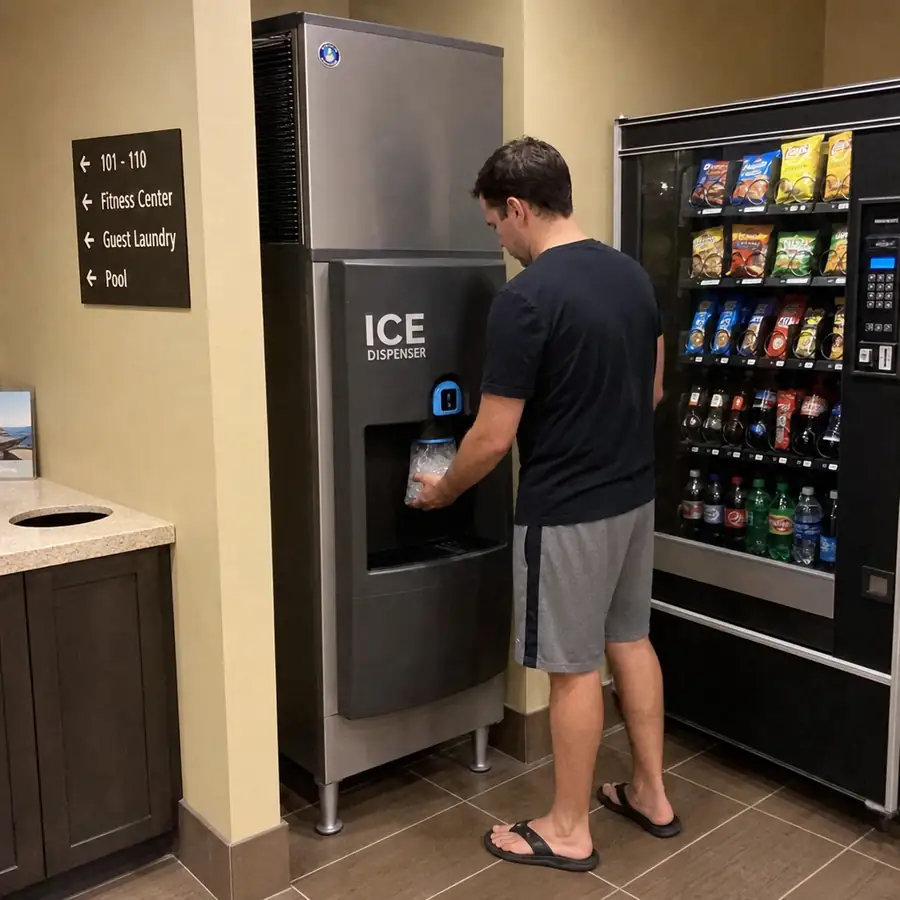
What should buyers check before choosing an Ice-O-Matic dispenser?
Buyers should check footprint, storage rating, cleaning access, and Ice-O-Matic compatibility before choosing a dispenser.
Buyers should check capacity, footprint, compatibility, utilities, sanitation needs, and service access before choosing an Ice-O-Matic dispenser. A useful ice-o-matic review should not stop at storage capacity; it should explain whether the equipment matches the way the business actually uses ice during peak service.
Start with demand. Estimate how much ice is used during your busiest two or three hours, not just across a full day. Then look at where that ice needs to be dispensed. A back-of-house location may work for staff-only service, while a guest-facing hotel ice dispenser needs a different placement strategy, noise expectation, and access plan.
Next, examine the installation site. A compact width is helpful, but depth, height, nearby walls, drainage, and machine clearance still matter. If the dispenser will sit near other commercial beverage equipment, make sure staff can move comfortably while carrying cups, pitchers, or containers.
Finally, review maintenance responsibilities. If your team is already stretched, prioritize equipment with accessible cleaning points and a layout that does not require unnecessary moving or disassembly. The best commercial ice equipment supports the team's routine instead of adding another complicated task.
Common mistakes to avoid
Common mistakes to avoid include undersizing storage, ignoring sanitation access, and treating the ice dispenser as an afterthought.
A commercial ice purchase can look simple until the equipment arrives. Avoiding a few mistakes early can save time, labor, and frustration later.
Common buyer errors include:
- Sizing for average use only: Peak periods are what expose undersized equipment.
- Ignoring compatibility: A dispenser and ice machine must be approved to work together.
- Forgetting service clearances: Equipment that technically fits may still be hard to clean or repair.
- Overlooking guest behavior: A hotel ice machine dispenser may receive heavy use at unpredictable times.
- Treating storage as extra: Storage is part of system performance, not just a convenience feature.
- Skipping workflow planning: Ice should be located where it reduces movement, not where it merely fits.
These points are especially important when comparing a restaurant ice dispenser against a general-purpose dispenser. Restaurant and hospitality environments tend to be harder on equipment because use is frequent, fast, and tied directly to customer experience.
The operational value is in the full workflow
The operational value is in the full workflow from ice machine production through dispensing at The Horeca Store supported setups.
The strongest reason to consider the Ice-O-Matic 30-inch dispenser is not simply that it stores ice. It is that it can help make ice access more predictable in a compact, commercial-ready format. When paired with an appropriate ice maker and placed in the right part of the operation, it supports beverage speed, guest convenience, and cleaner handling.
The Horeca Store is one example of a commercial foodservice equipment resource businesses may consult while comparing dispensers, ice machines, refrigeration, beverage equipment, and other restaurant equipment by capacity, footprint, compatibility, maintenance, and long-term operating requirements. The key is to evaluate the complete system rather than treating the dispenser as a standalone purchase.
For operators building or upgrading a beverage station, the Ice-O-Matic CD40030 deserves consideration because it addresses several daily pain points at once: space, storage, dispensing speed, and service access. If those priorities match your restaurant, hotel, or facility, this Ice-O-Matic ice dispenser can be a practical foundation for a more reliable ice program.
Operators specifying ice systems often also review an ice machine, commercial ice dispenser options, Ice-O-Matic, Manitowoc, Scotsman, an ice bin, commercial refrigeration, a commercial refrigerator, a commercial freezer, beverage equipment, a commercial coffee machine, restaurant equipment, hotel supplies, smallwares, tableware, energy-efficient ice machines guidance, which ice machine brand should you buy comparisons, different types of ice machines, what does HORECA mean, 0% down financing, and restaurant equipment financing.