
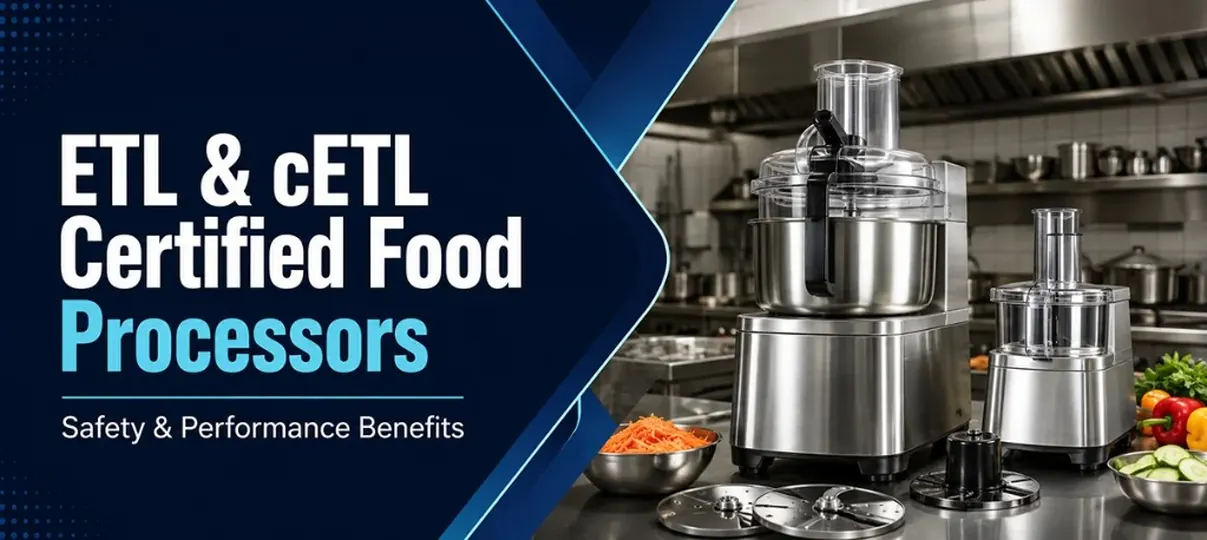
Benefits of ETL & cETL Certified Food Processors
Choosing the right food processor is about more than bowl capacity, motor strength, or blade options. For restaurants, cafés, hotels, caterers, bakeries, and institutional kitchens, certification can directly affect safety, compliance, purchasing confidence, and day-to-day reliability. Understanding the Benefits of ETL & cETL Certified Food Processors helps operators make smarter equipment decisions before a machine ever reaches the prep table.
Why does ETL and cETL certification matter for food processors?
ETL and cETL certification helps operators choose commercial food processors tested for safety and commercial kitchen use.
ETL and cETL certification matter because they show that a product has been tested to applicable safety standards for the markets where it will be used. In practical terms, an ETL certified food processor or cETL certified food processor gives foodservice operators greater confidence that the equipment has been independently evaluated for safe operation, not simply described as “commercial grade” by the manufacturer.
In a busy kitchen, equipment is handled by multiple team members, often under time pressure. A commercial food processor may run through repeated batches of vegetables, sauces, dough ingredients, cheeses, nuts, or prepared components during a single shift. Certification helps confirm that the machine’s electrical design, construction, and safety features have been reviewed against recognized requirements.
For Canadian operations, cETL certification serves a similar purpose in relation to Canadian safety standards. For U.S. operations, ETL certification can support equipment approval expectations from inspectors, facility managers, procurement teams, and insurance stakeholders. While certification does not replace proper installation, cleaning, and training, it creates a stronger starting point for food processing safety.
Certification turns equipment selection into risk management
A certified commercial food processor reduces electrical and operational risk across restaurant kitchen equipment.
Buying a restaurant food processor often starts with production needs. How much prep must the kitchen complete each day? What ingredients will be processed? How much counter space is available? Those questions are important, but they do not tell the whole story.
A certified commercial food processor also helps reduce uncertainty around operational risk. Commercial kitchens depend on equipment that can withstand heavy use, frequent cleaning, and consistent handling. When a product is ETL listed, the buyer has an added layer of assurance that the unit has gone through recognized testing rather than relying only on appearance, marketing claims, or price.
This is especially valuable for growing businesses. A small café adding catering, a ghost kitchen expanding its menu, or a hotel kitchen standardizing prep stations may all need equipment that supports higher volume without creating avoidable compliance concerns. Food processor certification helps teams choose machines that align with professional use instead of settling for equipment that may not be suitable for commercial environments.
Key risks certification can help address include:
- Electrical safety concerns related to motors, switches, cords, and internal components.
- Suitability for commercial use where equipment may run frequently and under load.
- Inspection readiness when authorities or facility managers review kitchen equipment.
- Procurement consistency across multiple locations or departments.
- Reduced guesswork when comparing etl approved products from different suppliers.
The Horeca Store can be a practical source for operators comparing commercial food processors and broader professional kitchen equipment, especially when certification is part of the buying checklist.
The everyday benefits show up in kitchen workflow
Certified processors support faster, safer prep alongside other food prep equipment on the line.
The Benefits of ETL & cETL Certified Food Processors are not limited to documentation. They affect how confidently a kitchen can build repeatable prep routines. A reliable processor can reduce manual chopping, support consistency, and free staff for higher-value tasks, but those workflow gains are most useful when the machine is suitable for the environment.
In a restaurant, speed only matters if it comes with dependability. A processor used for onions in the morning, herbs before lunch, sauces in the afternoon, and prep for dinner service must perform without creating frequent interruptions. Certification does not guarantee that every model is right for every job, but it helps narrow the field to equipment designed and tested with recognized safety expectations in mind.
For managers, this can make staff training simpler. Operators can focus on correct blade handling, batch sizing, cleaning procedures, and safe loading practices instead of worrying whether the unit belongs in a commercial kitchen at all. For owners, it can also make purchasing decisions easier to explain to partners, finance teams, or facilities staff.
ETL compliance supports inspections and internal standards
ETL compliance gives managers a clear standard when reviewing restaurant equipment during inspections.
ETL compliance can be especially important in foodservice spaces where equipment decisions are reviewed by more than one person. A chef may care most about performance. A facilities manager may focus on electrical safety. A purchasing team may want documentation. A health or building inspector may ask whether equipment is approved for use in the setting.
An ETL listed food processor gives these groups a shared reference point. Instead of debating whether a machine “looks professional,” the team can verify that it carries a recognized listing mark. That is useful in restaurants, schools, healthcare foodservice, hotels, corporate cafeterias, commissary kitchens, and multi-unit operations.
Food industry certification is not only about meeting outside expectations. Many operators create internal standards for all future equipment purchases. Requiring commercial kitchen equipment certification for food preparation machines can help avoid inconsistent buying habits, especially when multiple managers or locations are involved.
A simple internal policy might state that new powered prep equipment should be:
- Intended for commercial foodservice use.
- Listed or certified by a recognized testing body where applicable.
- Matched to the kitchen’s electrical supply and installation conditions.
- Easy for staff to clean, operate, and maintain.
- Purchased from a supplier that can help identify relevant product details.
This approach keeps purchasing practical. It does not overcomplicate the process, but it does make safety and compliance part of the first conversation rather than an afterthought.
What should operators check before buying a certified food processor?
Confirm listing marks, capacity, and intended use before buying any restaurant food processor from The Horeca Store.
Operators should check the certification mark, intended market, capacity, motor strength, included attachments, cleaning requirements, warranty details, and supplier support before buying. A food safety certification mindset means looking beyond the product photo and confirming that the processor fits the kitchen’s real operating conditions.
Start with the listing. If a product is described as certified, confirm whether it is ETL, cETL, or both. An ETL certified food processor may be appropriate for U.S. use, while a cETL certified food processor is relevant for Canadian requirements. Some products may carry marks for both markets, which can be useful for groups operating across borders or planning standardized purchasing.
Next, match performance to the menu. A small prep kitchen that dices vegetables for salads may not need the same machine as a catering operation processing large batches of slaws, dips, and fillings. Overspending on unnecessary capacity can waste space and budget, while undersizing the processor can lead to slow prep, overheating, or staff frustration.
Use this checklist before purchasing:
- Confirm the certification mark and understand which market it applies to.
- Review the product’s intended use as commercial, not residential.
- Check bowl capacity and batch size against daily prep volume.
- Consider the ingredients the team processes most often.
- Look at blade and disc options for slicing, shredding, chopping, grating, or mixing.
- Confirm voltage and plug requirements before ordering.
- Evaluate cleaning access, removable parts, and sanitation procedures.
- Review available support, replacement parts, and product documentation.
- Consider total workflow fit, including counter space and storage.
The Horeca Store is a convenient destination for restaurant and foodservice operators to explore commercial kitchen essentials such as commercial food processors, vegetable preparation machines, mixers, slicers, food preparation equipment, refrigeration equipment, cooking equipment, and more. Looking at equipment categories together can help operators build a more coordinated kitchen rather than buying each item in isolation.
Certified equipment can strengthen food safety culture
Listed equipment reinforces food safety habits when paired with training and proper commercial kitchen workflows.
Food safety certification often brings to mind sanitation, storage temperatures, labeling, and handling procedures. Those areas are essential, but equipment choice also plays a role in a strong safety culture. A food processor that is appropriate for commercial use, simple to clean, and correctly installed supports safer routines from the start.
Food processing safety depends on both the machine and the people using it. Even certified equipment must be operated according to the manufacturer’s instructions. Staff should understand how to lock bowls and lids correctly, avoid overfilling, handle sharp blades, disconnect power before cleaning where required, and inspect parts for wear.
Certification helps create a foundation, but daily habits preserve it. Managers should treat equipment training as part of onboarding, not something staff learn casually during a rush. A short, repeatable training routine can prevent misuse and improve consistency.
Helpful training points include:
- Demonstrate proper assembly before the first use.
- Explain which blades or discs match specific prep tasks.
- Set clear batch size limits to avoid strain and inconsistent results.
- Require safe blade handling during washing and storage.
- Build cleaning steps into closing procedures.
- Encourage staff to report unusual noises, loose parts, or damaged cords.
When certified equipment and disciplined procedures work together, the kitchen gains more than speed. It gains a cleaner, safer, more predictable preparation process.
ETL approved products help buyers compare with confidence
ETL approved products make it easier to compare models from trusted restaurant equipment suppliers.
Commercial equipment catalogs can be overwhelming. Many machines look similar, and product descriptions often use the same language: powerful, durable, efficient, professional. Certification gives buyers a more concrete way to compare options.
ETL approved products can help narrow the selection to items that have met applicable safety testing requirements. From there, buyers can compare practical details like capacity, footprint, controls, attachments, ease of cleaning, and availability. This creates a more balanced decision: safety and compliance first, then productivity and convenience.
A restaurant food processor may be used by prep cooks, line cooks, pastry teams, banquet staff, or catering crews. Because so many hands may touch the machine, equipment selection should favor clarity and durability. Simple controls, stable construction, and easy disassembly can be just as important as raw motor power.
For multi-location operators, certification can also simplify standardization. If every location uses equipment that meets a defined certification and performance profile, training materials and maintenance routines become easier to repeat. That consistency supports brand standards without forcing every kitchen to solve the same equipment questions from scratch.
Certification is only one part of a smart purchase
Match certification with bowl size, blades, and menu needs—not just the label on a food processor.
It is important to keep certification in perspective. ETL certification and cETL certification are valuable, but they do not automatically make one processor the best option for every kitchen. A certified machine can still be too small, too large, too complex, or poorly matched to the menu.
The best purchasing decisions combine compliance with operational fit. A sandwich shop may prioritize slicing and shredding attachments. A bakery may need a processor that handles nuts, fillings, or crumb bases. A hotel kitchen may need capacity and repeatability across multiple dayparts. A commissary may care most about durability and production speed.
Before choosing a model, ask how the processor will be used during a normal week, not just on the busiest day. Consider who will operate it, where it will sit, how often it will be cleaned, and which tasks it should replace. These details help prevent a common mistake: buying a machine with impressive specifications that does not actually fit the kitchen’s workflow.
The Horeca Store can support this comparison process by giving operators a trusted place to review commercial food preparation equipment alongside related essentials. Considering processors together with mixers, slicers, refrigeration, and cooking equipment can make it easier to plan a kitchen that works as a connected system.
A practical buying framework for foodservice teams
Use a practical framework to compare commercial food processors, warranties, and supplier support.
A clear buying framework helps teams move from “we need a processor” to “this is the right certified processor for our operation.” It also keeps the conversation focused when several stakeholders are involved.
Use this sequence when evaluating a certified commercial food processor:
- Define the workload. List the ingredients, batch sizes, and frequency of use. A processor used once a day has different demands than one used throughout service.
- Confirm certification needs. Decide whether ETL, cETL, or both are relevant based on where the equipment will operate.
- Match capacity to prep habits. Choose a bowl size and output level that support real production without encouraging overfilling.
- Review attachments. Make sure the available blades and discs match the kitchen’s actual prep tasks.
- Check installation details. Confirm voltage, plug type, counter space, and access to safe cleaning areas.
- Plan staff training. Decide who will train users and how safe operation will be reinforced.
- Consider future growth. If menu volume is increasing, select equipment that can support reasonable expansion without oversizing dramatically.
This framework is simple, but it prevents rushed decisions. It also helps teams document why they chose an ETL listed food processor rather than a cheaper or uncertified alternative.
The long-term value is confidence
Long-term value comes from dependable prep equipment backed by recognized safety certification.
The strongest benefit of certified equipment is confidence. Operators know they are starting with a product tested against recognized safety expectations. Staff know they are using equipment intended for professional environments. Managers know they have considered compliance, workflow, and food processing safety before purchase.
That confidence matters in foodservice because small equipment decisions can affect daily operations. A dependable processor can reduce prep bottlenecks, improve consistency, and help teams stay organized during busy periods. When certification is part of the decision, those benefits rest on a stronger safety and compliance foundation.
The Benefits of ETL & cETL Certified Food Processors are ultimately practical: safer purchasing decisions, clearer compliance conversations, smoother inspections, better workflow planning, and more dependable kitchen routines. For any operation investing in commercial food preparation equipment, certification should not be treated as a technical detail hidden in the product description. It should be part of the core buying criteria.
Final takeaway
Choose ETL or cETL certified food processors for safer prep and smarter restaurant equipment decisions at The Horeca Store.
A commercial food processor is a daily workhorse, and the right certification helps ensure it belongs in a professional kitchen. ETL and cETL marks give operators a clearer way to evaluate safety, support compliance, and choose equipment with greater confidence.
When performance, sanitation, staff training, and certification all align, a food processor becomes more than a convenience. It becomes a safer, more reliable part of the kitchen’s production system.