
A practical bakery equipment list helps you match your budget, menu, production volume, and kitchen layout before you start buying. The right mix of commercial ovens, industrial mixers, proofing equipment, refrigeration, prep stations, and small baking tools can make the difference between smooth daily production and constant bottlenecks. This guide walks through the essential bakery equipment most operators consider, with extra focus on oven equipment, mixing, dough handling, and the operational tools that support profitable growth.
What equipment do you need to start a bakery?
You need commercial ovens, mixers, bakery proofing equipment, refrigeration, and a bakery equipment list matched to the menu.
The equipment needed to start a bakery depends on what you sell, how much you produce, and whether you operate from a small permitted kitchen, a retail storefront, or a larger commercial facility. At minimum, most bakeries need a reliable commercial bakery oven, a commercial bakery mixer, bakery refrigeration equipment, prep surfaces, proofing space, pans, racks, measuring tools, packaging supplies, and cleaning equipment. As production grows, dough processing equipment, larger refrigeration, sheeters, dividers, and more specialized bakery machinery become easier to justify.
Think of your commercial bakery equipment list in production phases. Ingredients need to be stored safely. Doughs and batters need to be mixed accurately. Products need time and space to ferment, rest, bake, cool, finish, package, and move out the door. When one phase lacks the right bakery kitchen equipment, the entire workflow slows down.
Before purchasing equipment, bakery owners can research commercial equipment categories from suppliers such as The Horeca Store to compare ovens, refrigeration, mixers, food-preparation equipment, and related supplies. Reviewing categories this way can help operators organize equipment requirements before requesting supplier quotes or finalizing their kitchen layout.
Commercial ovens are the center of production
Commercial ovens are the center of production, from convection ovens and deck ovens to combination ovens.
For most bakeries, the oven is the most important piece of commercial baking equipment. It shapes crust, texture, moisture, color, batch timing, and daily output. A weak oven can make even excellent recipes inconsistent, while the right oven equipment helps standardize results across busy production days.
Convection ovens support flexible daily baking
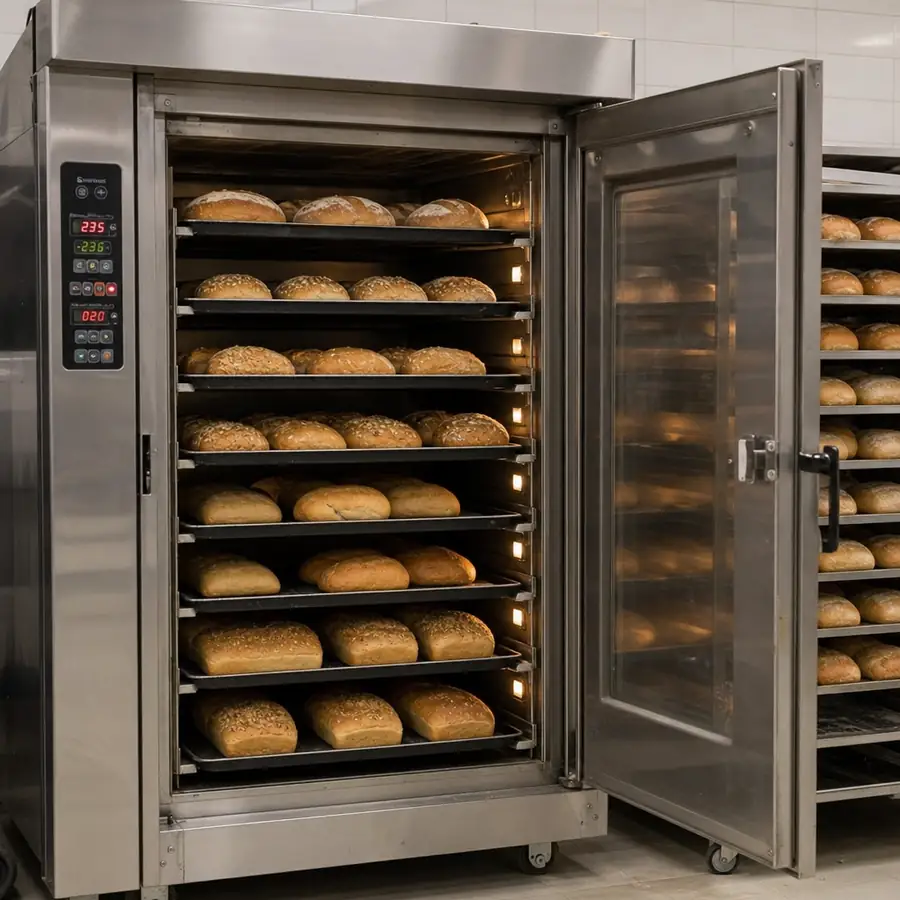
Convection ovens support flexible daily baking when trays of pastries, cookies, and sheet pans share one chamber.
Commercial ovens with convection airflow use fans to circulate hot air through the baking chamber. This helps heat reach trays more evenly, which is useful for cookies, pastries, rolls, sheet cakes, muffins, and many everyday bakery items. A convection oven can be a smart first commercial bakery oven when your menu is broad and your production volume is still developing.
The main advantage is versatility. You can bake multiple trays at once, rotate products efficiently, and keep a consistent rhythm during morning production. However, fan-driven heat can be too aggressive for some delicate items if settings, pan spacing, or bake times are not managed carefully.
Deck ovens are built for bread and crust development
Deck ovens are built for bread and crust development and pair well with a spiral mixer and proofing cabinets.
Deck ovens use heated decks, often stone or ceramic, and radiant heat. They are especially useful for artisan loaves, hearth breads, pizza-style products, and items that benefit from strong bottom heat and crust structure. For operators focused on commercial bread bakery equipment, a deck oven is often worth serious consideration.
The tradeoff is that deck ovens usually require more skill and planning. Loading, steaming, timing, and unloading can be more hands-on than with rack or convection systems. Still, if bread quality is central to your brand, deck-style oven equipment may support the texture and appearance customers expect.
Combination and high-speed ovens add flexibility
Combination ovens add humidity control when a combi oven needs to steam and bake in one footprint.
Combination ovens can use steam and convection, giving bakeries more control over humidity and heat. This can help with products that need moisture at certain stages, reheating, or mixed production. High-speed ovens are designed to shorten bake or finishing times, which can help in cafés, service counters, or tight production windows.
These ovens are not automatically better for every bakery. They are best evaluated against your actual menu, staff workflow, power or gas access, ventilation, and service expectations. A compact operation selling pastries may need very different commercial ovens than a wholesale bread producer.
Mixing equipment determines consistency
Mixing equipment determines consistency, whether you choose planetary mixers, a spiral mixer, or another commercial bakery mixer.
After ovens, mixers are often the next major investment in professional bakery equipment. Dough mixers and industrial mixers affect gluten development, batter texture, batch size, labor time, and product repeatability. Choosing too small a mixer can create constant delays; choosing too large a mixer can waste space and make small batches harder to manage.
Planetary mixers handle varied menus
Planetary mixers handle cakes, cookies, frostings, and mixed menus that a dough mixer alone cannot cover.
Planetary mixers are versatile and common in bakeries that produce a mix of batters, frostings, fillings, cookie doughs, and some bread doughs. With the right attachments, they can whip, blend, cream, and mix. This makes them useful bakery startup equipment for businesses with a wide menu and changing production needs.
If your bakery makes cakes, cookies, muffins, buttercream, and seasonal items, a planetary mixer may earn its space quickly. The key is to size the bowl capacity around your most common batch, not your most ambitious future batch.
Spiral mixers are designed for dough performance
Spiral mixers are designed for bread dough when industrial mixers need to protect gluten and hydration.
Spiral mixers are made for bread and dough-focused production. They typically mix dough efficiently while limiting heat buildup, which can help maintain dough quality during longer or heavier mixes. For bakeries producing bagels, loaves, rolls, pizza dough, or enriched breads, a spiral mixer may be more suitable than a general-purpose mixer.
When comparing a commercial bakery mixer, consider hydration levels, dough weight, motor strength, bowl style, and how often the machine will run each day. This is where underbuying can become expensive, because a mixer that struggles during peak production may wear faster and slow down the whole bakery.
Dough handling and proofing equipment improve flow
Dough handling and proofing equipment improve flow with dough sheeters, proofing cabinets, and bakery proofing equipment.
Mixing is only one step. Dough must be divided, shaped, rested, proofed, and moved to the oven in a predictable rhythm. Dough processing equipment can reduce hand labor and improve consistency, especially as orders increase.
Common dough-focused equipment includes:
- Dough dividers for portioning dough evenly and reducing scaling time.
- Dough sheeters for laminated dough, croissants, pastry bases, pie dough, and consistent rolled products.
- Rounders and moulders for shaping bread dough more efficiently.
- Proofing cabinets for controlling temperature and humidity during fermentation.
- Retarder proofers for slowing fermentation and scheduling production around labor availability.
Bakery proofing equipment is especially important for bread, rolls, laminated products, and yeasted pastries. Without controlled proofing, dough may rise too quickly, dry out, or behave differently from season to season. A proofing cabinet adds structure to production and helps bakers plan when products are ready for the oven.
Refrigeration protects ingredients and finished goods
Refrigeration protects ingredients and finished goods when bakery refrigeration equipment sits next to prep tables.
Bakery refrigeration equipment supports food safety, shelf life, dough control, and finishing work. Even a bakery that focuses on shelf-stable products may need reach-in refrigerators, freezers, undercounter refrigeration, or refrigerated prep space for butter, eggs, cream, fillings, fruit, chocolate, yeast, and prepared components.
Refrigeration choices should follow your menu. A cake studio may need space for finished cakes and buttercream. A bread bakery may need cold storage for preferments, shaped dough, or overnight fermentation. A café bakery may need display refrigeration for cream-filled pastries, desserts, beverages, and grab-and-go items.
Do not treat refrigeration as an afterthought. If cold storage is too small, staff may overfill units, block airflow, or waste time rearranging product. If it is poorly placed, ingredients travel too far between prep, mixing, finishing, and service.
Prep, storage, and small tools complete the bakery
Prep, storage, and small tools complete the bakery with sheet pans, smallwares, and stainless prep tables.
The large machines get most of the attention, but small baking equipment and bakery supplies keep daily production moving. Pans, racks, scales, timers, spatulas, bench knives, and pastry tools often determine how efficiently staff can move through repetitive tasks.
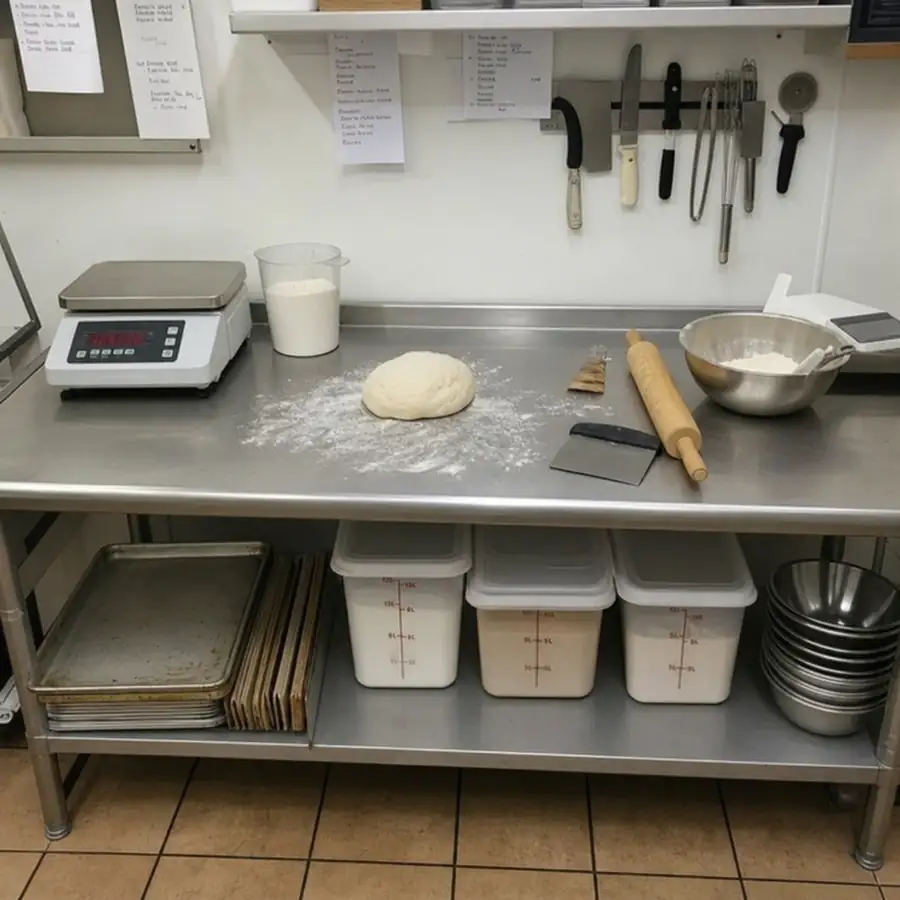
Essential bakery equipment in this category may include:
- Stainless steel prep tables for sanitary, durable work surfaces.
- Sheet pans, loaf pans, muffin tins, cake pans, and specialty molds matched to your menu.
- Cooling racks and speed racks for moving trays through baking, cooling, glazing, and packaging.
- Digital scales for accurate recipes, portion control, and cost tracking.
- Thermometers and timers for dough temperature, oven checks, syrup stages, and bake consistency.
- Pastry bags, tips, scrapers, rolling pins, cutters, whisks, brushes, and offset spatulas for finishing and detail work.
- Ingredient bins and shelving for flour, sugar, packaging, dry goods, and daily mise en place.
- Sinks, sanitation supplies, and cleaning tools appropriate for the kitchen's requirements.
This category is easy to underestimate. A bakery can own excellent bakery machinery and still lose time if there are not enough trays, racks, labeled bins, or measuring tools for multiple staff members to work at once.
How should you prioritize your bakery equipment checklist?
Prioritize your bakery equipment checklist around ovens, mixers, and restaurant equipment financing if you phase the buy.
Start with the products you will sell every day, then build your bakery equipment checklist around the steps required to make those products consistently. A bakery that sells sourdough loaves needs different priorities than one that sells cupcakes, laminated pastries, wedding cakes, or wholesale cookies. The smartest purchases are the ones that remove the biggest production constraint without adding unnecessary complexity.
A useful priority order looks like this:
- Core production equipment: ovens, mixers, refrigeration, proofing, prep tables, and storage.
- Menu-specific tools: sheeters for laminated pastry, deck ovens for artisan bread, display refrigeration for chilled desserts, or decorating tools for cakes.
- Volume upgrades: larger mixers, additional oven capacity, dividers, rounders, larger racks, or automated depositors.
- Workflow improvements: better shelving, labeled bins, mobile racks, portioning tools, and packaging stations.
- Backup and redundancy: extra smallwares, additional scales, backup thermometers, and replacement pans for high-use items.
If you are evaluating bakery equipment for sale, separate must-haves from nice-to-haves before speaking with vendors. The phrase "commercial bakery equipment for sale" can lead to everything from a single mixer to a full production line, so clarity protects your budget. If you plan to buy commercial bakery equipment in stages, focus first on machines that directly affect safety, consistency, and daily output.
New and used equipment both have a place
New and used equipment both have a place when you compare top tips for buying used kitchen equipment against warranty and parts access.
New equipment can offer current models, known condition, and clearer documentation, while used commercial bakery equipment can reduce startup costs and help a bakery access larger-capacity machines sooner. The right choice depends on budget, risk tolerance, service availability, and how critical the item is to production.
Used commercial bakery equipment for sale may be worth considering for racks, tables, shelving, some pans, and certain heavy-duty machines if they are in sound condition. Be more cautious with items that have complex controls, refrigeration systems, burners, motors, seals, or heavy wear. Always inspect condition, confirm dimensions, understand utility requirements, and consider service access before committing.
For mission-critical equipment, reliability matters more than the lowest purchase price. A bargain oven that fails during holiday production or a mixer that cannot handle your dough load can cost more in lost sales, repairs, and stress than it saved upfront.
Inventory and cost tracking make equipment decisions smarter
Inventory and cost tracking make equipment decisions smarter so commercial bakery equipment is sized to real batch volume.
Bakery equipment is not only about production; it also supports pricing, waste control, purchasing, and scheduling. Inventory management software or structured tracking systems can help operators monitor ingredient usage, recipe costs, packaging needs, and stock levels. When recipes are costed accurately, it becomes easier to set prices that reflect flour, butter, labor, packaging, utilities, and the capacity of your equipment.
Tracking also reveals whether your equipment is being used well. If one oven is always overloaded while another sits idle, the issue may be scheduling, rack flow, or product mix. If ingredients expire before use, the problem may be purchasing habits rather than storage capacity. If staff spend too much time hand-portioning, dough processing equipment or better portioning tools may be the next practical upgrade.
A simple operating review can include:
- Which products create the highest demand during peak hours.
- Which equipment creates bottlenecks most often.
- Which ingredients are wasted, rushed, or frequently out of stock.
- Which recipes require the most labor compared with their selling price.
- Which tools would reduce repeated manual steps.
This information turns a general commercial bakery equipment list into a staged purchasing plan based on actual needs.
Kitchen layout should follow the production path
Kitchen layout should follow the production path from mixers to proofing cabinets to commercial ovens.
Good bakery kitchen equipment choices still need a workable layout. Ingredients should move logically from receiving and storage to scaling, mixing, proofing, baking, cooling, finishing, packaging, and pickup or delivery. If staff constantly cross paths with hot trays, heavy ingredient bins, or finished products, the kitchen will feel crowded even if the square footage looks adequate.
Plan clear zones for dry storage, cold storage, mixing, dough handling, baking, cooling, decorating, dishwashing, and packaging. Leave space around doors, racks, ovens, and mixers so staff can work safely. Also check utility requirements early, including electrical load, gas access, water, drainage, ventilation, and clearance needs.
The Horeca Store can be used as a neutral research reference while you compare commercial bakery equipment categories and create a preliminary purchasing checklist. Looking across categories before buying helps you see how ovens, mixers, refrigeration, food processing equipment, bakery supplies, and prep stations fit together as a working system rather than separate purchases.
A practical starting list for different bakery scales
A practical starting list for different bakery scales still starts with a bakery equipment list, a planetary mixer, and convection ovens.
A small bakery or permitted home-style operation may begin with fewer machines, but it still needs professional discipline. Start with accurate scales, dependable mixing capacity, approved refrigeration, suitable baking equipment, adequate racks, and sanitary prep space. As demand grows, move toward true commercial bakery equipment that can handle longer run times and larger batches.
A retail storefront generally needs more complete bakery startup equipment: commercial ovens, industrial mixers, proofing cabinets, display or storage refrigeration, speed racks, ingredient bins, prep tables, pans, packaging supplies, and cleaning stations. If the bakery serves customers on site, front-of-house display, holding, and service flow also matter.
A wholesale or production bakery needs higher-capacity commercial baking equipment and more specialized bakery machinery. That may include larger deck or rack ovens, spiral mixers, dividers, sheeters, conveyors, blast chilling or expanded refrigeration, and more robust storage. The goal is not simply to own more equipment; it is to remove constraints that limit consistent output.
Final takeaway
Final takeaway: source professional bakery equipment from The Horeca Store, then review essential steps for a successful bakery business plan, top features to look for in commercial ovens, a pizza restaurant equipment list, and types of pizza ovens.
The best bakery equipment list starts with your menu, volume, space, and workflow-not with the biggest machine you can afford. Prioritize a dependable commercial bakery oven, the right mixer, controlled proofing, adequate refrigeration, durable prep surfaces, and accurate small tools before adding specialized upgrades. With a clear bakery equipment checklist and careful comparison of new and used options, you can invest in professional bakery equipment that supports quality, consistency, and growth without overbuying too soon.